Industry-Verified Manufacturing Data (2026)

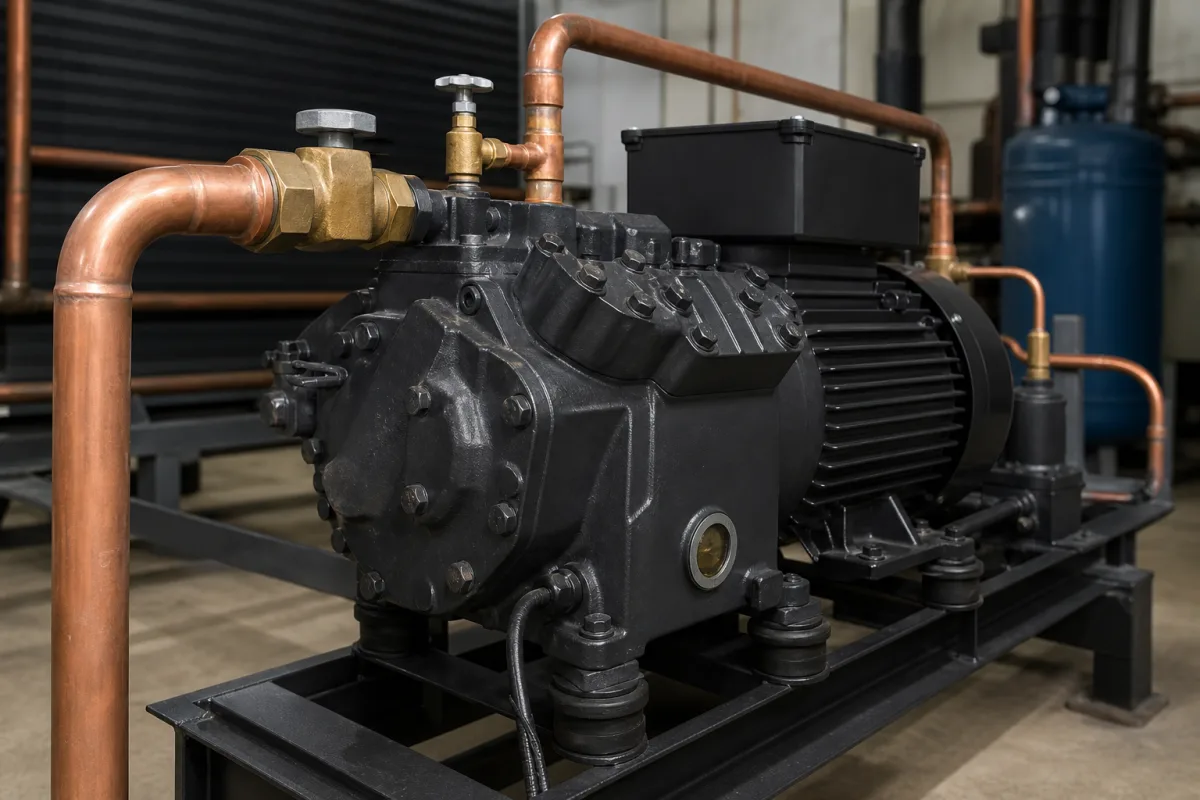
Compressor

Based on aggregated insights from multiple verified factory profiles within the CNFX directory, the standard Compressor used in the Machinery and Equipment Manufacturing sector typically supports operational capacities ranging from standard industrial configurations to heavy-duty production requirements.

Technical Definition & Core Assembly

A canonical Compressor is characterized by the integration of Motor and Cylinder. In industrial production environments, manufacturers listed on CNFX commonly emphasize Cast iron construction to support stable, high-cycle operation across diverse manufacturing scenarios.

Mechanical device that increases the pressure of refrigerant gas in a refrigeration system
Product Specifications

Technical details and manufacturing context for Compressor

Definition
A compressor is the heart of a refrigeration system that pressurizes low-pressure refrigerant vapor from the evaporator, raising its temperature and pressure to enable heat rejection in the condenser. It creates the pressure differential necessary for refrigerant circulation through the system.
Working Principle
The compressor draws in low-pressure refrigerant vapor from the evaporator, compresses it through mechanical action (reciprocating, rotary, scroll, or screw mechanisms), and discharges it as high-pressure, high-temperature vapor to the condenser. This compression increases the refrigerant's boiling point, allowing it to release heat effectively in the condenser.
Common Materials
Cast iron, Steel, Aluminum alloys, Copper alloys
Technical Parameters
  • Motor power rating indicating the compressor's capacity and energy consumption (kW) Per Request
Components / BOM
  • Motor
    Provides rotational power to drive the compression mechanism
    Material: Copper windings, steel laminations
  • Cylinder
    Houses the piston and provides the compression chamber
    Material: Cast iron or aluminum
  • Piston
    Moves within the cylinder to compress refrigerant gas
    Material: Aluminum alloy or steel
  • Valves
    Control the flow of refrigerant into and out of the compression chamber
    Material: Stainless steel
  • Crankshaft
    Converts rotational motion from the motor to reciprocating motion of the piston
    Material: Forged steel
Engineering Reasoning
2.0-25.0 bar (discharge pressure), 0.5-8.0 bar (suction pressure)
Discharge pressure exceeding 30.0 bar causes mechanical seal failure, suction pressure below 0.3 bar induces refrigerant starvation
Design Rationale: Compressor failure occurs due to refrigerant oil breakdown at 150°C (flash point), leading to lubrication loss and metal-to-metal contact between piston and cylinder walls
Risk Mitigation (FMEA)
Trigger Refrigerant liquid slugging due to evaporator coil flooding
Mode: Hydraulic lock causing connecting rod bending stress exceeding 450 MPa yield strength
Strategy: Install liquid line accumulator with 0.5 L capacity and suction line heat exchanger
Trigger Bearing lubrication failure from refrigerant dilution at oil viscosity below 32 cSt at 40°C
Mode: Journal bearing seizure at surface temperature exceeding 200°C
Strategy: Implement oil separator with 99.7% efficiency and oil level monitoring with ±2 mm accuracy

Industry Taxonomies & Aliases

Commonly used trade names and technical identifiers for Compressor.

Applied To / Applications

This component is essential for the following industrial systems and equipment:

Industrial Ecosystem & Supply Chain DNA

Complementary Systems
Downstream Applications
Specialized Tooling

Application Fit & Sizing Matrix

Operational Limits
pressure: Up to 500 psi (typical maximum discharge pressure)
flow rate: 0.5 to 5000 CFM (cubic feet per minute)
temperature: -40°C to 150°C (typical refrigerant gas temperature range)
slurry concentration: Not applicable (designed for clean gas only)
Media Compatibility
✓ R-134a refrigerant ✓ R-410A refrigerant ✓ Ammonia (NH3) refrigerant
Unsuitable: Corrosive or abrasive gas environments (e.g., chlorine gas, sand-laden air)
Sizing Data Required
  • Required cooling capacity (tons of refrigeration)
  • Suction pressure and temperature
  • Discharge pressure requirement

Reliability & Engineering Risk Analysis

Failure Mode & Root Cause
Bearing failure
Cause: Inadequate lubrication, contamination ingress, misalignment, or excessive loading leading to overheating, wear, and eventual seizure or fracture.
Valve failure
Cause: Fatigue from cyclic loading, fouling from process contaminants or oil carbonization, or improper seating due to wear or debris, resulting in reduced efficiency, overheating, or catastrophic breakdown.
Maintenance Indicators
  • Unusual knocking or grinding noises from the compressor housing, indicating potential bearing wear, piston slap, or valve issues.
  • Excessive vibration or overheating detected via sensors or touch, signaling imbalance, misalignment, or internal friction problems.
Engineering Tips
  • Implement a rigorous lubrication management program with scheduled oil analysis to monitor contamination, viscosity, and additive levels, ensuring optimal bearing and component health.
  • Establish a predictive maintenance routine using vibration analysis and thermal imaging to detect early signs of imbalance, misalignment, or overheating before failure occurs.

Compliance & Manufacturing Standards

Reference Standards
ISO 1217:2009 (Displacement compressors - Acceptance tests) ANSI/ASME B19.3:2008 (Safety Standard for Compressors for Process Industries) DIN 1945-1:2016 (Reciprocating compressors - Part 1: Acceptance tests)
Manufacturing Precision
  • Cylinder bore diameter: +/-0.025mm
  • Crankshaft journal runout: 0.02mm maximum
Quality Inspection
  • Hydrostatic pressure test (1.5x maximum working pressure)
  • Vibration analysis and balancing verification

Factories Producing Compressor

Verified manufacturers with capability to produce this product in China

✓ 94% Supplier Capability Match Found

P Procurement Specialist from United Arab Emirates Feb 24, 2026
★★★★★
"Found 55+ suppliers for Compressor on CNFX, but this spec remains the most cost-effective."
Technical Specifications Verified
T Technical Director from Australia Feb 21, 2026
★★★★★
"The technical documentation for this Compressor is very thorough, especially regarding technical reliability."
Technical Specifications Verified
P Project Engineer from Singapore Feb 18, 2026
★★★★★
"Reliable performance in harsh Machinery and Equipment Manufacturing environments. No issues with the Compressor so far."
Technical Specifications Verified
Verification Protocol

“Feedback is collected from verified sourcing managers during RFQ (Request for Quote) and factory evaluation processes on CNFX. These reports represent historical performance data and technical audit summaries from our B2B manufacturing network.”

14 sourcing managers are analyzing this specification now. Last inquiry for Compressor from Brazil (1h ago).

Supply Chain Compatible Machinery & Devices

Automated Assembly Line System

Integrated production system for sequential component assembly operations

Explore Specs →
Automated Powder Coating System

Integrated industrial system for applying dry powder coatings to metal substrates.

Explore Specs →
Centrifugal Pump Impeller

Rotating component that transfers energy to fluid in centrifugal pumps.

Explore Specs →
High-Precision CNC Laser Cutting Machine

Computer-controlled industrial machine using focused laser beams to cut sheet metal with micron-level accuracy.

Explore Specs →

Frequently Asked Questions

What materials are used in this compressor's construction?

This compressor is constructed using durable materials including cast iron for the main housing, steel for structural components, aluminum alloys for lightweight parts, and copper alloys for heat exchange elements.

What are the main components included in this compressor?

The compressor includes a crankshaft, cylinder, motor, piston, and valves as key components that work together to increase refrigerant gas pressure in refrigeration systems.

What industries typically use this type of compressor?

This compressor is designed for machinery and equipment manufacturing applications, particularly in commercial refrigeration, HVAC systems, industrial cooling, and food processing facilities.

Can I contact factories directly on CNFX?

CNFX is an open directory, not a transaction platform. Each factory profile provides direct contact information and production details to help you initiate direct inquiries with Chinese suppliers.

Get Quote for Compressor

Request technical pricing, lead times, or customized specifications for Compressor directly from verified manufacturing units.

Your business information is encrypted and only shared with verified Compressor suppliers.

Thank you! Your message has been sent. We'll respond within 1–3 business days.

Need to Manufacture Compressor?

Connect with verified factories specializing in this product category

Add Your Factory Contact Us
Previous Product
Compression Chamber
Next Product
Concentration Sensor