Editorial Technical Reference

Container Positioning System

This page explains how Container Positioning System is classified within Machinery and Equipment Manufacturing. Technical values and manufacturer relationships are research references; confirm the current specification and supplier evidence for each order.

Technical Definition & Core Assembly

A precision mechanical system that accurately positions beverage containers for friction testing within an automated testing apparatus.
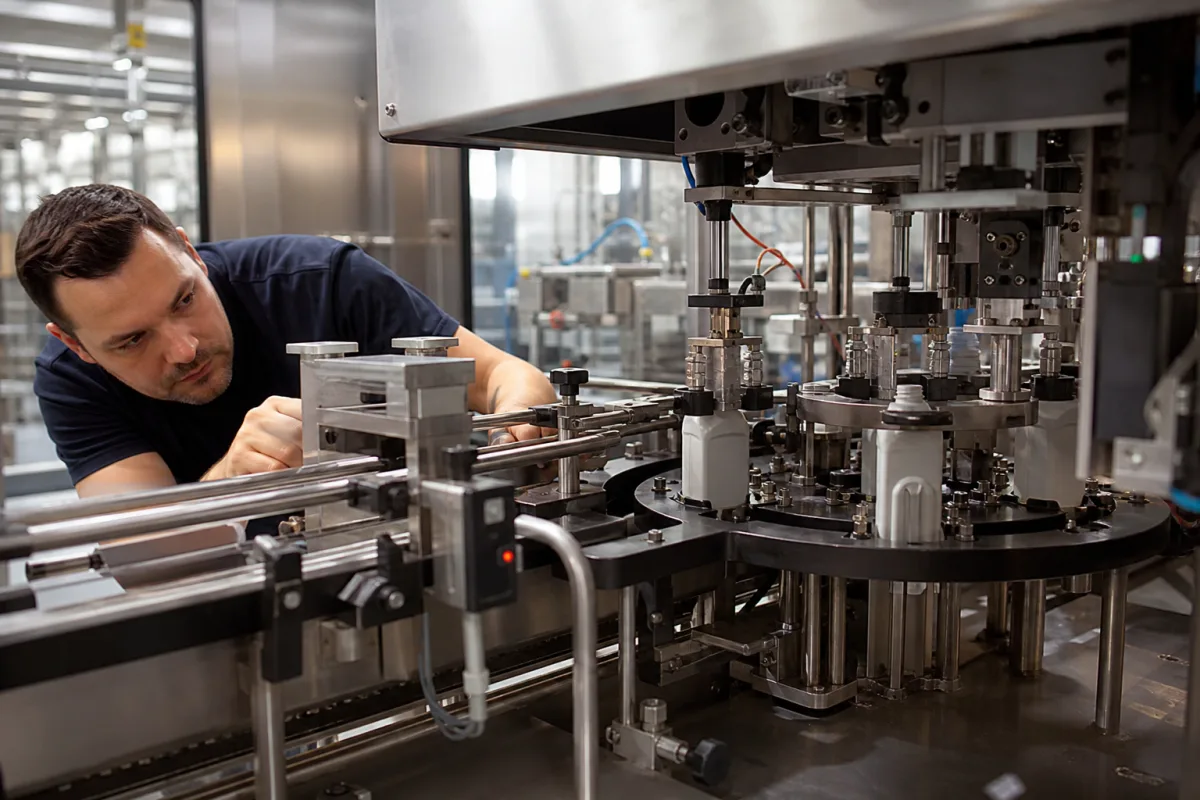
Representative product image. Confirm appearance and specifications with the manufacturer.

Product Specifications

Technical details and manufacturing context for Container Positioning System

Definition
The Container Positioning System is a critical sub-assembly of the Automated Beverage Container Friction Testing System. Its primary function is to receive, orient, and precisely locate beverage containers (such as bottles, cans, or cartons) at a designated test station. It ensures repeatable and accurate positioning so that friction measurement probes or surfaces can engage the container at the correct location and angle, enabling reliable and standardized test results. The system typically employs a combination of conveyors, guides, and actuators. Containers are fed into the system via an infeed conveyor. Mechanical guides or vision systems orient the container. A positioning mechanism, often using servo motors, linear actuators, or pneumatic cylinders, then moves the container into the precise X, Y, Z, and rotational coordinates required for the friction test. Clamps or vacuum cups may secure the container during the test cycle before it is released to an outfeed conveyor. The system is designed to handle containers with a diameter range of 50–120 mm and a height range of 80–250 mm, with a maximum weight of 5 kg. It achieves a positioning repeatability of ±0.05 mm and an overall accuracy of ±0.1 mm, per ISO 9283. Cycle time is 2–5 seconds per container. Clamping force is adjustable between 50–200 N to prevent deformation. Operating pressure is 0.4–0.8 MPa, supply voltage is 24 V DC ±10%, and power consumption is 50–100 W. The system operates in temperatures from 5–45 °C and has a protection class of IP54–IP65 (IEC 60529). Materials include aluminum alloy (frame/guides), stainless steel (actuator components), and engineering plastics (wear surfaces/bushings). The system weighs 15–25 kg depending on configuration. All values are reference ranges; verify model-specific specifications with the manufacturer.
Working Principle
Containers enter via an infeed conveyor. Guides or vision systems orient them. A positioning mechanism using servo motors, linear actuators, or pneumatic cylinders moves the container to the required X, Y, Z, and rotational coordinates. Clamps or vacuum cups secure it during the test. After testing, the container is released to an outfeed conveyor. The system uses sensors and control logic to ensure repeatable positioning within ±0.05 mm.
Common Materials
Aluminum Alloy (frame/guides), Stainless Steel (actuator components), Engineering Plastics (wear surfaces/bushings)
Technical Parameters
ParameterTypical rangeNotes & selection driver
Positioning RepeatabilityRequired±0.05 mmMaximum allowable deviation in the X, Y, Z position of the container between cycles.ISO 9283
Maximum Container WeightRequired5 kgThe heaviest container the system is designed to handle and position.
Cycle TimeRequired2–5 secondsTime required to position one container, including acquisition and release.
Container Diameter Range50–120 mmStandard beverage container sizes
Container Height Range80–250 mmCovers common can and bottle heights
Clamping Force50–200 NAdjustable to prevent deformation
Positioning Accuracy±0.1 mmOverall accuracy including repeatabilityISO 9283
Operating Pressure0.4–0.8 MPaBelow 0.4 MPa clamping force insufficient
Supply Voltage24 ±10% V DCFor sensors and control
Power Consumption50–100 WDepends on actuation frequency
Operating Temperature5–45 °COutside range, seals may fail
Protection ClassIP54–IP65Protects against dust and water splashesIEC 60529
MaterialAluminum 6061 / Stainless Steel 304Corrosion-resistant for beverage environmentASTM B221 / ASTM A240
Weight15–25 kgDepends on configuration

Ranges are indicative industry figures for RFQ preparation, not a supplier commitment. Confirm every value and standard with the legal manufacturer before ordering.

Components / BOM
  • Infeed Guide Rail Part
    Channels containers from the main conveyor into the positioning mechanism.
    Material: Stainless Steel or UHMW-PE
  • Positioning Actuator (X/Y/Z)
    Provides precise linear movement to place the container at the test coordinates.
    Material: Aluminum housing, Steel lead screw/ball screw
  • Rotary Indexing Stage
    Provides precise rotational positioning of the container about its vertical axis.
    Material: Aluminum alloy, precision bearings
  • Container Clamp/Vacuum Cup Part
    Secures the container firmly in place during the friction test to prevent movement.
    Material: Polyurethane (clamp pads), Silicone (vacuum cups)
  • Position Sensors
    Confirm the container reached the commanded coordinates before the test starts.

Industry Taxonomies & Aliases

Commonly used trade names and technical identifiers for Container Positioning System.

Applied To / Applications

This component is essential for the following industrial systems and equipment:

Industrial Ecosystem & Supply Chain Structure

Complementary Systems
Downstream Applications
Specialized Tooling

Application Fit & Sizing Matrix

Operational Limits
pressure: Atmospheric (no pressure rating required)
temperature: 10°C to 40°C (ambient operating range)
operating speed: Up to 60 cycles per minute
max container height: 300 mm
max container weight: 5 kg
positioning accuracy: ±0.1 mm
max container diameter: 150 mm
Media Compatibility
✓ Glass bottles ✓ Aluminum cans ✓ PET plastic containers
Unsuitable: Abrasive or corrosive particulate environments (e.g., sandblasting areas, chemical spray zones)
Sizing Data Required
  • Container dimensions (diameter and height)
  • Required positioning accuracy (±mm)
  • Cycle rate (containers per minute)

Reliability & Engineering Risk Analysis

Failure Mode & Root Cause
Positioning drift/inaccuracy
Cause: Encoder/sensor calibration drift due to vibration, thermal expansion, or electrical noise interference
Mechanical binding/sticking
Cause: Wear debris accumulation in linear guides/rails, lack of lubrication, or misalignment from foundation settling
Maintenance Indicators
  • Audible grinding or scraping noises during positioning movements
  • Visible position overshoot/undershoot beyond specified tolerances during routine operation
Engineering Tips
  • Implement predictive maintenance through vibration analysis and thermal monitoring of drive components to detect early degradation
  • Establish strict contamination control protocols and use high-purity lubricants specifically rated for precision positioning systems

Indicative industry ranges for design and RFQ preparation. Confirm the exact figures and applicable standard with the manufacturer before specifying.

Compliance & Manufacturing Standards

Applicable Standards
ISO 10816: Mechanical vibration - Evaluation of machine vibration by measurements on non-rotating parts ANSI/ASME B30.13: Storage/Retrieval (S/R) Machines and Associated Equipment DIN EN 15011: Cranes - Bridge and gantry cranes

Quoted from the published standard.

Manufacturing Precision
  • Positioning accuracy: +/- 2 mm
  • Repeatability: +/- 0.5 mm
Quality Inspection
  • Load capacity verification test
  • Laser alignment and positioning accuracy test

Manufacturers of Container Positioning System

Manufacturer profiles associated with Container Positioning System.

Sourcing Container Positioning System from China?
Tell us your specification and target quantity — we will match it against manufacturer records and come back with the factories that fit.
Request manufacturers We manufacture this

Manufacturer listings support early research and capability understanding. They are not certification, ranking, or transaction guarantees.

Technical documentation
Request current drawings, revision history, and a signed specification sheet.
Manufacturing capability
Verify equipment lists, process limits, capacity, and representative production evidence.
Inspection readiness
Confirm test methods, calibrated equipment, sampling plans, and traceable reports.
Supplier transparency
Check the legal entity, factory address, ownership, certifications, and direct contacts.

CNFX does not score or rank suppliers. Buyers must verify all claims and documents with the legal manufacturer before ordering.

Supply Chain Compatible Machinery & Devices

Automated Powder Coating System

Integrated industrial system for applying dry powder coatings to metal substrates.

Explore Specs →
Centrifugal Pump Impeller

The centrifugal pump impeller is a critical rotating component that converts mechanical energy from the motor into kinetic energy in fluid systems.

Explore Specs →
High-Precision CNC Laser Cutting Machine

Computer-controlled industrial machine using focused laser beams to cut sheet metal with micron-level accuracy.

Explore Specs →
Industrial-Grade Hydraulic Cylinder Piston Rod

This industrial-grade piston rod is a precision-ground cylindrical component designed for use in hydraulic cylinders.

Explore Specs →

Frequently Asked Questions

What is the positioning repeatability of the system?

The positioning repeatability is ±0.05 mm, as per ISO 9283. This indicates the maximum deviation in X, Y, Z position between cycles. Verify the actual value for your specific model.

What container sizes can the system handle?

The system is designed for containers with a diameter range of 50–120 mm and a height range of 80–250 mm. The maximum container weight is 5 kg. Confirm compatibility with your container dimensions.

What is the cycle time for positioning one container?

The cycle time is 2–5 seconds per container, including acquisition and release. This depends on the specific configuration and actuation speed. Check the manufacturer's data for your application.

What are the operating pressure and voltage requirements?

The operating pressure is 0.4–0.8 MPa, and the supply voltage is 24 V DC ±10%. Ensure your facility provides these utilities. Verify with the manufacturer for exact requirements.

Data Basis

Editorial classification, named public sources where available, and source-reviewed manufacturer records.

Preliminary Technical Classification
This page supports structured research, RFQ preparation, and supplier evaluation. It does not replace buyer-led supplier qualification, standards review, or technical approval.
Buyer enquiry

Request manufacturing insight for Container Positioning System

Ask for use case, specification boundaries, supplier type, and RFQ preparation information for this product.

Where it goes
Straight to the CNFX editorial desk, and to the manufacturer if this product is linked to a claimed profile. Nothing is broadcast to a supplier list.
Your details stay here
We do not sell or rent enquiry data, and we do not add you to a mailing list. Used only to answer this request.
No commission, no middleman
CNFX is a directory. We take no cut of any order and never negotiate on a supplier's behalf.
What we don't claim
A listing is not an endorsement. Qualify every supplier and verify every figure yourself before ordering.

Your business information is used only to process this request.

Thank you! Your message has been sent. We'll respond within 1–3 business days.
Sorry, we couldn't send your message. Please try again, or email us at contact@cnfx.com.

Need to Manufacture Container Positioning System?

Compare manufacturer profiles with relevant product and process capability.

Previous Product
Z-axis Ram/Spindle
Last Product
Get QuotesChat