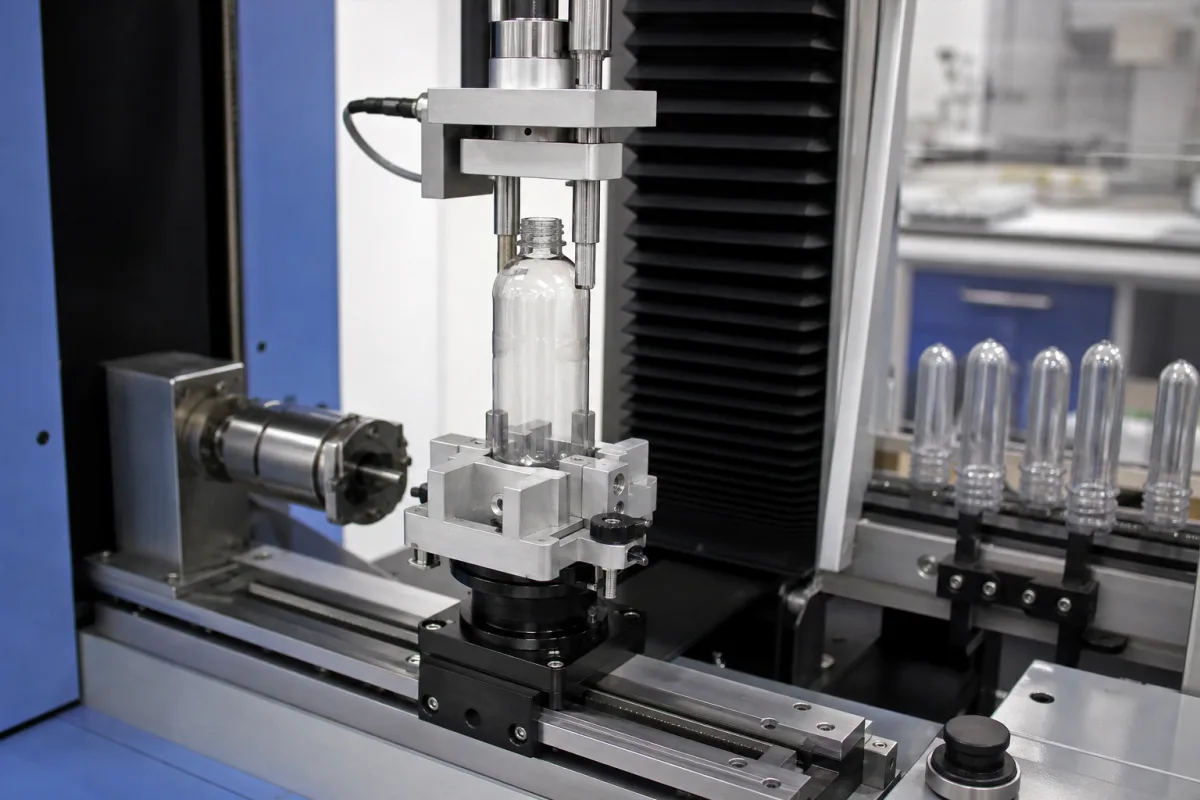
Automated beverage container friction testing system
Friction and mobility testing of bottles, preforms and cans · Tilt-table slip angle against coefficient of static friction, bottle-to-bottle torque testers, flat-sled ASTM D1894 tests for films and labels, test speed, load and ageing effects
An automated beverage container friction testing system measures how easily containers slide against each other or against line surfaces — the property that decides whether bottles, preforms and cans flow through conveyors, combiners and packers or stick and jam. Ask three things first: which contact matters (container on container, container on guide or belt, or film and label on itself), which method and report the specification uses (slip angle, static or kinetic coefficient), and what speed, load and conditioning the test must hold.
Instruments for measuring the friction or mobility of beverage containers and their surfaces: tilt-table and incline mobility testers for bottles and cans, bottle-to-bottle torque friction testers for PET bottles and preforms, and flat-sled testers for films, labels and sheet to ASTM D1894. Conveyor lubricants, cold-end coating equipment, line simulators and general universal testing machines are outside this page except where compared.
CNFX editorial research · Sources checked October 11, 2026 · 4 sources
Choose the friction method for the contact that matters
US patent application 2002/0194895 explains why container friction matters on the line: PET has a static coefficient of friction above 1.0, so preforms pile into cones in boxes and jam feeder rails, and when rows of bottles from the blow moulder or depalletizer are merged into single file the pressure between bottles rises and high friction makes them stick and jam; it notes that the ASTM D1894 film method suits planar surfaces only, not curved bottles, and that a Japanese conveyor-load method cannot give a bottle-to-bottle value. [1]
For glass, US patent 10,351,470 describes an AGR International tilt table: three containers in a pyramid, the bottom two constrained, the table tilted by a motor at 3.6° per second until the top container slides and hits a trip bar that stops the motor and brakes the table to avoid reading too high; lubricity is read as the slip angle or as the coefficient of static friction, and in that patent a slip angle below 15°, preferably below 13°, is treated as lubricous enough. [2]
For aluminium cans, US patent 6,190,738 describes an incline plane mobility test: two base cans on the platform, a third laid on top about one inch from their open end, the platform raised slowly until the top can slides, repeated with the base cans rotated to give eight readings, and the result reported as the average incline angle or as the coefficient of static friction, the tangent of that angle. [3]
Editorial calculation: since μs = tan(slip angle), 15° corresponds to μs ≈ 0.27 and 13° to μs ≈ 0.23; state in the specification whether limits are given as angles or as coefficients. [2][3]
Give the supplier the containers (material, size, coating or lubricant, preform or finished bottle), the contact to be tested, the method and report your specification uses, the speed or tilt rate, load, number of repeats, conditioning and ageing time after forming, environment, data output, and whether films and labels must also be tested on a flat sled.
02
Set speed, load, ageing and reporting
The PET bottle patent describes a tester that rotates one bottle in a chuck at a set speed against a stationary second bottle pressed down with a set force, records the torque at the moment of slip and the torque to keep constant speed, and computes μ = (torque / R) / F2, where R is the rotating bottle's radius and F2 the contact load derived from the applied force through a lever ratio; in its examples on 20 oz bottles, rotation speed and ageing time after forming had a significant effect on the measured coefficient while applied load from 100 to 1,000 g did not, with mean values of about 1.1 to 1.6. [1]
Intertek summarises ASTM D1894 for plastic film and sheeting: a specimen on a sled of specified weight is pulled across a second surface at 150 mm/min, 64 mm square specimens are tested against a 254 × 127 mm second surface, and the static coefficient is the initial force reading divided by sled weight and the kinetic coefficient the average force during uniform sliding divided by sled weight. [4]
Editorial note: because speed and ageing changed results in the PET patent's examples, fix the test speed, the time between forming and testing, and the conditioning in the specification, and compare suppliers' instruments on the same samples.
03
Bottle pyramid, can pyramid, rotating-bottle torque and flat sled
Holders, tilt or rotation drive, load, torque sensor and slip detection
The sources detect slip in two ways: the sliding glass bottle hits a trip bar that stops the tilt motor, while the PET tester reads the torque at the moment the rotating bottle starts to slide. [2][1]
Friction range, tilt or pull speed, normal force and container size for a tester quotation
The speeds in this table — 3.6°/s tilt, 150 mm/min sled pull and a set rpm for the rotating bottle — belong to different methods, so name the method before comparing any instrument's speed range. [2][4][1]
Field
What it means and published values
Ask the supplier for
Friction coefficient range
PET static COF above 1.0 reported; tilt slip below 15° (μ ≈ 0.27) as lubricous glass. [1][2]
Measuring range.
Test speed range
Tilt at 3.6°/s; sled at 150 mm/min; rotation speed set in rpm. [2][4][1]
1 company lists this product among what they make. Company figures are quoted from each
company's own website; every card states where the relationship came from.
Labthink Instruments Co., Ltd.
Manufacturing site to be confirmed for the order
Its website lists “MXD-02 Coefficient of Friction Tester”.
Explore company information and manufacturing capabilities, then discuss the scope of your project with a relevant supplier.
Share this page
Compiled and source-reviewed by the CNFX editorial team.
Each manufacturer above links to the page on that company's own website where the product is listed, with the date we checked it. How we source and review
· Page last updated 13 October 2026
Buyer questions
How is a slip angle turned into a coefficient of friction?
The coefficient of static friction is the tangent of the slip angle, so 15° is about 0.27. [3][2]
Can ASTM D1894 be used for bottles?
It measures flat films and sheets with a sled at 150 mm/min; a PET bottle patent notes it does not suit curved bottles. [4][1]
Why does bottle friction matter on a filling line?
Where rows merge into single file, pressure between bottles rises and high friction makes them stick and jam. [1]
Sources and what still needs a direct check
Sources checked 2026-10-11. The patents describe the test methods used by their applicants and the Intertek page summarises a standard; the ASTM text must be obtained from ASTM, and instrument ranges from the supplier offered.