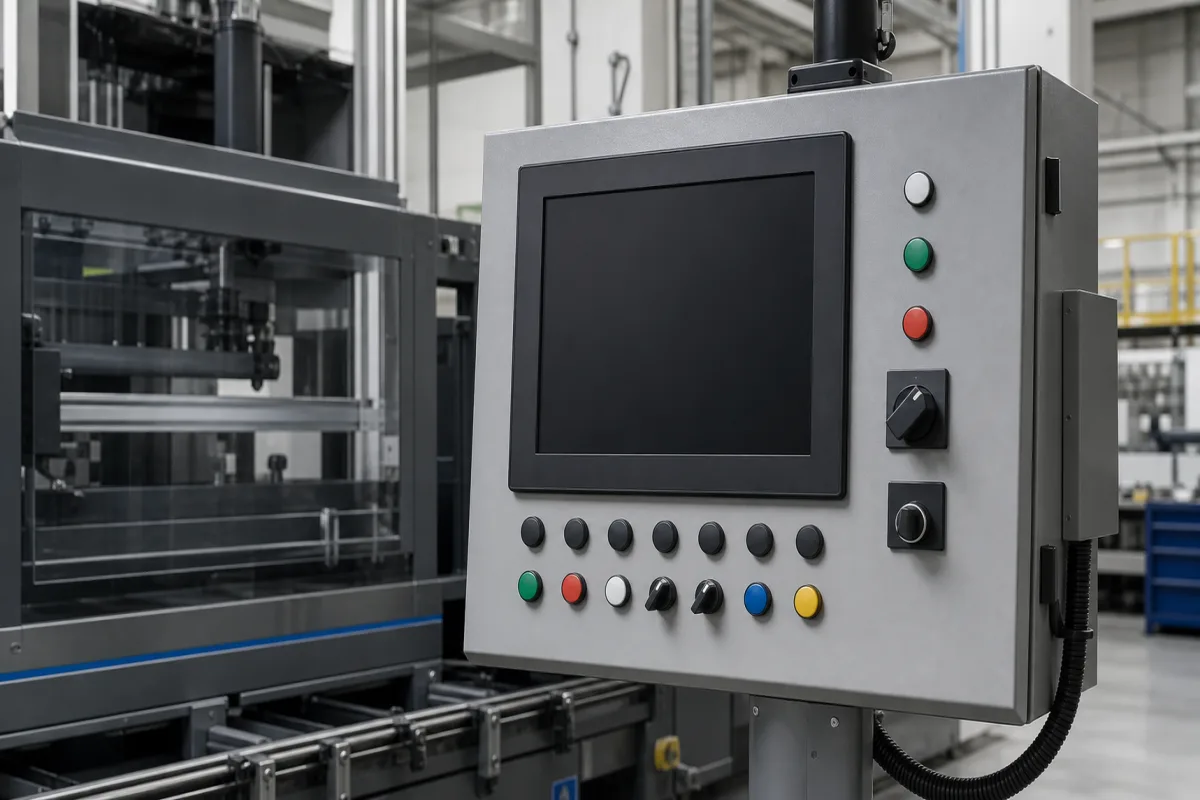
Steam boiler control and monitoring panel: burner sequencing relay, two low-water alarms and the interlock annunciator behind the door
Front panels of packaged steam boilers · a burner management relay with door-mounted display and lockout history, first and second low-water alarms, interlock annunciation over Modbus, and the daily and weekly tests the panel has to make possible
The panel on the front of a packaged steam boiler does two jobs that a general machine control cabinet does not: it sequences the burner through purge, ignition trials and flame supervision, and it holds the boiler off when the water level, pressure or fuel interlocks say it is unsafe to fire. What the operator sees on the door, pilot lights, a reset button, a text display of the last lockout, is the visible end of those circuits. Specifying the panel means fixing the burner management timings, how many low-water alarms there are and which one locks out, how interlock trips are annunciated, and how the panel lets the boiler attendant test them.
Control and monitoring panels for automatically fired steam boilers: the burner management (flame safeguard) control and its door display, low- and high-water alarm and lockout circuits, fuel, air and pressure interlock annunciation, remote reset and Modbus links to a building or plant system, and the routine alarm tests these panels must support. General low-voltage control cabinets are covered on the Control cabinet page; the machine control panel housing PLC, drives and protection on the Control system cabinet page; PLC panel wiring on the PLC control panel page; controller mounting and 24 V supply on the PLC control cabinet page; factory testing of finished cabinets on the Control system cabinet tested before it ships page; machining-cell cabinets on the Central control cabinet page; PLC system engineering on the PLC control system page; control-system cybersecurity on the HMI/PLC control system page; control-room desks on the Control Console page; process alarm presentation on the Control interface panel for process monitoring page; flame scanners themselves on the Flame sensor and scanner page; burners on the Industrial burner page; safety valves on the Boiler safety relief system page; and the boiler plant on the Industrial steam generation system for process heating page.
CNFX editorial research · Sources checked October 13, 2026 · 4 sources
The burner management relay inside the panel: purge, pilot and main-flame trials, flame-failure time and lockout memory
Fireye describes its BurnerLogiX YB110/YB230 as a microprocessor control that, working with the boiler's limit and operating controls, programmes the blower motor, ignition and fuel valves on automatically ignited oil, gas and dual-fuel burners, with a plug-in programmer module that sets pre-purge time, recycling or non-recycling interlocks, high-fire proving and the pilot and main trial-for-ignition timings. [1] The chassis itself is rated NEMA 1 (IP01), while the optional 2-line, 16-character display mounted remotely is NEMA 4X (IP66), which is why the relay sits on the panel's mounting plate and the display goes in the door. [1]
For monitoring, the display's lockout history keeps the last ten lockouts with the burner hour and cycle at which each occurred, and the same records, burner-on minutes and cycle counts can be read over the RS-485 Modbus link, which Fireye limits to 1,000 m (3,300 ft) of cable and polling no faster than once every 200 ms. [1] A remote reset push-button may be up to 152 m (500 ft) away but must stay within sight and sound of the burner, and limit and interlock wiring to the control is limited to 61 m (200 ft). [1]
Interlock annunciation is a separate module: Fireye's YZ300 interlock annunciator reports, among others, low water, high water, high and low gas pressure, low oil pressure and temperature, low atomising media and air flow, each readable as bits in Modbus registers 40901–40903. [1] Editorial calculation: at the factory defaults a cold start spends 30 s in purge and up to 10 s in pilot trial and 15 s in main trial before the burner is released, at least 55 s before modulation, excluding damper travel and the additional 10 s pilot proving that Fireye notes for some programmers. [1]
State the programmer model and its flame-failure response time, the purge time required by the burner maker, whether the display is door-mounted, and which interlocks must be annunciated individually rather than grouped into one trip signal.
02
First and second low-water alarms, lockout reset and the panel features the daily and weekly tests need
HSE's leaflet on industrial boilers describes two low-water alarms: the first prevents the boiler from operating while the level is low but lets it restart once the water has risen; the second, set lower, shuts the boiler down completely and requires a manual restart. [2] Spirax Sarco gives the same UK arrangement, calling the second alarm the lockout, which stays locked out even after the level recovers and any fault is put right, and lists feedtank shortage, feed-pump failure, an isolated feedwater line and a failed level control as causes of low water. [3]
The panel has to make these tests visible and recordable: HSE says routine tests of controls, limiting devices and feedwater quality should be recorded electronically or manually with the result against the required value, the operator, the date and any corrective action. [2] For a high water level, Spirax Sarco lists responses ranging from an alarm in a manned boiler house to stopping the feed pump, closing the feed valve or locking out the burner, chosen to suit the plant. [3]
HSE also notes that unmanned boilers have increased, attributing it to more reliable electronic control systems. [2]
Level control arrangement
Test described by Spirax Sarco for UK practice
Attendance it allows
Float or probe controls in external chambers, manual sequencing valves
Daily blow-through of chambers and test of 1st and 2nd low alarms; weekly evaporation to 1st low and blowdown to 2nd low [4]
Trained attendant on site whenever the boiler runs [4]
External chambers with automatic sequencing valves
Automatic sequenced blowdown and electrical test; weekly manual test [4]
A watchman or porter able to respond to alarms [4]
High-integrity self-monitoring probes in internal protection tubes
No daily test; full weekly operational test in the UK; 6 months between manual tests in Germany for approved probes [4]
Confirm the supervision regime the boiler will run under before the panel is built: it decides whether self-monitoring level controls, automatic chamber blowdown and remote alarm outputs are needed, and what the test log must capture.
03
Data for a steam boiler control and monitoring panel
Paste it into your enquiry below or into an email to a maker, then replace every bracket.
Burner: [fuel(s); burner maker's purge, PTFI and MTFI times; flame detector type; flame-failure response time]
Water level: [level control type; 1st and 2nd low-water alarms; high-water action; self-monitoring or not]
Interlocks to annunciate: [gas and oil pressure, air flow, high steam pressure, high temperature, others]
Display and reset: [door display; remote reset location; alarm outputs]
Communication: [Modbus RS-485 or other; registers required by the plant system]
Supervision regime: [attended, part-attended or unattended; test logging]
Explore company information and manufacturing capabilities, then discuss the scope of your project with a relevant supplier.
Share this page
Compiled and source-reviewed by the CNFX editorial team.
Each manufacturer above links to the page on that company's own website where the product is listed, with the date we checked it. How we source and review
· Page last updated 13 October 2026
Buyer questions
What is the difference between the first and second low-water alarm on a boiler panel?
The first stops the burner at its level but allows it to restart when the water recovers; the second, set lower, shuts the boiler down and needs a manual reset before it can fire again. [2][3]
How long does a burner management control purge before ignition?
On Fireye's BurnerLogiX the factory default purge is 30 s, adjustable from 0 s to 60 min, with pilot and main trials for ignition of 5 or 10 s and up to 15 s selectable on the keypad. [1]
Can a boiler panel report lockouts to a plant system?
BurnerLogiX stores the last ten lockouts with burner hour and cycle and makes them, plus interlock annunciator bits, available over RS-485 Modbus at up to 38,400 baud over as much as 1,000 m of cable. [1]
How often must low-water alarms be tested?
In UK practice described by Spirax Sarco, alarms in external chambers are blown through and tested daily and fully tested weekly; approved self-monitoring probes drop the daily test but keep the weekly one, while Germany allows 6 months between manual tests for them. [4]
Sources and what still needs a direct check
Sources checked 2026-10-13. The UK Health and Safety Executive's leaflet on industrial boilers, Fireye's BurnerLogiX bulletin BL-1001 (May 2026), and two Spirax Sarco steam engineering pages on water-level alarms and boiler-house testing.