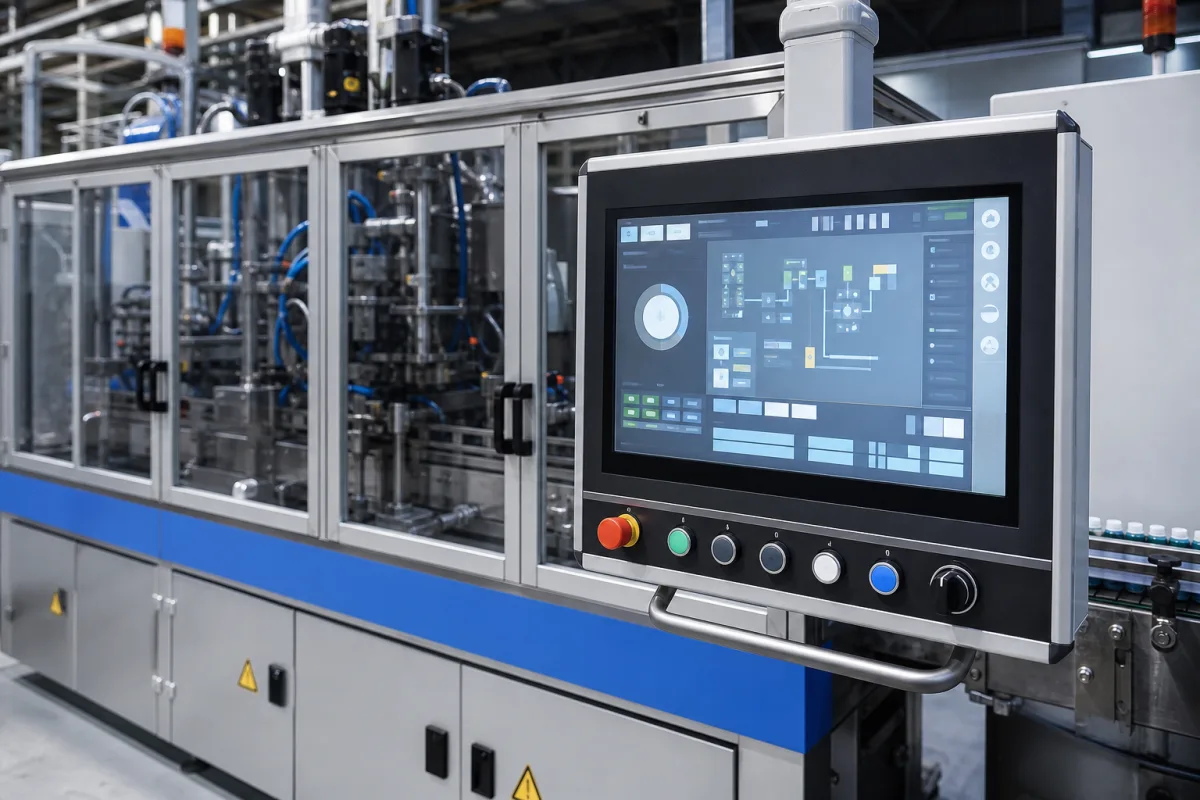
Control interface panel for process monitoring: how many alarms it may show, in which priorities, and the tools to keep them useful
The operator panel as an alarm interface for a process or line · alarm-rate targets of one per 10 minutes and ten in an upset, 5/15/80% priority split, shelving and out-of-service lists, and chattering and stale-alarm checks
The panel beside a fermenter or a production line does two jobs: it lets the operator run the process, and it tells them when something needs action. The second job fails first — when the panel shows more alarms than a person can read, or ranks them badly, the important one is missed. This page treats the control interface panel from that side: the alarm load it may present, how priorities are split, which functions the panel software needs so alarms can be shelved and tracked, and how nuisance alarms are found and fixed.
Alarm presentation and alarm-handling functions of operator control panels for process and production plant (fermentation, beverage, chemical and similar): alarm-rate and flood targets, priority distribution, shelving, suppression and out-of-service handling, alarm response information, and performance checks. Panel hardware — sealing, power, protocols and ISA-101 screen design — is covered on the Human-machine interface (HMI) page; operating housings with E-stops and pushbuttons on the HMI interface operator station page; signal towers and indicator lights on the Status indicators page; fermenter jacket, probe and glycol control on the Automated fermentation control system page.
CNFX editorial research · Sources checked October 12, 2026 · 3 sources
How many alarms one panel may present: one per 10 minutes in normal running, ten in the first 10 minutes of an upset
HSE's information sheet on alarm handling starts from the 1994 explosion and fires at the Texaco Milford Haven refinery, which injured 26 people and caused around £48 million of damage: in the last 11 minutes before the explosion, two operators had to recognise, acknowledge and act on 275 alarms. HSE's targets, taken from the EEMUA 191 guide, are a long-term average of no more than one alarm every ten minutes during normal operation, and no more than ten displayed in the first ten minutes after a major plant upset. [1]
Editorial calculation: 275 alarms in 11 minutes is 25 per minute, or about 250 per ten minutes — 25 times HSE's upset target of ten and 250 times its normal-running average of one. A day has 144 ten-minute periods, so one alarm per ten minutes is 144 per day, close to ISA's 150. [1][2]
A 2018 white paper from MAC Solutions, reported by BINDT, notes that IEC 62682:2014 gives around 144 alarms per day as a good target, and that the 2016 edition of ISA-18.2 dropped the per-day KPI along with two others; it also argues that one alarm per time frame cannot simply be converted into alarms per hour. [3] Check which edition a project's alarm philosophy cites before using the table as acceptance criteria.
ISA-18.2 (2009) metric, per operating position, ≥30 days of data
Ask the panel or system supplier for alarm counts per operator position from a comparable running plant, the flood figures, and how the panel behaves when more alarms arrive than it can list on one page.
02
Three priorities, split 5% high, 15% medium, 80% low
HSE recommends about three priorities, based on the potential consequence if the operator fails to respond, and proportionate prioritisation — for example 5% high, 15% medium and 80% low. [1] The Siemens article on ISA-18.2 gives the same split for annunciated alarms with three priorities and, with four, 80% low, 15% medium, 5% high and under 1% 'highest'; it states that ISA-18.2 recommends no more than three or four priorities and no more than 5% of alarms configured as high. [2]
Editorial calculation: on a panel carrying 400 configured alarms, the 5/15/80 split gives 20 high, 60 medium and 320 low-priority alarms. If the same panel shows 60 high-priority alarms, a third of its high-priority list carries consequences that the rationalisation has rated lower, and the operator can no longer use priority to choose what to answer first.
HSE adds that process status indications should not be designated as alarms, and that each alarm should have a defined operator response — alarms with none are the first to remove. [1]
Require the panel to display priority by colour and symbol consistently, to sort and filter by priority, and to export the configured priority distribution for review.
03
Functions the panel software needs: shelving with timeout, out-of-service lists, response information and a change log
The Siemens article on implementing ISA-18.2 lists the handling tools a panel should provide. Shelving lets the operator temporarily suppress an alarm during an upset; shelved alarms reappear after a preset time, are cleared from graphics and faceplates while shelved, and must be listed on a dedicated display. [2]
Unauthorised suppression and unauthorised attribute changes both have a target of zero in the ISA metrics table. [2] HSE likewise asks whether displays and on-line help present alarm information in the best way, giving coloured mimics instead of alarm lists as an example. [1]
Function (per the ISA-18.2 article)
What the panel should do
Shelving
Operator-initiated temporary suppression; automatic return after a preset time; list of shelved alarms [2]
Suppressed by design
Suppression by plant state or other conditions within the alarm system [2]
Out of service
Suppression for maintenance, with a complete list reviewed before equipment returns to service [2]
Alarm response information
Cause, consequence, corrective action and time to respond available online [2]
Every change through the panel logged with timestamp, from and to values and user; access rights for acknowledging, changing limits and disabling [2]
04
Finding nuisance alarms: chattering, stale and the top ten
ISA-18.2's monitoring metrics, as tabulated in the Siemens article, set chattering and fleeting alarms at zero, stale alarms — those in alarm for more than 24 hours — at fewer than five per day, and the share of the top ten alarms by frequency in the total load at under 1% to 5% at most, each with an action plan where exceeded. [2]
The quick fixes HSE lists from the EEMUA guide are practical at panel level: remove or review alarms with no defined response, tune settings on nuisance alarms, adjust deadbands on repeating alarms, suppress alarms from out-of-service plant, re-engineer repeating alarms, and replace digital alarm sensors that cause nuisance with analogue ones. HSE warns that a first-pass review may cover perhaps 50 alarms per shift, while a thorough review and redesign may take more than one shift per alarm. [1]
Editorial calculation: at HSE's two rates, a panel with 400 alarms needs about 8 shifts for a first pass (400 ÷ 50) but more than 400 shifts for a full redesign — which is why the alarm list is best rationalised before a new panel is commissioned rather than after.
Ask for the panel's alarm statistics: frequency per tag, average time in alarm, time between alarms and time to acknowledge, and a filter by time in alarm to list stale alarms.
05
What to specify for a control interface panel's alarm handling
Paste it into your enquiry below or into an email to a maker, then replace every bracket.
Process: [fermentation, filling, chemical; number of operator positions]
Alarm list: [number configured; priority split]
Targets: [alarms per 10 min and per day; flood limit]
Functions: [shelving with timeout; out-of-service list; response info; comments]
Security: [access rights; change log]
Analysis: [statistics; export; stale and chattering reports]
Standard: [ISA-18.2 edition, IEC 62682 or EEMUA 191 cited]
Explore company information and manufacturing capabilities, then discuss the scope of your project with a relevant supplier.
Share this page
Compiled and source-reviewed by the CNFX editorial team.
Each manufacturer above links to the page on that company's own website where the product is listed, with the date we checked it. How we source and review
· Page last updated 13 October 2026
Buyer questions
How many alarms should an operator panel show?
HSE's targets are no more than one every ten minutes on average in normal operation and no more than ten in the first ten minutes after a major upset; ISA-18.2 (2009) gives 150 per day as very likely acceptable and 300 as maximum manageable. [1][2]
How should alarm priorities be split?
About three priorities in the proportion 5% high, 15% medium and 80% low, per HSE and the ISA-18.2 metrics. [1][2]
What is alarm shelving?
Operator-initiated temporary suppression of an alarm that returns after a preset time and is listed on its own display. [2]
Is the 150 alarms per day target still in ISA-18.2?
A MAC Solutions white paper says the 2016 edition dropped it, while IEC 62682:2014 gives around 144 per day as a good target. [3]
Sources and what still needs a direct check
Sources checked 2026-10-12. Alarm-rate targets, priorities and review effort come from HSE's Chemicals Sheet No 6, which draws on EEMUA 191; the ISA-18.2 metrics table and handling functions from a Siemens article in Process Online; edition changes and IEC 62682 from a MAC Solutions white paper reported by BINDT.