Industry-Verified Manufacturing Data (2026)

Control Processor

Based on aggregated insights from multiple verified factory profiles within the CNFX directory, the standard Control Processor used in the Machinery and Equipment Manufacturing sector typically supports operational capacities ranging from standard industrial configurations to heavy-duty production requirements.

Technical Definition & Core Assembly

A canonical Control Processor is characterized by the integration of Microcontroller/Microprocessor Core and Memory (Flash/RAM). In industrial production environments, manufacturers listed on CNFX commonly emphasize Semiconductor Silicon construction to support stable, high-cycle operation across diverse manufacturing scenarios.

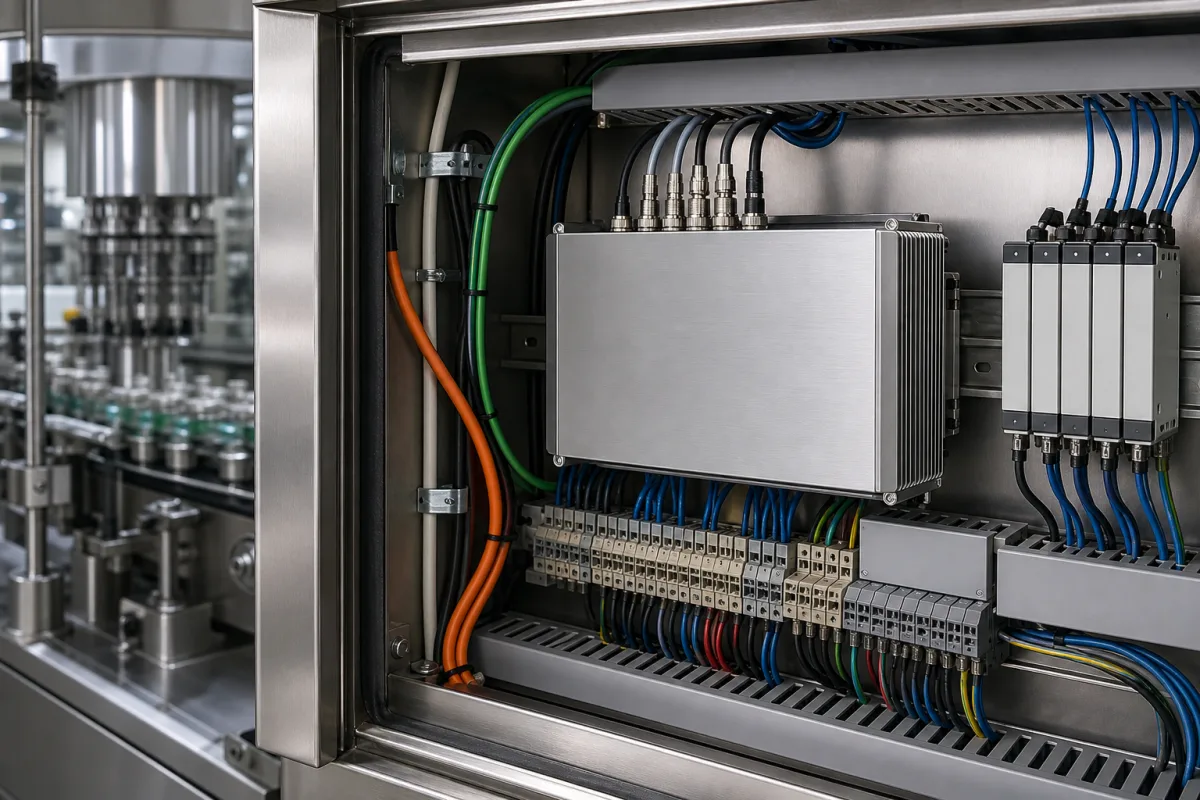
Electronic component within a Torque Control Unit that processes sensor inputs and executes control algorithms to regulate torque output.
Product Specifications

Technical details and manufacturing context for Control Processor

Definition
The Control Processor is the computational core of a Torque Control Unit, responsible for receiving real-time data from torque sensors and other system inputs, executing programmed control logic (such as PID algorithms), and sending precise command signals to actuators (like servo motors or hydraulic valves) to achieve and maintain the desired torque level. It ensures accurate, responsive, and stable torque application in industrial machinery.
Working Principle
The processor operates by continuously sampling input signals (e.g., actual torque, speed, position). It compares these values to a setpoint or target torque profile. Using embedded control algorithms, it calculates an error signal and determines the necessary corrective output. This output signal, often a PWM (Pulse Width Modulation) or analog voltage/current command, is then sent to the power drive stage to adjust the actuator, thereby regulating the torque output of the system.
Common Materials
Semiconductor Silicon, PCB (Printed Circuit Board), Encapsulation Epoxy
Technical Parameters
  • Processor clock speed, affecting control loop execution speed and responsiveness. (MHz) Per Request
Components / BOM
  • Microcontroller/Microprocessor Core
    Executes the control program and arithmetic calculations.
    Material: Semiconductor (Silicon)
  • Memory (Flash/RAM)
    Stores the control program (Flash) and temporary data during operation (RAM).
    Material: Semiconductor (Silicon)
  • Analog-to-Digital Converter (ADC)
    Converts analog sensor signals (e.g., from torque transducers) into digital values for the processor.
    Material: Semiconductor (Silicon)
  • Digital-to-Analog Converter (DAC) / PWM Generator
    Converts the processor's digital output commands into analog voltage/current or PWM signals for the actuator drive.
    Material: Semiconductor (Silicon)
  • Communication Interface (e.g., CAN, Ethernet, Serial)
    Enables communication with higher-level controllers (PLCs) or networks for parameter setting and data monitoring.
    Material: Semiconductor (Silicon), Copper
Engineering Reasoning
3.3-5.0 VDC, -40 to 85°C ambient temperature, 0-100% relative humidity non-condensing
Voltage drop below 2.7 VDC or above 5.5 VDC for >10 ms, junction temperature exceeding 125°C, clock frequency deviation >±0.1% from 16 MHz nominal
Design Rationale: Electromigration at current densities >1×10⁶ A/cm² causing open circuits, dielectric breakdown at electric field strengths >10 MV/cm, latch-up triggered by transient currents >100 mA
Risk Mitigation (FMEA)
Trigger Electrostatic discharge (ESD) event exceeding 2 kV HBM
Mode: Gate oxide rupture in CMOS transistors causing permanent short circuit
Strategy: Integrated ESD protection diodes with 5 ns response time and 3 A clamping current
Trigger Alpha particle radiation from packaging materials causing >10⁴ particles/cm²·hr flux
Mode: Single event upset (SEU) flipping memory bits in control algorithm registers
Strategy: Triple modular redundancy (TMR) voting logic with 2 ns synchronization delay

Industry Taxonomies & Aliases

Commonly used trade names and technical identifiers for Control Processor.

Applied To / Applications

This component is essential for the following industrial systems and equipment:

Industrial Ecosystem & Supply Chain DNA

Complementary Systems
Downstream Applications
Specialized Tooling

Application Fit & Sizing Matrix

Operational Limits
pressure: 0 to 10 bar ambient pressure rating
other spec: IP67 ingress protection, 24V DC ±10% power supply
temperature: -40°C to +85°C operating range
Media Compatibility
✓ hydraulic oil systems ✓ industrial lubricants ✓ clean compressed air environments
Unsuitable: high-concentration abrasive slurry with particulates >50 microns
Sizing Data Required
  • maximum torque output requirement (Nm)
  • control loop response time (ms)
  • sensor input voltage/current range

Reliability & Engineering Risk Analysis

Failure Mode & Root Cause
Overheating and thermal degradation
Cause: Inadequate cooling, dust accumulation on heat sinks, or prolonged high CPU load leading to component failure.
Memory corruption or data loss
Cause: Power supply fluctuations, electromagnetic interference (EMI), or aging capacitors causing unstable voltage to memory modules.
Maintenance Indicators
  • Unusual audible alarms or beeping from the processor unit indicating fault codes.
  • Visible warning lights (e.g., red LED indicators) or error messages on connected HMIs/control panels.
Engineering Tips
  • Implement regular cleaning of cooling fans and heat sinks, and ensure ambient temperature control within specified limits.
  • Use uninterruptible power supplies (UPS) and surge protectors to stabilize power input and protect against electrical transients.

Compliance & Manufacturing Standards

Reference Standards
ISO 9001:2015 Quality Management Systems IEC 61508:2010 Functional Safety of Electrical/Electronic/Programmable Electronic Safety-related Systems CE Marking (EU Machinery Directive 2006/42/EC)
Manufacturing Precision
  • Dimensional Stability: +/-0.05mm across operating temperature range
  • Signal Timing Accuracy: +/-1 microsecond for critical control signals
Quality Inspection
  • Environmental Stress Screening (ESS) - Thermal Cycling & Vibration
  • Functional Safety Verification Testing (IEC 61508 SIL Level Assessment)

Factories Producing Control Processor

Verified manufacturers with capability to produce this product in China

✓ 95% Supplier Capability Match Found

P Project Engineer from Brazil Feb 18, 2026
★★★★★
"Testing the Control Processor now; the technical reliability results are within 1% of the laboratory datasheet."
Technical Specifications Verified
S Sourcing Manager from Canada Feb 15, 2026
★★★★★
"Impressive build quality. Especially the technical reliability is very stable during long-term operation."
Technical Specifications Verified
P Procurement Specialist from United States Feb 12, 2026
★★★★★
"As a professional in the Machinery and Equipment Manufacturing sector, I confirm this Control Processor meets all ISO standards."
Technical Specifications Verified
Verification Protocol

“Feedback is collected from verified sourcing managers during RFQ (Request for Quote) and factory evaluation processes on CNFX. These reports represent historical performance data and technical audit summaries from our B2B manufacturing network.”

19 sourcing managers are analyzing this specification now. Last inquiry for Control Processor from USA (1h ago).

Supply Chain Compatible Machinery & Devices

Automated Assembly Line System

Integrated production system for sequential component assembly operations

Explore Specs →
Automated Powder Coating System

Integrated industrial system for applying dry powder coatings to metal substrates.

Explore Specs →
Centrifugal Pump Impeller

Rotating component that transfers energy to fluid in centrifugal pumps.

Explore Specs →
High-Precision CNC Laser Cutting Machine

Computer-controlled industrial machine using focused laser beams to cut sheet metal with micron-level accuracy.

Explore Specs →

Frequently Asked Questions

What is the primary function of this control processor in machinery?

This control processor processes sensor inputs and executes control algorithms to precisely regulate torque output in industrial machinery and equipment.

What communication interfaces does this control processor support?

The processor supports industrial communication interfaces including CAN, Ethernet, and Serial protocols for seamless integration with machinery control systems.

What materials are used in the construction of this control processor?

It's constructed with semiconductor silicon for the core components, PCB for circuitry, and encapsulation epoxy for protection against industrial environments.

Can I contact factories directly on CNFX?

CNFX is an open directory, not a transaction platform. Each factory profile provides direct contact information and production details to help you initiate direct inquiries with Chinese suppliers.

Get Quote for Control Processor

Request technical pricing, lead times, or customized specifications for Control Processor directly from verified manufacturing units.

Your business information is encrypted and only shared with verified Control Processor suppliers.

Thank you! Your message has been sent. We'll respond within 1–3 business days.

Need to Manufacture Control Processor?

Connect with verified factories specializing in this product category

Add Your Factory Contact Us
Previous Product
Control Pod
Next Product
Control Rod