Editorial Technical Reference

Emergency Shutdown System

This page explains how Emergency Shutdown System is classified within Machinery and Equipment Manufacturing. Technical values and manufacturer relationships are research references; confirm the current specification and supplier evidence for each order.

Technical Definition & Core Assembly

A safety-critical control system designed to rapidly and safely halt machinery or processes in emergency situations.
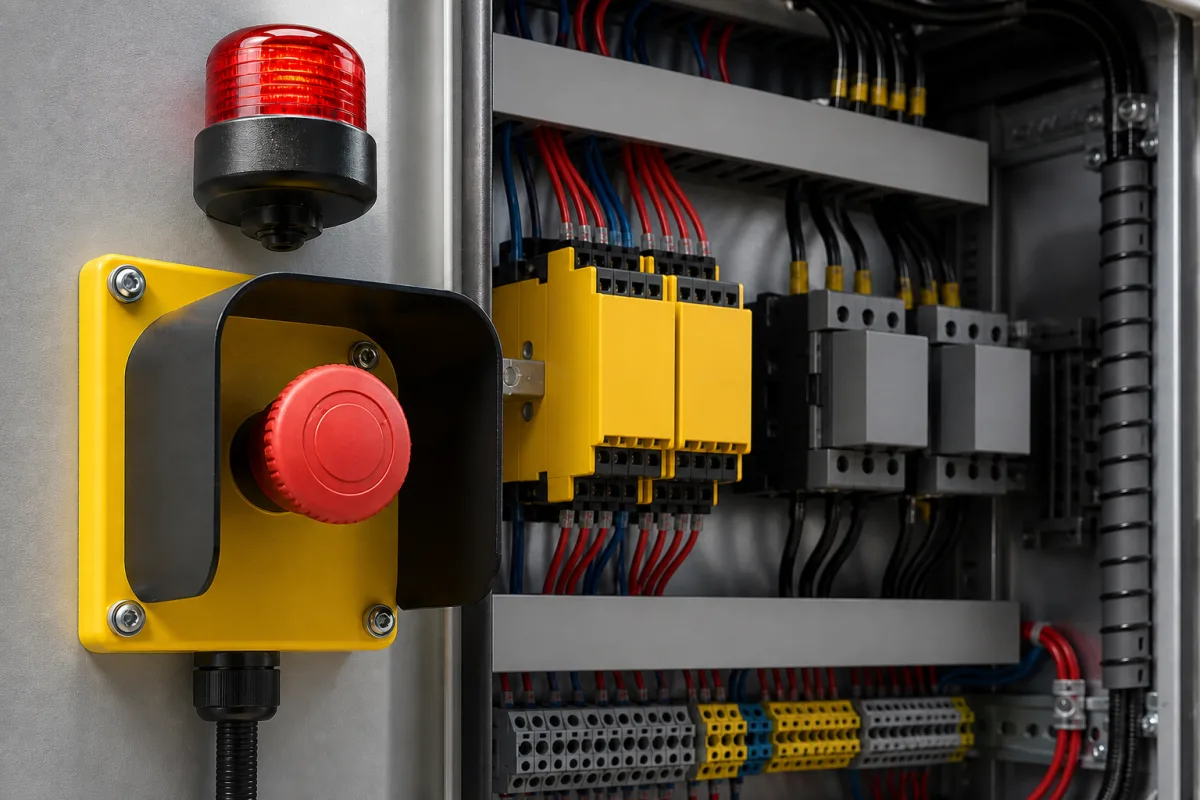
Representative product image. Confirm appearance and specifications with the manufacturer.

Product Specifications

Technical details and manufacturing context for Emergency Shutdown System

Definition
The Emergency Shutdown System (ESD) is an integral safety component typically housed within the Control Cabin of industrial machinery. Its primary function is to continuously monitor operational parameters and, upon detection of predefined hazardous conditions, trigger an immediate shutdown of connected equipment or processes. This rapid intervention prevents equipment damage, product loss, and personnel injury. The system operates by receiving signals from various sensors that track parameters such as temperature, pressure, and mechanical integrity. When thresholds are exceeded, the ESD activates shutdown sequences through electrical relays, pneumatic valves, or mechanical brakes, ensuring a controlled and safe stop. The system is designed for high-demand mode and is rated SIL 3 according to IEC 61508, indicating a high level of safety integrity. It operates on a standard control voltage of 24 V DC (±10%) per IEC 61131-2, with power consumption ranging from 15 to 30 W depending on the number of I/O modules. The response time from signal to output de-energization is ≤100 ms, meeting IEC 61508 requirements. The system supports configurable digital and analog I/O channels (16–64) and communicates via safety protocols such as PROFIsafe and EtherCAT FSoE, compliant with IEC 61784-3. It is designed for harsh environments, with an operating temperature range of -40 to 85 °C (IEC 60068-2-1/2) and ingress protection ratings of IP54 to IP65 (IEC 60529). The enclosure is typically made of stainless steel, and the system includes electronic circuit boards and industrial-grade relays. Physical specifications include a weight of 2.5–5.0 kg and dimensions of 200×300×100 mm (W×H×D). Certifications such as TÜV, CE, and UL are listed as references for safety-critical applications, but verification with the manufacturer is required. This directory entry provides reference ranges; actual model-specific values and standards must be confirmed with the legal manufacturer or supplier.
Working Principle
The Emergency Shutdown System continuously monitors sensors for abnormal conditions such as over-temperature, over-pressure, or mechanical failure. When any threshold is exceeded, the system activates shutdown sequences through electrical relays, pneumatic valves, or mechanical brakes to safely stop equipment operation. The system is designed to respond within 100 ms to de-energize outputs, ensuring rapid intervention. It operates in high-demand mode and is rated SIL 3, meaning it is suitable for applications where failure could have severe consequences. The system's inputs and outputs are configurable, allowing adaptation to specific machinery. Communication via safety protocols ensures integration with broader control systems. The system's design includes redundancy and diagnostic features to maintain safety integrity.
Common Materials
Stainless Steel Enclosure, Electronic Circuit Boards, Industrial-grade Relays
Technical Parameters
ParameterTypical rangeNotes & selection driver
Rated Voltage24 ±10% V DCStandard control voltage for industrial systemsIEC 61131-2
Power Consumption15–30 WDepends on number of I/O modules
Response Time≤100 msFrom signal to output de-energizationIEC 61508
Safety Integrity LevelSIL 3High demand modeIEC 61508
Operating Temperature-40–85 °CExtended temperature range for harsh environmentsIEC 60068-2-1/2
Ingress ProtectionIP54–IP65IP65 for panel-mounted, IP54 for field enclosuresIEC 60529
Number of Inputs/Outputs16–64 channelsConfigurable digital and analog I/O
Communication ProtocolPROFIsafe, EtherCAT FSoESafety protocols for real-time controlIEC 61784-3
CertificationTÜV, CE, ULRequired for safety-critical applicationsIEC 61508, ISO 13849
Weight2.5–5.0 kgDepends on configuration and enclosure
Dimensions (W×H×D)200×300×100 mmTypical panel-mount enclosure

Ranges are indicative industry figures for RFQ preparation, not a supplier commitment. Confirm every value and standard with the legal manufacturer before ordering.

Components / BOM
  • Control Processor
    Monitors sensor inputs and executes shutdown logic
    Material: Electronic components on PCB
  • Emergency Stop Button
    Manual activation interface for immediate shutdown
    Material: Impact-resistant plastic with metal contacts
  • Output Relay Module
    Switches power to connected machinery during shutdown
    Material: Copper contacts in protective housing
  • Status Indicator Panel
    Displays system status and fault conditions
    Material: LED indicators in polycarbonate panel
  • Pneumatic Shutdown Valve Optional
    Dumps or blocks air pressure to stop the machine, on installations whose final element is pneumatic.

Applied To / Applications

This component is essential for the following industrial systems and equipment:

Industrial Ecosystem & Supply Chain Structure

Complementary Systems
Downstream Applications
Specialized Tooling

Application Fit & Sizing Matrix

Operational Limits
pressure: 0 to 100 bar (standard), up to 600 bar (high-pressure variants)
temperature: -40°C to +85°C (operating), -50°C to +100°C (storage)
response time: ≤ 50 ms (typical), ≤ 20 ms (high-performance)
environmental rating: IP66/IP67 (standard), NEMA 4X (harsh environments)
safety integrity level: SIL 2 to SIL 3 (IEC 61508/61511)
Media Compatibility
✓ Natural gas processing systems ✓ Chemical reactor shutdown applications ✓ High-pressure hydraulic machinery
Unsuitable: Marine/saltwater immersion environments without specialized corrosion protection
Sizing Data Required
  • Process shutdown time requirement (seconds)
  • Maximum system pressure during emergency (bar/psi)
  • Safety Integrity Level (SIL) certification required

Reliability & Engineering Risk Analysis

Failure Mode & Root Cause
Sensor Drift or Calibration Loss
Cause: Environmental factors (temperature, humidity), aging components, or contamination affecting sensor accuracy, leading to false trips or failure to detect actual shutdown conditions.
Control Logic or Communication Failure
Cause: Software bugs, hardware faults in PLCs/controllers, network interruptions, or power supply issues disrupting the system's ability to execute shutdown commands reliably.
Maintenance Indicators
  • Frequent false trips or alarms without actual process deviations
  • Unresponsive or delayed system behavior during testing or actual emergencies
Engineering Tips
  • Implement regular functional testing and calibration schedules aligned with SIL (Safety Integrity Level) requirements, using certified procedures and tools.
  • Enhance redundancy and diversity in critical components (e.g., sensors, controllers) and ensure robust cybersecurity measures to protect against unauthorized access or tampering.

Indicative industry ranges for design and RFQ preparation. Confirm the exact figures and applicable standard with the manufacturer before specifying.

Compliance & Manufacturing Standards

Applicable Standards
ISO 13849-1: Safety of machinery - Safety-related parts of control systems ANSI/ISA-84.00.01: Functional Safety: Safety Instrumented Systems for the Process Industry Sector DIN EN 418: Safety of machinery - Emergency stop equipment - Principles for design

Quoted from the published standard.

Manufacturing Precision
  • Actuation force: +/- 10% of specified value
  • Response time: +/- 5% of design specification
Quality Inspection
  • Functional safety test (including response time verification)
  • Environmental stress screening (temperature, humidity, vibration)

Manufacturers of Emergency Shutdown System

Manufacturer profiles associated with Emergency Shutdown System.

Sourcing Emergency Shutdown System from China?
Tell us your specification and target quantity — we will match it against manufacturer records and come back with the factories that fit.
Request manufacturers We manufacture this

Manufacturer listings support early research and capability understanding. They are not certification, ranking, or transaction guarantees.

Technical documentation
Request current drawings, revision history, and a signed specification sheet.
Manufacturing capability
Verify equipment lists, process limits, capacity, and representative production evidence.
Inspection readiness
Confirm test methods, calibrated equipment, sampling plans, and traceable reports.
Supplier transparency
Check the legal entity, factory address, ownership, certifications, and direct contacts.

CNFX does not score or rank suppliers. Buyers must verify all claims and documents with the legal manufacturer before ordering.

Supply Chain Compatible Machinery & Devices

Automated Powder Coating System

Integrated industrial system for applying dry powder coatings to metal substrates.

Explore Specs →
Centrifugal Pump Impeller

The centrifugal pump impeller is a critical rotating component that converts mechanical energy from the motor into kinetic energy in fluid systems.

Explore Specs →
High-Precision CNC Laser Cutting Machine

Computer-controlled industrial machine using focused laser beams to cut sheet metal with micron-level accuracy.

Explore Specs →
Industrial-Grade Hydraulic Cylinder Piston Rod

This industrial-grade piston rod is a precision-ground cylindrical component designed for use in hydraulic cylinders.

Explore Specs →

Frequently Asked Questions

What is the response time of the Emergency Shutdown System?

The response time from signal to output de-energization is ≤100 ms, as per IEC 61508. This ensures rapid shutdown in emergency situations.

What safety integrity level does the system meet?

The system is rated SIL 3 in high-demand mode according to IEC 61508, indicating a high level of safety integrity for critical applications.

What communication protocols are supported?

The system supports PROFIsafe and EtherCAT FSoE, which are safety protocols compliant with IEC 61784-3 for real-time control.

What certifications are listed for this system?

TÜV, CE, and UL certifications are listed as references for safety-critical applications. However, actual certification status must be verified with the manufacturer or supplier.

Data Basis

Editorial classification, named public sources where available, and source-reviewed manufacturer records.

Preliminary Technical Classification
This page supports structured research, RFQ preparation, and supplier evaluation. It does not replace buyer-led supplier qualification, standards review, or technical approval.
Buyer enquiry

Request manufacturing insight for Emergency Shutdown System

Ask for use case, specification boundaries, supplier type, and RFQ preparation information for this product.

Where it goes
Straight to the CNFX editorial desk, and to the manufacturer if this product is linked to a claimed profile. Nothing is broadcast to a supplier list.
Your details stay here
We do not sell or rent enquiry data, and we do not add you to a mailing list. Used only to answer this request.
No commission, no middleman
CNFX is a directory. We take no cut of any order and never negotiate on a supplier's behalf.
What we don't claim
A listing is not an endorsement. Qualify every supplier and verify every figure yourself before ordering.

Your business information is used only to process this request.

Thank you! Your message has been sent. We'll respond within 1–3 business days.
Sorry, we couldn't send your message. Please try again, or email us at contact@cnfx.com.

Need to Manufacture Emergency Shutdown System?

Compare manufacturer profiles with relevant product and process capability.

Previous Product
Z-axis Ram/Spindle
Last Product
Get QuotesChat