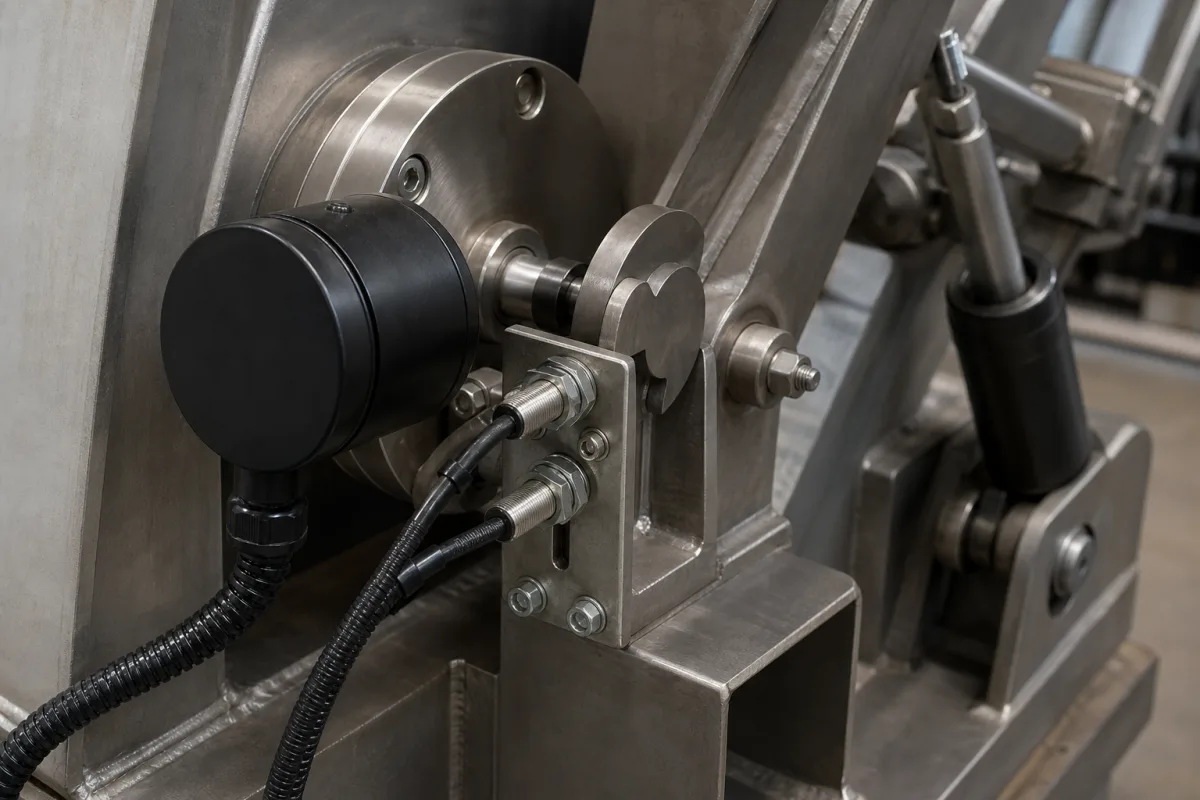
Control sensor: Hall-effect rotary angle sensor for the pivot of a tipping or inverting mechanism
Hall-effect rotary angle sensing on tipping and inverting pivots · shaft-type or two-part magnet design, air gap and offset error, 4–20 mA range and diagnosis
On a mechanism that tips, tilts or inverts a container, the controller needs to know the angle of the pivot through the whole stroke, so that it can slow down before the end, stop at a dump angle and confirm that the load is back level. A Hall-effect rotary angle sensor does this without contact: a magnet turns with the pivot and the sensor converts the field direction into an analogue or digital signal. Decide first whether the sensor carries its own shaft or reads a separate magnet on your pivot, then fix the measuring range, output and the gap and offset your bracket can hold.
Non-contact rotary angle sensors (Hall-effect, shaft-type or two-part with magnetic position marker) used to measure the angle of pivots, tipping frames and inverting arms, with analogue current or voltage output. Inductive switches that only report a target being present at an end position are covered on the Proximity sensor page, and the brackets and holders for barrel sensors on the Sensor mount page. Inclinometers, incremental encoders and potentiometers with wipers are outside this page.
CNFX editorial research · Sources checked October 12, 2026 · 3 sources
Integral shaft or separate magnet on the pivot: loads, air gap and offset error
A shaft-type sensor is coupled to the pivot, so the coupling and its tolerances load the sensor bearing; a two-part sensor reads a magnet fixed to the pivot through an air gap, so nothing is coupled but the gap and the centring of the magnet have to be held by the bracket.
elobau's 424D is a shaft-type Hall sensor with a PBT housing and no mechanical stop; its data sheet allows a maximum shaft load of 50 N axial and 100 N radial, fastening screws torqued to 2.5 N·m, and IP67 to DIN EN 60529. [1] Honeywell's RTY series, also shaft-actuated, is offered with an integral shaft with or without a lever and is rated for a 35 million cycle life; the companion RTP series separates the magnet from the sensor body, which Honeywell says removes bearing wear from radial forces and allows unlimited rotation. [3]
Novotechnik describes its RFC-4800 as a two-part design of sensor and magnetic position marker without shaft or bearing, less sensitive to axial and radial tolerances, and able to measure through any non-ferromagnetic material. [2] Its working distance depends on the marker: 0 to 4 mm for the Z-RFC-P02/P04/P08 group on single-channel versions without diagnosis, and 0 to 1.5 mm for the P03/P30 group. Radial offset adds linearity error: for the P02/P04/P08 group the single-channel figures are ±0.4° at 0.5 mm, ±1.1° at 1.0 mm and ±3.5° at 2.0 mm, and redundant versions show larger values (±0.7°, ±1.8°, ±5.2°). Mounting the magnet axially on a magnetizable shaft reduces the working distance by about 20%. [2]
Honeywell's RTP data give an air gap of 3.00 ± 0.5 mm for the bare magnet and 2.00 ± 0.5 mm for the housed magnet with 2.00 mm maximum misalignment, specify non-magnetic stainless steel screws, and warn that ferrous material or magnet material over 300 Gauss within 10 mm of the sensor boundary may affect performance. [3] On a steel tipping frame this sets where the sensor bracket and any end-position switches may sit.
Tell the supplier whether the pivot can drive a shaft through a coupling or lever, or carry a magnet on its end face; the pivot material; the gap and radial offset your bracket can hold through the full tipping stroke; and any steel parts or magnets within about 10 mm of the sensor.
02
Measuring range, 4–20 mA span and what the error figures mean in degrees
A tipping stroke rarely uses a full turn, so choosing a range close to the stroke puts the whole signal span on the movement that matters.
The RFC-4800 current version is programmed from 0–30° up to 0–360° in 10° steps, with independent linearity ≤ ±0.5 %FS, 12-bit resolution, repeatability listed as "typ. ≤ ±0.1°" and temperature error as "typ. ±1.2 %FS" for ranges of 30–170° and "typ. ±0.6 %FS" for ranges of 180° and above. Its diagnosis drives the output outside the plausible signal range when an error is detected, and the 4–20 mA output allows a burden of up to 500 Ω above 13 V supply (250 Ω at or below 13 V). [2]
Editorial calculation: on a 90° range, ±0.5 %FS is ±0.45°, and a ±1.2 %FS temperature error is ±1.08°; the same percentages on a 360° range would be ±1.8° and, at ±0.6 %FS, ±2.16°. A 4–20 mA output spread over 90° gives about 0.18 mA per degree, against about 0.044 mA per degree over 360°.
elobau gives the 424D a 20°–360° range, 4–20 mA (12 mA at centre) or 0.5–4.5 V output, a 0.09° resolution, 10–30 V DC supply, 30 mA consumption, 200 Ω maximum load on the current version and a 1,600 Hz signal update rate. [1] Honeywell's RTY and RTP sensors give 0.5–4.5 V or inverted 4.5–0.5 V outputs over eight ranges from 50° to 360°, with output signal delay listed as "4 ms typ." and 12-bit resolution. [3] Editorial calculation: 360° divided into 4,096 steps (12 bits) is 0.088°, consistent with elobau's 0.09° figure.
03
Supply, temperature and interference ratings for vehicle-mounted tippers
Container tippers and inverters on vehicles see vehicle supply transients and wash-down, so the published environmental and EMC ratings belong in the comparison.
Novotechnik states that the RFC-4800 is suitable for safety-related applications to ISO 13849 only after customer validation, and offers one- and two-channel versions. [2] If the tipping angle is used to stop a hazardous movement, ask for the dual-channel version and the safety data, not only the MTTFd figure.
Paste it into your enquiry below or into an email to a maker, then replace every bracket.
Mechanism: [tipping, tilting or inverting; stroke in degrees; cycles per day]
Pivot: [shaft diameter; material; shaft drive or magnet on end face]
Mounting: [air gap; radial offset through stroke; steel or magnets within 10 mm]
Signal: [range; 4–20 mA or 0.5–4.5 V; one or two channels; diagnosis]
Power and environment: [supply; temperature; IP rating; wash-down; vehicle EMC]
Connection: [connector or cable; length]
Explore company information and manufacturing capabilities, then discuss the scope of your project with a relevant supplier.
Share this page
Compiled and source-reviewed by the CNFX editorial team.
Each manufacturer above links to the page on that company's own website where the product is listed, with the date we checked it. How we source and review
· Page last updated 13 October 2026
Buyer questions
Why use a rotary angle sensor instead of proximity switches on a tipping pivot?
A Hall-effect angle sensor reports the angle over its whole programmed range, such as 0–30° up to 0–360° on the Novotechnik RFC-4800, so the controller can follow the stroke rather than only see the end positions. [2]
How much gap can there be between sensor and magnet?
It depends on the magnet: Novotechnik lists 0–4 mm for its P02/P04/P08 markers and 0–1.5 mm for P03/P30 on single-channel versions without diagnosis; Honeywell's RTP needs 3.00 ± 0.5 mm with a bare magnet. [2][3]
What does radial offset of the magnet do?
It adds linearity error; Novotechnik gives ±0.4° at 0.5 mm, ±1.1° at 1.0 mm and ±3.5° at 2.0 mm for single-channel versions with its P02/P04/P08 markers. [2]
How much load can a shaft-type angle sensor take?
elobau allows 50 N axial and 100 N radial on the 424D shaft, so the pivot should drive it through a coupling or lever rather than carry the mechanism's load. [1]
Sources and what still needs a direct check
Sources checked 2026-10-12. elobau, Novotechnik and Honeywell are sensor makers publishing data for their own angle sensors; values apply to the versions named.