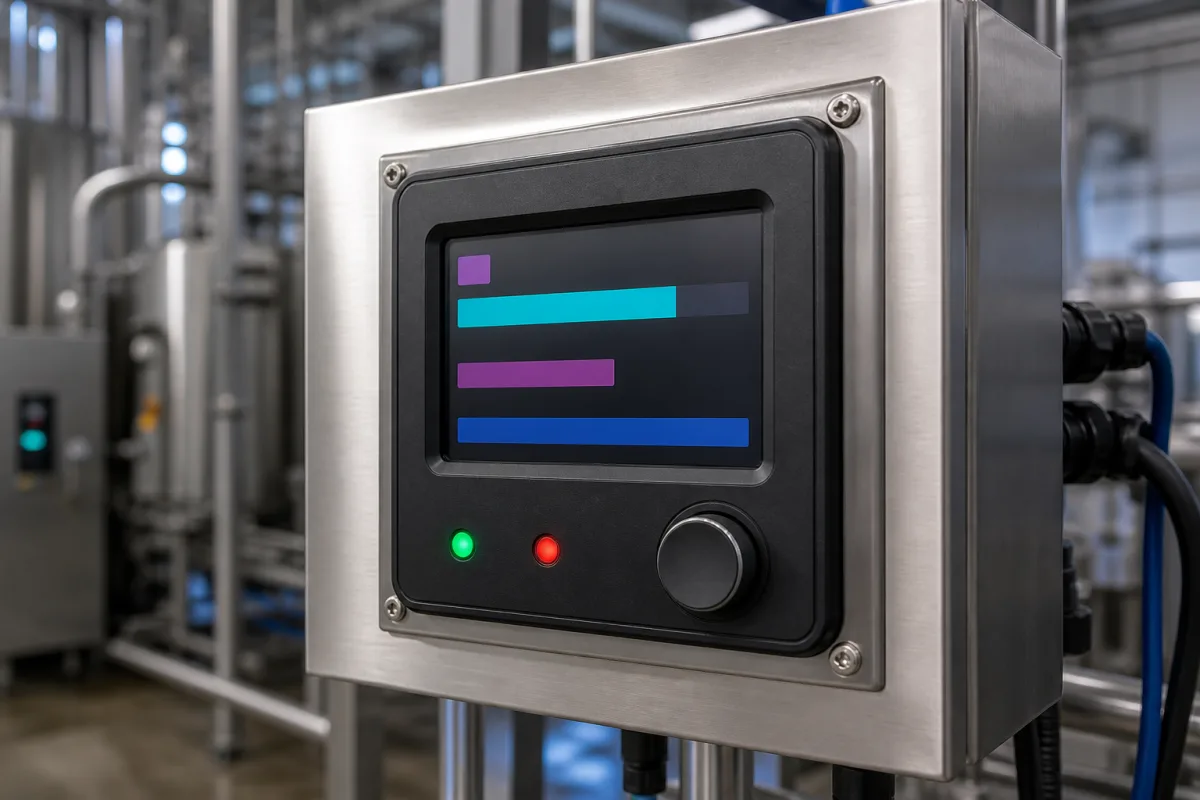
Controller unit for refrigeration (the electronic thermostat and defrost controller of a cold room or refrigerated cabinet)
The electronic controller that runs a cold room or refrigerated cabinet · set point and differential, compressor minimum on and off times, electric or hot-gas defrost by time and by evaporator temperature, drip time, fan delay, door input, and alarm delays that skip the defrost period
A refrigeration controller does more than hold a set point. It starts and stops the compressor within minimum on and off times, starts defrost on a clock and ends it on time or evaporator temperature, holds the fans until the coil has drained, reacts to the door switch, and delays alarms, with separate delays for the door and for the period after defrost. The parameter list is where these behaviours are specified.
Electronic refrigeration controllers for cold rooms, refrigerated cabinets and display cases: thermostat, compressor protection timers, defrost, evaporator fans, door input and alarms. General panel and DIN-rail temperature controllers for heating processes are covered on the Temperature controller page; DIN-rail trip units on the Temperature alarm module: DIN-rail trip unit that switches a relay when an RTD or thermocouple reading crosses a limit page; condensing units on the Refrigeration condensing units for cold rooms page; unit coolers on the Evaporators (refrigeration) page; wall-mounted room displays on the User interface for HVAC thermostats: wall-mounted room display unit wired to a zone or VAV controller page.
CNFX editorial research · Sources checked October 13, 2026 · 2 sources
Danfoss's instruction sheet for the EKC 202A, 202B and 202C (115 V, RI8KL45J, 08-2010) lists each parameter with its range and factory setting. The controller has relay outputs for refrigeration, defrost, fan, and alarm, light or rail heat. [1]
A Dixell XR60CX operating manual published by LabRepCo for its laboratory refrigerators defines the anti-short-cycle delay as the "Minimum interval between the compressor stop and the following restart", the defrost interval as the time "between the beginning of two defrost cycles", and drip time as the time that "allows the evaporator to eliminate water drops that might have formed due to defrost". With an evaporator probe fitted, defrost ends at the termination temperature and the maximum length acts as a limit; without one, defrost is timed. [2]
The same manual offers electric defrost with the compressor off or hot gas with the compressor on. Danfoss offers no defrost, electric or gas, and defrost on demand from accumulated refrigeration time. [2][1]
EKC 202A/B/C parameter
Code
Range
Factory setting
Set point
---
-50 to 50 °C
2 °C
Thermostat differential
r01
0.1 to 20 K
2 K
Compressor min. ON-time
c01
0 to 30 min
0 min
Compressor min. OFF-time
c02
0 to 30 min
0 min
Defrost stop temperature
d02
0 to 25 °C
6 °C
Interval between defrost starts
d03
0 to 48 h
8 h
Max. defrost duration
d04
0 to 180 min
45 min
Drip-off time
d06
0 to 60 min
0 min
Delay for fan start after defrost
d07
0 to 60 min
0 min
Values are Danfoss's factory settings, not a recipe; give the supplier the room temperature, product, evaporator and defrost type, and ask for the parameter set they will load.
02
Fans, door switch, alarms and a failed probe
In Danfoss's table, temperature alarms wait 30 minutes by default (A03), door alarms 60 minutes (A04), and temperature alarms after defrost 90 minutes (A12), each settable from 0 to 240 minutes; the default high and low alarm limits are 8 °C and -30 °C. Outputs are held for 5 seconds after start-up by default (o01, 0 to 600 s). [1]
The Dixell manual lets the door switch input stop the fans, the compressor, or both while the door is open, and sets whether regulation restarts after the door delay even with the door alarm active. If the thermostat probe fails, the compressor runs on a fixed on time and off time; with the on time set to 0 "compressor is always OFF". [2]
Fan modes in the Dixell manual run the fans with the compressor or continuously, and either off or on during defrost; a fan stop temperature keeps the fans off while the evaporator probe reads above it. [2]
Decide alarm limits and delays from the product being stored, state where alarms go (relay, display, network), and ask how the controller behaves on probe failure.
03
Refrigeration controller details
Paste it into your enquiry below or into an email to a maker, then replace every bracket.
Explore company information and manufacturing capabilities, then discuss the scope of your project with a relevant supplier.
Share this page
Compiled and source-reviewed by the CNFX editorial team.
Each manufacturer above links to the page on that company's own website where the product is listed, with the date we checked it. How we source and review
· Page last updated 13 October 2026
Buyer questions
How often does a refrigeration controller defrost by default?
Danfoss's EKC 202A/B/C table sets 8 hours between defrost starts and 45 minutes maximum duration. [1]
What is an anti-short-cycle delay?
The minimum interval between a compressor stop and the next restart, per the Dixell XR60CX manual. [2]
Why is the temperature alarm delayed after defrost?
Danfoss provides a separate delay for temperature alarms after defrost, 90 minutes by default, alongside the standard 30-minute delay. [1]
What happens if the room probe fails?
In the Dixell manual the compressor cycles on a set on time and off time while the thermostat probe is faulty. [2]
Sources and what still needs a direct check
Sources checked 2026-10-13. Danfoss publishes the EKC 202A/B/C instruction sheet; LabRepCo publishes the Dixell XR60CX operating manual for its L2X laboratory refrigerators.