Industry-Verified Manufacturing Data (2026)

Diaphragm or Peristaltic Pump

Based on aggregated insights from multiple verified factory profiles within the CNFX directory, the standard Diaphragm or Peristaltic Pump used in the Machinery and Equipment Manufacturing sector typically supports operational capacities ranging from standard industrial configurations to heavy-duty production requirements.

Technical Definition & Core Assembly

A canonical Diaphragm or Peristaltic Pump is characterized by the integration of Pump Head / Fluid Chamber and Diaphragm (for diaphragm pumps). In industrial production environments, manufacturers listed on CNFX commonly emphasize Stainless Steel (housing) construction to support stable, high-cycle operation across diverse manufacturing scenarios.

A pump component used in abrasive slurry delivery systems to precisely meter and transfer abrasive-laden fluids.
Product Specifications

Technical details and manufacturing context for Diaphragm or Peristaltic Pump

Definition
Within an Abrasive Slurry Delivery System, the diaphragm or peristaltic pump is a critical component responsible for the controlled, pulsation-free transfer of abrasive slurry mixtures. It ensures consistent flow rates and pressure to downstream application points, such as cutting or polishing heads, while protecting the pump mechanism from the damaging effects of abrasive particles.
Working Principle
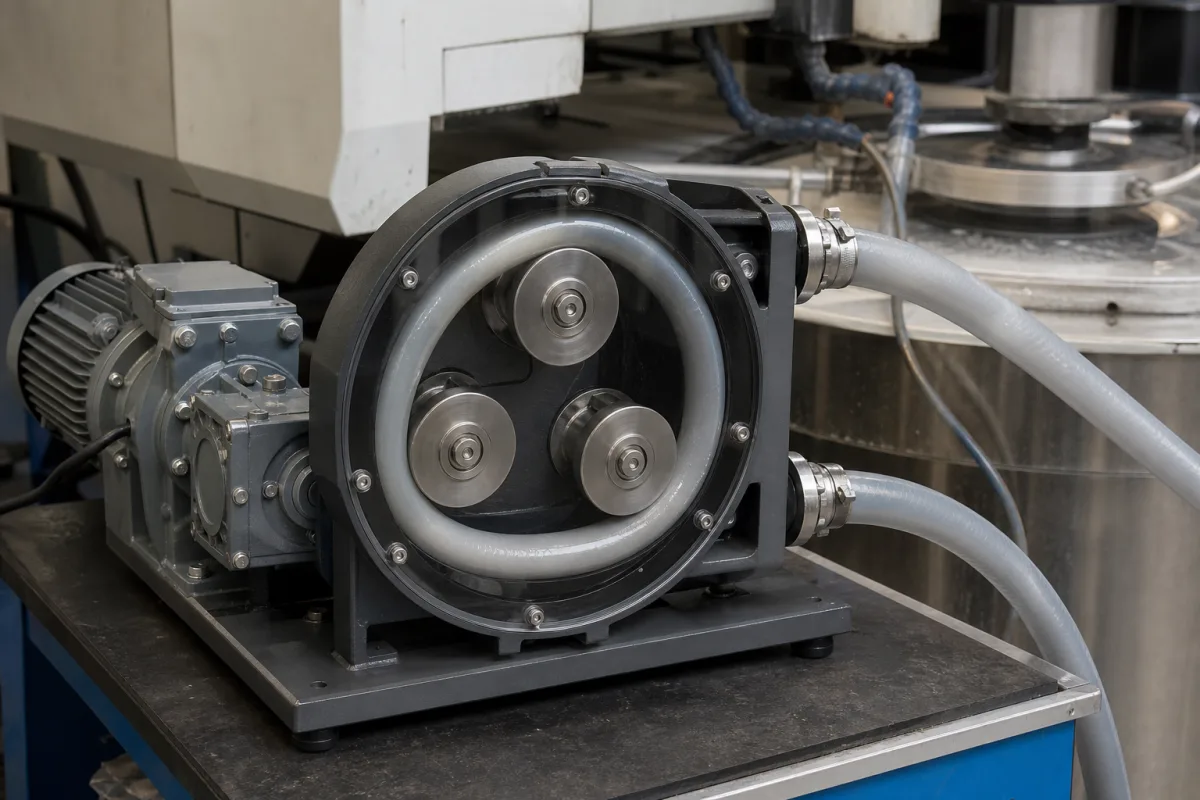
A diaphragm pump uses a flexible diaphragm actuated by a reciprocating mechanism to create a pumping action, isolating the abrasive fluid from the drive components. A peristaltic pump uses rotating rollers to compress a flexible tube, creating a moving occlusion that pushes the fluid forward, with the tube acting as both the fluid path and the wear part.
Common Materials
Stainless Steel (housing), PTFE/ETFE (diaphragm), Reinforced Rubber/Silicone (tube for peristaltic)
Technical Parameters
  • Flow rate capacity for abrasive slurry (L/min) Standard Spec
Components / BOM
  • Pump Head / Fluid Chamber
    Contains the pumping mechanism (diaphragm assembly or tube) and directs fluid flow.
    Material: Stainless Steel, Ceramic, or engineered plastic
  • Diaphragm (for diaphragm pumps)
    Flexible membrane that displaces fluid on its stroke while isolating it from the drive.
    Material: PTFE, ETFE, or other abrasion-resistant elastomer
  • Tube (for peristaltic pumps)
    Flexible conduit that is compressed by rollers to create flow; the primary wear component.
    Material: Reinforced rubber, silicone, or other abrasion-resistant polymer
  • Drive Mechanism / Actuator
    Provides the mechanical motion (reciprocating or rotary) to operate the pump.
    Material: Stainless Steel, Aluminum
  • Valves (for diaphragm pumps)
    Check valves (inlet and outlet) that ensure one-way flow of the abrasive slurry.
    Material: Ceramic, hardened steel, or engineered plastic
Engineering Reasoning
0.1-6.0 bar differential pressure, 0.5-100 L/min flow rate
Diaphragm: 10^7 cycles at 2.0 bar, Peristaltic: 2000 hours at 80°C with 40% silica slurry
Design Rationale: Diaphragm: High-cycle fatigue failure at stress concentration points exceeding 35 MPa. Peristaltic: Abrasive wear reducing tube wall thickness below 1.5 mm, causing rupture at operating pressure.
Risk Mitigation (FMEA)
Trigger Abrasive particle size >100 μm at 25% concentration by volume
Mode: Accelerated wear rate exceeding 0.1 mm/hour on wetted components
Strategy: Install 50 μm in-line filtration with differential pressure monitoring at 0.5 bar threshold
Trigger Pulsation frequency resonance at 15-25 Hz matching system natural frequency
Mode: Structural fatigue cracking at pump housing weld joints
Strategy: Implement pulsation dampener with 0.5 L accumulator volume and isolation mounting

Industry Taxonomies & Aliases

Commonly used trade names and technical identifiers for Diaphragm or Peristaltic Pump.

Applied To / Applications

This component is essential for the following industrial systems and equipment:

Industrial Ecosystem & Supply Chain DNA

Complementary Systems
Downstream Applications
Specialized Tooling

Application Fit & Sizing Matrix

Operational Limits
pressure: Up to 8 bar (116 psi)
flow rate: 0.1 to 100 L/min
temperature: -20°C to 80°C
slurry concentration: Up to 60% solids by weight
Media Compatibility
✓ Ceramic slurries with abrasive particles ✓ Chemical polishing compounds ✓ Mining tailings with suspended solids
Unsuitable: High-viscosity fluids (>5000 cP) or media with large particulates (>5 mm)
Sizing Data Required
  • Required flow rate (L/min)
  • Maximum system pressure (bar)
  • Slurry particle size and abrasiveness rating

Reliability & Engineering Risk Analysis

Failure Mode & Root Cause
Diaphragm fatigue cracking
Cause: Cyclic stress from repeated flexing, chemical degradation from incompatible fluids, or excessive pressure differentials exceeding design limits
Valve seat wear or fouling
Cause: Abrasive particles in the fluid, chemical attack on valve materials, or buildup of solids/precipitates preventing proper sealing
Maintenance Indicators
  • Irregular or pulsating flow output despite constant operating conditions
  • Unusual knocking or clicking sounds from the pump head during operation
Engineering Tips
  • Implement condition-based monitoring with pressure transducers and flow meters to detect performance degradation before catastrophic failure
  • Establish preventive maintenance schedules for diaphragm replacement based on actual runtime hours rather than calendar time, and maintain strict fluid compatibility controls

Compliance & Manufacturing Standards

Reference Standards
ISO 28580:2009 (Diaphragm pumps - Performance tests) ANSI/HI 7.1-7.5 (Rotodynamic pumps for nomenclature, design, application, operation, and test) DIN EN 809 (Pumps and pump units for liquids - Common safety requirements)
Manufacturing Precision
  • Diaphragm thickness: +/-0.05mm
  • Pump housing bore concentricity: 0.03mm TIR
Quality Inspection
  • Hydrostatic pressure test (1.5x max operating pressure)
  • Material composition verification via XRF analysis

Factories Producing Diaphragm or Peristaltic Pump

Verified manufacturers with capability to produce this product in China

✓ 94% Supplier Capability Match Found

P Project Engineer from United Arab Emirates Feb 22, 2026
★★★★★
"Impressive build quality. Especially the technical reliability is very stable during long-term operation."
Technical Specifications Verified
S Sourcing Manager from Australia Feb 19, 2026
★★★★★
"As a professional in the Machinery and Equipment Manufacturing sector, I confirm this Diaphragm or Peristaltic Pump meets all ISO standards."
Technical Specifications Verified
P Procurement Specialist from Singapore Feb 16, 2026
★★★★★
"Standard OEM quality for Machinery and Equipment Manufacturing applications. The Diaphragm or Peristaltic Pump arrived with full certification."
Technical Specifications Verified
Verification Protocol

“Feedback is collected from verified sourcing managers during RFQ (Request for Quote) and factory evaluation processes on CNFX. These reports represent historical performance data and technical audit summaries from our B2B manufacturing network.”

15 sourcing managers are analyzing this specification now. Last inquiry for Diaphragm or Peristaltic Pump from Turkey (1h ago).

Supply Chain Compatible Machinery & Devices

Heavy-Duty CNC Plasma Cutting Machine

Industrial machine for precision metal cutting using plasma arc technology

Explore Specs →
Automated Assembly Line System

Integrated production system for sequential component assembly operations

Explore Specs →
Automated Powder Coating System

Integrated industrial system for applying dry powder coatings to metal substrates.

Explore Specs →
Centrifugal Pump Impeller

Rotating component that transfers energy to fluid in centrifugal pumps.

Explore Specs →

Frequently Asked Questions

What materials are best for diaphragm pumps handling abrasive slurries?

For abrasive slurry applications, diaphragm pumps should use PTFE or ETFE diaphragms for chemical resistance and wear durability, paired with stainless steel housings to withstand corrosive and abrasive environments in machinery manufacturing.

How do peristaltic pumps handle abrasive fluids compared to diaphragm pumps?

Peristaltic pumps use reinforced rubber or silicone tubes that contain the abrasive fluid entirely within the tube, preventing contact with pump internals. This makes them ideal for highly abrasive slurries, while diaphragm pumps use valves and diaphragms that may require more maintenance in extreme abrasive conditions.

What maintenance considerations exist for slurry delivery pumps in manufacturing?

Key maintenance includes regular inspection of diaphragms (for wear/tear), tube replacement in peristaltic pumps, valve checks in diaphragm pumps, and monitoring drive mechanisms. Using materials like PTFE, ETFE, and reinforced rubber extends service life in abrasive slurry systems.

Can I contact factories directly on CNFX?

CNFX is an open directory, not a transaction platform. Each factory profile provides direct contact information and production details to help you initiate direct inquiries with Chinese suppliers.

Get Quote for Diaphragm or Peristaltic Pump

Request technical pricing, lead times, or customized specifications for Diaphragm or Peristaltic Pump directly from verified manufacturing units.

Your business information is encrypted and only shared with verified Diaphragm or Peristaltic Pump suppliers.

Thank you! Your message has been sent. We'll respond within 1–3 business days.

Need to Manufacture Diaphragm or Peristaltic Pump?

Connect with verified factories specializing in this product category

Add Your Factory Contact Us
Previous Product
Diaphragm Head
Next Product
Diaphragm Pump