Editorial Technical Reference

Abrasive Slurry Delivery System

This page explains how Abrasive Slurry Delivery System is classified within Computer, Electronic and Optical Product Manufacturing. Technical values and manufacturer relationships are research references; confirm the current specification and supplier evidence for each order.

Technical Definition & Core Assembly

A subsystem responsible for the controlled delivery and distribution of abrasive slurry to the polishing interface in a precision optical lens polishing machine.
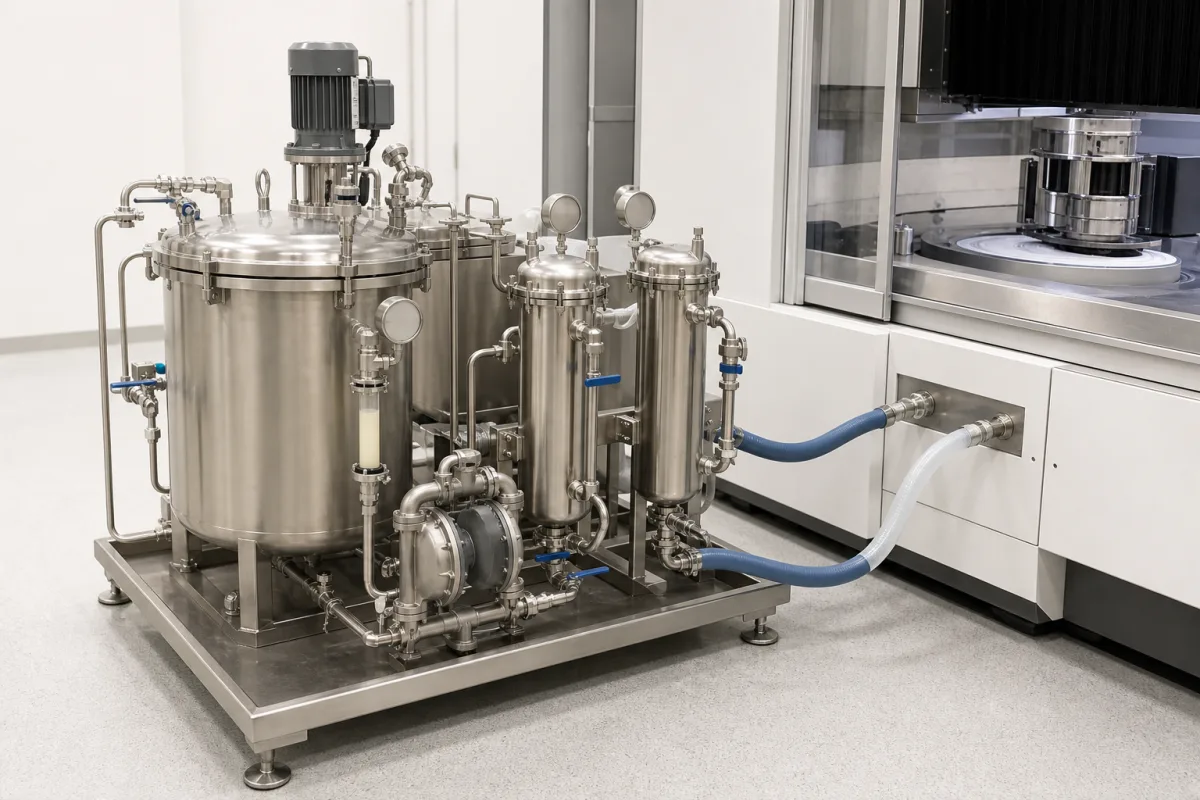
Representative product image. Confirm appearance and specifications with the manufacturer.

Product Specifications

Technical details and manufacturing context for Abrasive Slurry Delivery System

Definition
The Abrasive Slurry Delivery System is a critical component of a Precision Optical Lens Polishing Machine. Its primary function is to precisely meter, transport, and uniformly distribute a suspension of fine abrasive particles (the slurry) to the contact point between the polishing tool (e.g., a polishing pad) and the optical lens substrate. This ensures consistent material removal, surface finish quality, and process control during the precision polishing operation. The system typically comprises a slurry reservoir, a pump or pressurized delivery mechanism, flow control valves, and distribution nozzles or manifolds. The abrasive slurry is drawn from the reservoir and propelled through the delivery lines. Flow rate and pressure are precisely regulated to maintain a consistent supply of fresh abrasive to the polishing zone. The slurry is then dispensed onto the polishing pad or directly at the lens interface, where the abrasive particles facilitate the micro-cutting and smoothing of the lens surface. The system is designed for integration into industrial polishing machines, with wetted parts made of corrosion-resistant stainless steel (grade 316L) and chemical-resistant polymers such as PTFE or PVC. It handles slurry particle sizes from 0.05 to 10 μm, operates within a temperature range of 10–40 °C, and delivers flow rates of 0.5–5 L/min at pressures of 0.2–0.6 MPa. Electrical requirements include a supply voltage of 220–380 V AC (IEC 60038) and power consumption of 0.5–1.5 kW. The system offers ingress protection ratings of IP54–IP65 (IEC 60529) and weighs between 50 and 150 kg, with dimensions ranging from 600×400×500 to 800×600×700 mm. These values are reference ranges; actual specifications must be confirmed with the legal manufacturer or supplier for the specific model and application. The system is not a standalone product but a component intended for use in precision optical lens polishing machines.
Working Principle
The system operates by drawing abrasive slurry from a reservoir via a pump or pressurized mechanism. Flow control valves regulate the flow rate and pressure, ensuring a consistent supply to the polishing zone. The slurry is then distributed through nozzles or manifolds onto the polishing pad or directly at the lens interface. The abrasive particles in the slurry perform micro-cutting and smoothing of the lens surface. The system maintains uniform distribution to achieve consistent material removal and surface finish.
Common Materials
Stainless Steel (for wetted parts and tubing), Chemical-resistant polymers (e.g., PTFE, PVC for seals and lines), Abrasive particles (e.g., cerium oxide, aluminum oxide, diamond)
Technical Parameters
ParameterTypical rangeNotes & selection driver
Delivery Flow Rate0.5–5 L/minAdjustable to match polishing pad size
Operating Pressure0.2–0.6 MPaBelow 0.2 MPa may cause inconsistent slurry distribution
Slurry Particle Size Compatibility0.05–10 μmLarger particles may clog the system
Temperature Range10–40 °COutside range may affect slurry viscosity
Electrical Power0.5–1.5 kWFor pump and control system
Supply Voltage220–380 V ACThree-phase for industrial useIEC 60038
Ingress ProtectionIP54–IP65Protects against dust and water jetsIEC 60529
Material of Wetted Parts316LCorrosion-resistant stainless steelASTM A240
Weight50–150 kgDepends on pump configuration
Dimensions (L×W×H)600×400×500–800×600×700 mmCompact design for integration

Ranges are indicative industry figures for RFQ preparation, not a supplier commitment. Confirm every value and standard with the legal manufacturer before ordering.

Components / BOM
  • Slurry Reservoir/Tank
    Stores and often agitates the abrasive slurry mixture to prevent particle settling.
    Material: Stainless steel or chemical-resistant plastic
  • Diaphragm or Peristaltic Pump
    Provides controlled, pulseless flow of the abrasive slurry from the tank to the delivery lines.
    Material: Stainless steel, PTFE, chemical-resistant elastomers
  • Flow Control Valve
    Precisely regulates the slurry flow rate to the polishing interface.
    Material: Stainless steel, ceramic
  • Distribution Manifold/Nozzle
    Evenly distributes the slurry across the polishing pad or directs it to specific points on the lens.
    Material: Stainless steel, aluminum
  • Delivery Tubing/Lines Part
    Transports the slurry from the pump to the distribution point.
    Material: Chemical-resistant tubing (e.g., PTFE, PVC)

Industrial Ecosystem & Supply Chain Structure

Complementary Systems
Downstream Applications
Specialized Tooling

Application Fit & Sizing Matrix

Operational Limits
pressure: 0.1 to 0.5 MPa (1 to 5 bar) delivery pressure, 0.05 MPa (0.5 bar) minimum backpressure
flow rate: 10 to 500 mL/min (adjustable per polishing head)
temperature: 5°C to 40°C (operating), 0°C to 50°C (storage)
slurry concentration: 5% to 40% abrasive solids by weight, particle size 0.1 to 10 μm
Media Compatibility
✓ Cerium oxide-based polishing slurries ✓ Alumina-based abrasive suspensions ✓ Diamond particle slurries in glycol/water carriers
Unsuitable: Highly acidic (pH < 2) or caustic (pH > 12) chemical environments
Sizing Data Required
  • Required total slurry flow rate (mL/min) across all polishing heads
  • Number of independent polishing zones requiring separate slurry delivery
  • Maximum allowable slurry particle size and viscosity range

Reliability & Engineering Risk Analysis

Failure Mode & Root Cause
Abrasive erosion
Cause: High-velocity slurry particles wearing down internal surfaces, especially at bends, valves, and pump impellers, due to inadequate material hardness or flow velocity exceeding design limits.
Cavitation
Cause: Localized pressure drops below vapor pressure in pumps or restrictions, forming and collapsing vapor bubbles that cause pitting and vibration, often from improper pump NPSH margins or blockages.
Maintenance Indicators
  • Audible high-frequency vibration or 'crackling' noises from pumps/pipes indicating cavitation or particle impingement
  • Visible external slurry leakage at joints or seals, or abnormal pressure gauge fluctuations suggesting internal wear or blockages
Engineering Tips
  • Specify wear-resistant materials (e.g., hardened alloys, ceramic liners, or polyurethane) for high-wear components and design gradual pipe bends to reduce particle impact angles
  • Implement real-time monitoring of pressure, flow, and vibration with automated alerts for deviations, and establish routine flushing procedures to prevent sediment buildup

Indicative industry ranges for design and RFQ preparation. Confirm the exact figures and applicable standard with the manufacturer before specifying.

Compliance & Manufacturing Standards

Applicable Standards
ANSI B74.3 - Specifications for abrasive grains CE Marking - Machinery Directive 2006/42/EC

Quoted from the published standard.

Manufacturing Precision
  • Pump flow rate: +/- 2% of rated capacity
  • Nozzle orifice diameter: +/- 0.05mm
Quality Inspection
  • Pressure decay leak test
  • Particle size distribution analysis of abrasive media

Manufacturers of Abrasive Slurry Delivery System

Manufacturer profiles associated with Abrasive Slurry Delivery System.

Sourcing Abrasive Slurry Delivery System from China?
Tell us your specification and target quantity — we will match it against manufacturer records and come back with the factories that fit.
Request manufacturers We manufacture this

Manufacturer listings support early research and capability understanding. They are not certification, ranking, or transaction guarantees.

Technical documentation
Request current drawings, revision history, and a signed specification sheet.
Manufacturing capability
Verify equipment lists, process limits, capacity, and representative production evidence.
Inspection readiness
Confirm test methods, calibrated equipment, sampling plans, and traceable reports.
Supplier transparency
Check the legal entity, factory address, ownership, certifications, and direct contacts.

CNFX does not score or rank suppliers. Buyers must verify all claims and documents with the legal manufacturer before ordering.

Supply Chain Compatible Machinery & Devices

Industrial IoT Gateway

The Industrial IoT Gateway is a ruggedized edge computing device designed for industrial environments.

Explore Specs →
Modular Industrial Edge Computing Device

This modular industrial edge computing device is a ruggedized system designed for deployment in harsh industrial environments to perform real-time data processing, analytics, and control functions at the network edge.

Explore Specs →
Industrial Smart Camera Module

The Industrial Smart Camera Module is a compact, self-contained vision processing unit designed for integration into industrial machinery and production lines.

Explore Specs →
Surface Mount Resistor

Passive electronic component for current limiting and voltage division in circuits

Explore Specs →

Frequently Asked Questions

What is the function of the Abrasive Slurry Delivery System?

It precisely meters, transports, and uniformly distributes abrasive slurry to the polishing interface, ensuring consistent material removal and surface finish during precision optical lens polishing.

What are the typical operating parameters?

Reference ranges include flow rate 0.5–5 L/min, pressure 0.2–0.6 MPa, particle size compatibility 0.05–10 μm, temperature 10–40 °C, and power 0.5–1.5 kW. Confirm exact values with the manufacturer.

What materials are used for wetted parts?

Wetted parts are made of stainless steel grade 316L (ASTM A240) and chemical-resistant polymers like PTFE or PVC, ensuring corrosion resistance and chemical compatibility.

What standards apply to this system?

Relevant standards include IEC 60038 for voltage, IEC 60529 for ingress protection, and ASTM A240 for material. These are references for verification, not certification.

Data Basis

Editorial classification, named public sources where available, and source-reviewed manufacturer records.

Preliminary Technical Classification
This page supports structured research, RFQ preparation, and supplier evaluation. It does not replace buyer-led supplier qualification, standards review, or technical approval.
Buyer enquiry

Request manufacturing insight for Abrasive Slurry Delivery System

Ask for use case, specification boundaries, supplier type, and RFQ preparation information for this product.

Where it goes
Straight to the CNFX editorial desk, and to the manufacturer if this product is linked to a claimed profile. Nothing is broadcast to a supplier list.
Your details stay here
We do not sell or rent enquiry data, and we do not add you to a mailing list. Used only to answer this request.
No commission, no middleman
CNFX is a directory. We take no cut of any order and never negotiate on a supplier's behalf.
What we don't claim
A listing is not an endorsement. Qualify every supplier and verify every figure yourself before ordering.

Your business information is used only to process this request.

Thank you! Your message has been sent. We'll respond within 1–3 business days.
Sorry, we couldn't send your message. Please try again, or email us at contact@cnfx.com.

Need to Manufacture Abrasive Slurry Delivery System?

Compare manufacturer profiles with relevant product and process capability.

Previous Product
3D Pattern Scanner
Next Product
Access Controller
Get QuotesChat