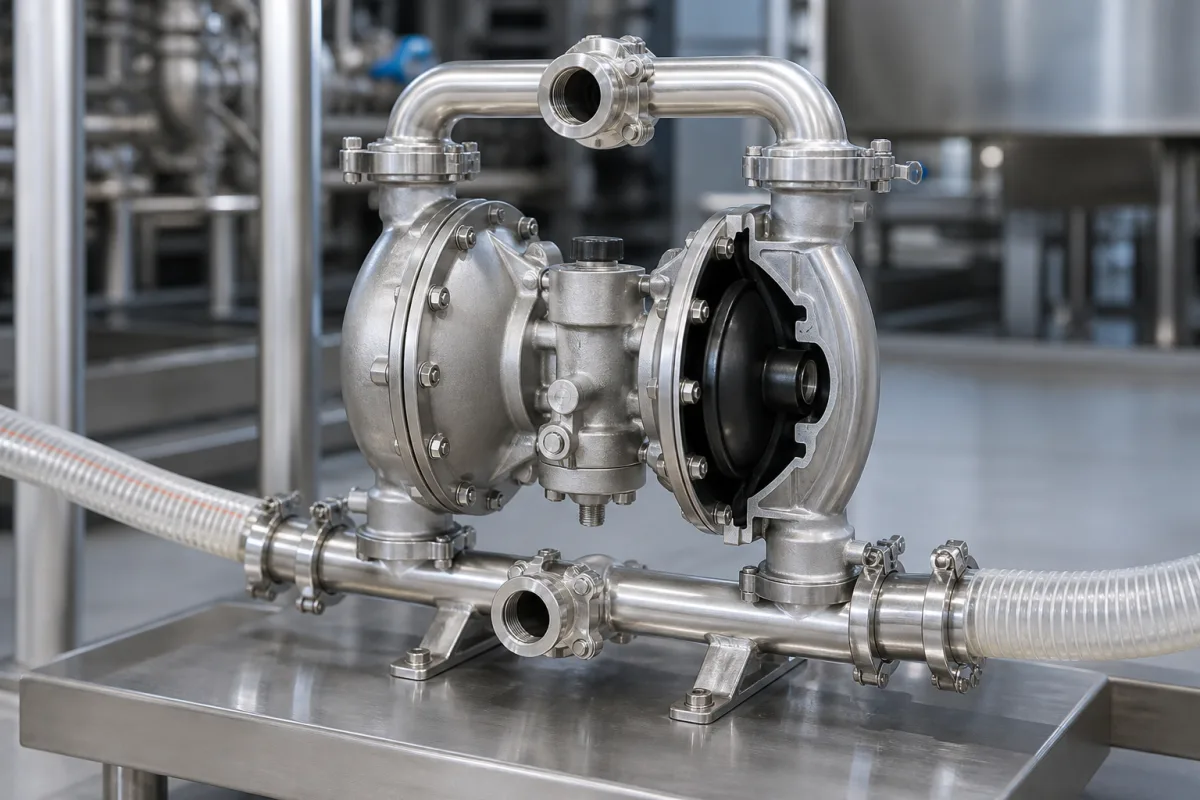
Fluid transfer · Air supply, diaphragm material and pulsation
A diaphragm pump has no seal or impeller in the fluid, so it is used for slurries, solvents and difficult fluids and can prime from a dry suction line. What it does need is compressed air: size it from the maker's curve, choose a diaphragm that survives both the chemistry and the flexing, and add a dampener where downstream equipment cannot take the pulses.
Air-operated double diaphragm pumps in metal and plastic, sanitary and high-pressure versions, and electric diaphragm pumps for transfer. Metering pumps for dosing are outside this page.
CNFX editorial research · Sources checked October 12, 2026 · 11 sources
Size the pump from flow, head and the air it needs
Yamada, an AODD pump maker, sizes a pump from two numbers, the required flow and the total dynamic head, plotted on the model's performance curve. In its example, an NDP-40 pump with rubber diaphragms delivering 80 US gal/min at 50 ft of head needs about 75 psi air inlet pressure and about 80 SCFM of air. [1]
As an editorial unit conversion of that example only: about 300 L/min at about 15 m head needs about 5.2 bar air pressure and about 2.3 m³/min of free air. The compressor and air line must deliver that volume at that pressure, or the pump will not reach the duty.
Yamada's 2:1 high-pressure pumps apply air to both diaphragms while using one liquid chamber, producing up to twice the air pressure at discharge, for example up to 200 psi from 100 psi air. Ask the supplier for the pressure ratio of the model offered and size the air supply from its curve. [3]
Give the supplier the fluid, its viscosity and solids, flow, discharge head, suction conditions and the air pressure and volume available on site. Ask which fluid the performance curve was drawn for, and for corrections for viscous fluids.
02
Choose the diaphragm for chemistry and duty
Yamada stresses that the diaphragm is a moving part that flexes every cycle, so the material must survive the fluid and also the cycling rate, suction conditions, positive inlet pressure, temperature, abrasives and assembly loads. PTFE resists a very broad range of chemicals, with a general range of 40 to 212 °F (about 4 to 100 °C) on Yamada's terminology page, but is not automatically the best choice. [6]
Ask the supplier which diaphragm and ball-valve materials are recommended for your fluid and duty, what service life to expect at your cycle rate, and whether a backup diaphragm or leak detection is available for hazardous fluids.
03
Plan suction, dry running and pulsation
Yamada describes its double diaphragm pumps as self-priming, able to evacuate air from the suction line and work with dry lift, submerged or flooded suction, with dry suction lift up to 20 ft (about 6 m) depending on model. [5]
Because the pump discharges in alternating strokes, its flow pulses. Yamada explains that a pulsation dampener absorbs pressure spikes and fills pressure drops in the discharge line, protecting piping, valves, filters, meters and spray equipment. [4]
Ask the supplier for the suction lift of the model with your fluid, whether a dampener and filter-regulator are needed, and for ATEX or other certification if the pump will work in a hazardous area.
04
Air-operated, electric, sanitary and micro diaphragm pumps listed by the linked makers
GIM Fluid lists AODD diaphragm pumps among its industrial pumps. [9]
Godo lists air-operated and electric diaphragm pumps; Qeehua lists diaphragm pumps alongside chemical and magnetic pumps; J&O lists pneumatic diaphragm pumps among sanitary equipment; Kamoer lists micro diaphragm pumps. [7][8][10][11]
05
Diaphragms, chambers, check valves, air valve, drive and pulsation dampener
Two rows decide whether a quoted pump fits the duty: the diaphragm material, which Yamada says must survive both the fluid and every flexing cycle, and the drive, which for an air pump means the air pressure and volume read from the curve. [6][1]
Part
Role
Fix in the order
Diaphragms
Flex to draw in and push out fluid; material sets chemical and fatigue life. [2][6]
Flow at head, discharge pressure, suction lift, temperature and diaphragm material for a pump order
Flow, operating pressure and the air demand all come from one duty point on the model's curve; the 2:1 discharge limit and the dry lift of up to about 6 m are Yamada figures, while viscosity, particle size, voltage, IP rating and weight have no published value here.
12 companies list this product among what they make. Company figures are quoted from each
company's own website; every card states where the relationship came from.
Explore company information and manufacturing capabilities, then discuss the scope of your project with a relevant supplier.
Share this page
Compiled and source-reviewed by the CNFX editorial team.
Each manufacturer above links to the page on that company's own website where the product is listed, with the date we checked it. How we source and review
· Page last updated 13 October 2026
Buyer questions
How do I size an air-operated diaphragm pump?
Yamada plots the required flow and total head on the model's curve to read the air pressure and air volume needed; in its example 80 US gal/min at 50 ft needs about 75 psi and 80 SCFM. [1]
Is PTFE always the best diaphragm?
No. Yamada calls PTFE "one of the most chemically resistant diaphragm materials available", but the diaphragm also flexes every cycle, so cycle rate, suction, temperature and abrasives must be considered. [6]
Can a diaphragm pump run dry and self-prime?
Yamada describes its double diaphragm pumps as self-priming, with dry suction lift up to about 20 ft depending on model. [5]
Sources and what still needs a direct check
Sources checked 2026-10-12. Yamada America is an AODD pump manufacturer; its learning-centre pages were read in the browser and its figures apply to its models. Supplier pages describe their own offers. ATEX and other certification standards were not read for this page.