Circuit breaker spring operating mechanisms · Stored-energy cycle and recharge time, opening and closing times, coil and motor supply, endurance and service intervals
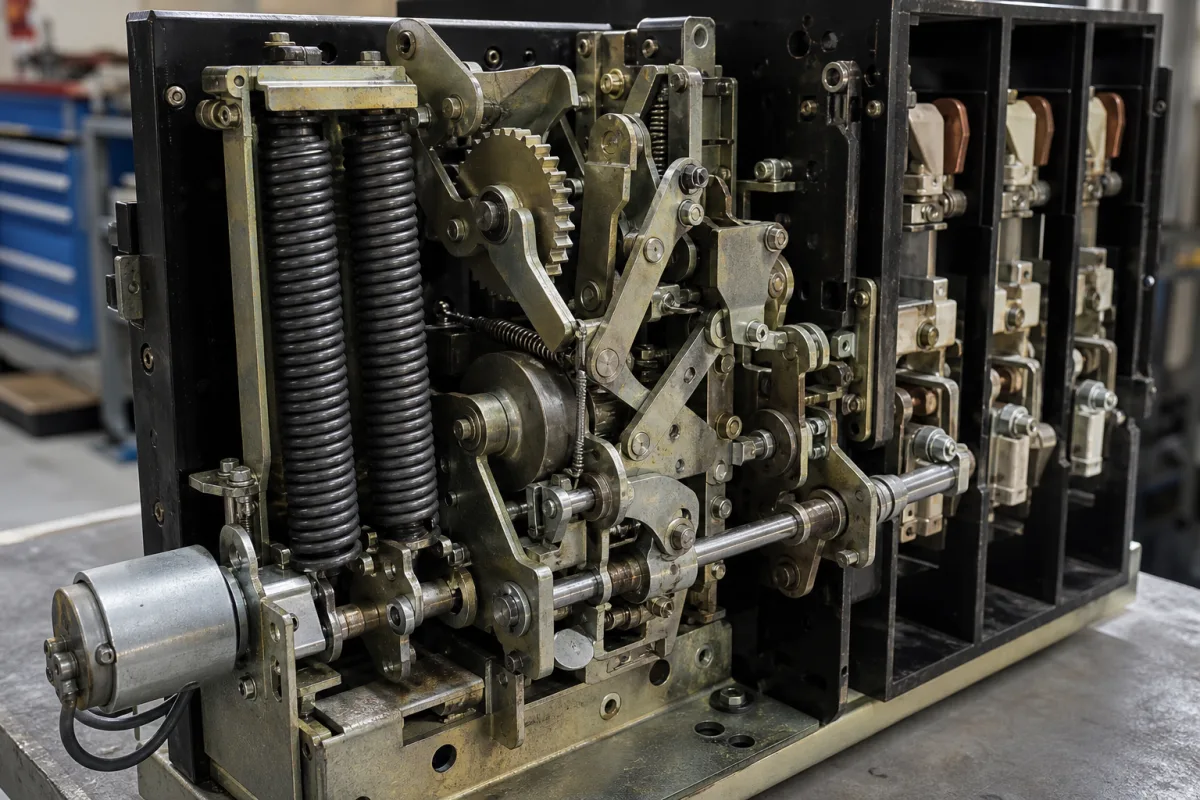
A spring operating mechanism opens and closes a circuit breaker's contacts using energy stored in springs: a motor (or hand crank) charges a closing spring, a close coil releases it to close the contacts while charging the opening springs, and a trip coil releases those to open them, like the motor-charged mechanism pictured beside its three-pole contact assembly. Ask three things first: what opening, closing and recharge times the mechanism achieves, what control voltage and current its coils and motor need, and how many operations it is rated for and how often it must be serviced.
Stored-energy spring operating mechanisms for medium-voltage vacuum and SF6 circuit breakers, load break switches and ring main units, supplied with the breaker or as replacement assemblies. Magnetic actuators, pneumatic and hydraulic mechanisms for high-voltage breakers, and low-voltage moulded-case breaker mechanisms are outside this page.
CNFX editorial research · Sources checked October 12, 2026 · 4 sources
GE's instruction book for the PowerVac ML-18/18H mechanism describes a stored-energy design in which a gearmotor charges a closing spring; on closing, that energy closes the vacuum interrupter contacts, compresses the wipe springs and charges the opening spring, whose energy then opens the contacts. It gives nominal times of 25–30 ms from trip signal to contact parting for 3-cycle breakers (32–45 ms for 5-cycle), 35–75 ms from close signal to contact closing, 2 ms maximum pole spread and an instantaneous re-close time of 85–150 ms. [2]
ABB's technical guide for its Vmax/A breaker states total interrupting time (opening time plus arc interruption) of 50 ms or less for 3-cycle breakers and 83 ms or less for 5-cycle breakers, and a spring charging motor run time of 6–7 seconds. [1]
Editorial calculation: at 60 Hz one cycle is about 16.7 ms, so 3 cycles is 50 ms and 5 cycles about 83 ms, matching ABB's figures. With a 6–7 s motor run time, a mechanism that has just closed cannot close again until its spring is recharged, so check the duty cycle and reclosing sequence you need against the recharge time. [1]
Give the supplier the breaker type and rating (voltage, current, short-circuit current), required operating sequence and reclosing, opening and closing times, control voltage (AC or DC) for coils and motor, second trip coil or undervoltage release, auxiliary contacts, interlocks, mechanical endurance class, ambient conditions and the service interval you can support.
02
Relate spring stiffness to opening and closing time
A 2025 open-access study in Scientific Reports models the mechanism of a manufactured spring-actuated vacuum circuit breaker as linked three-bar and four-bar sub-mechanisms and derives its timing from work-energy equations. The springs that set operating time in its case study are a tension spring and two compression springs coupled in parallel, measured on a uniaxial testing machine at 18,248 N/m and 24,637 N/m for the double compression springs and 6,364 N/m for the tension spring. The analysis gives an opening time of 39.9 ms and a closing time of 60.5 ms. [4]
The authors compare these results with earlier work and write that "in most cases, the closing time is less than 100 ms, while the opening time is less than 60 ms". They note that link angular velocities change rapidly after about 30 ms of the closing stroke, and that differences between studies arise from mechanism type (spring, hydraulic or pneumatic), spring preload and stiffness, and from friction and clearances in experimental measurements. [4]
Editorial calculation: the modelled 39.9 ms opening time sits inside GE's 32–45 ms band for 5-cycle breakers but above its 25–30 ms band for 3-cycle breakers, [2] and the 60.5 ms closing time sits inside GE's 35–75 ms close-signal-to-contact band. When a replacement mechanism or spring set is quoted, ask for measured timing against the breaker's own published bands rather than a generic figure. [4]
ABB's Vmax/A guide lists, for a 125 V DC control supply, trip coils drawing 2.0 A for 100 ms then 50 mA hold, a closing coil 2.0 A for 150 ms, an undervoltage release operating in 30 ms, and a spring charging motor drawing 5.0 A inrush for 0.2 s and 2.0 A running for 6–7 s (breakers up to 40 kA); at 24 V DC the motor runs at 8.37 A. Operating ranges at 125 V DC are 70–140 V for trip coils and 100–140 V for the closing coil and motor. [1]
The guide notes the EL mechanism has a mechanical anti-pump device so it does not rely on electrical anti-pumping, quick-change trip and close coils and charge motor, and can be replaced as a unit in under an hour. GE describes manual charging when control power is lost, a mechanically trip-free linkage at any point in the closing stroke, and an anti-pump feature in the control circuit. [1][2]
Editorial calculation: at 125 V DC a running charging motor drawing 2.0 A takes about 250 W, and a trip coil launch of 2.0 A about 250 W for 100 ms; size the station battery and control wiring for the motor inrush and simultaneous operations on two or more breakers.
WEG's VBWB vacuum breaker brochure lists the geared motor that charges the closing spring by control voltage: 24 V DC at 6.5 A, 100–130 V AC/DC at 1.4 A and 200–250 V AC/DC at 0.7 A, each rated 40 W (40 VA on AC), 8 rpm, 50 N·m, a charging time of 6–7 s, short-time duty S2 of 1 minute and operation from 85% to 110% of rated voltage. [3]
04
Check mechanical endurance and service intervals
ABB rates the Vmax/A mechanism for 10,000 no-load mechanical operations at both 5 kV and 15 kV, with 2,000 operations between servicing. [1]
GE's instruction book says maintenance frequency depends on service conditions; in mild service the interval may be extended to 10 years or 10,000 no-load or 5,000 normal-load operations. Mild conditions exclude salt spray, condensation, conductive or abrasive dust, damaging chemicals, vibration or shock, relative humidity of 90% and temperatures below −30 °C or above +40 °C. It also gives nominal opening and closing contact speeds and describes lubrication, slow-closing checks and wipe and gap adjustments. [2]
For its 24 kV, 21 kA withdrawable breaker WEG gives mechanical class M2 with 10,000 no-load operations, electrical class E2 and capacitive class C2 to the IEC classes, a rated operating sequence O – 0.3 s – CO – 15 s – CO, opening time of 60 ms or less, closing time of 70 ms or less, arcing time of 10–15 ms and total breaking time of 75 ms or less, at −5 to +40 °C and 90 kg. [3]
Editorial calculation: the O – 0.3 s – CO – 15 s – CO sequence needs the closing spring recharged within the 15 s gap; with WEG's 6–7 s charging time that leaves about 8 s of margin, while a mechanism that takes longer than 15 s to recharge could not meet the sequence. [3]
05
Compare what suppliers offer
Suppliers linked to this page list operating mechanisms; each card links to the page reviewed.
Listings include VS1-type spring operating mechanisms for indoor vacuum circuit breakers and operating mechanisms for SF6 load break switches. Ask each supplier for the breaker models the mechanism fits, timing test results, coil and motor data at your control voltage, and the mechanical endurance tested.
06
Trace the mechanism parts
This is a functional reference built from the sources cited; it is not one maker's specification.
Fill the specification fields with values for your breaker
An operating mechanism quotation needs values for your breaker and control system. The table explains each field, gives published values where a reviewed source states them, and says what to obtain from the supplier.
Explore company information and manufacturing capabilities, then discuss the scope of your project with a relevant supplier.
Share this page
Compiled and source-reviewed by the CNFX editorial team.
Published product pages show what a company offers, not tested performance. Confirm the legal seller, factory and scope for your order. How we source and review
· Page last updated 13 October 2026
Buyer questions
How long does a breaker spring take to recharge?
ABB lists a charging motor run time of 6–7 seconds for its Vmax/A breaker. [1]
How fast does a vacuum breaker open?
GE's PowerVac manual gives 25–30 ms from trip signal to contact parting for 3-cycle breakers. [2]
How many operations is a spring mechanism rated for?
ABB rates its Vmax/A mechanism for 10,000 no-load operations with servicing every 2,000. [1]
How fast must the spring recharge?
WEG's VBWB motor charges the closing spring in 6–7 s, inside the 15 s gap of its O – 0.3 s – CO – 15 s – CO rated sequence. [3]
How do spring stiffness and timing relate in a vacuum breaker mechanism?
In one 2025 Scientific Reports case study, compression springs of 18,248 and 24,637 N/m and a 6,364 N/m tension spring gave a calculated 39.9 ms opening and 60.5 ms closing time. [4]
Sources and what still needs a direct check
Sources checked 2026-10-12. ABB, GE and WEG are breaker makers; the ABB guide, GE instruction book and WEG brochure give values for their own breakers and mechanisms, and a 2025 Scientific Reports paper gives modelled timing for one spring mechanism.