Structured Manufacturing Data (2026)

Distributed Control Units

Based on aggregated insights from structured factory profiles within the CNFX directory, the standard Distributed Control Units used in the Machinery and Equipment Manufacturing sector typically supports operational capacities ranging from standard industrial configurations to heavy-duty production requirements.

Technical Definition & Core Assembly

A canonical Distributed Control Units is characterized by the integration of Processor Module and I/O Interface. In industrial production environments, manufacturers listed on CNFX commonly emphasize Printed Circuit Board construction to support stable, high-cycle operation across diverse manufacturing scenarios.

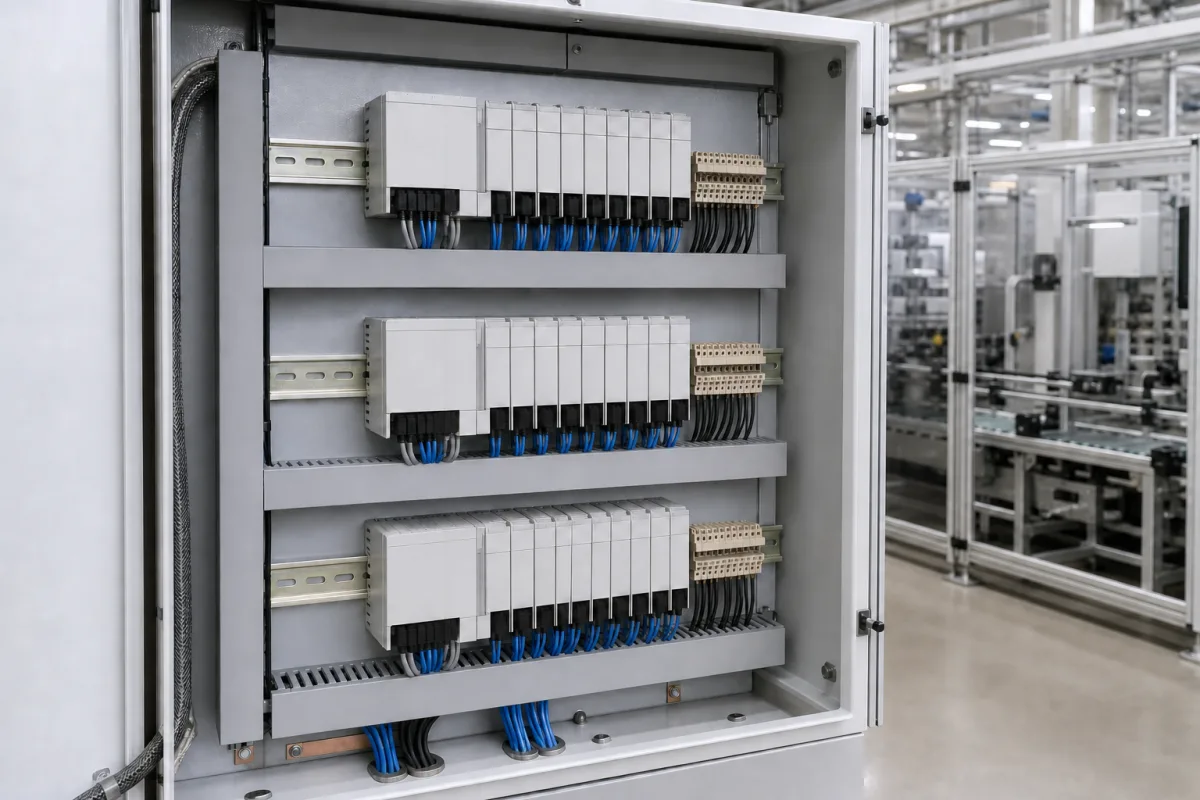
Localized control modules that execute specific automation tasks within a distributed control system.
Product Specifications

Technical details and manufacturing context for Distributed Control Units

Definition
Distributed Control Units are specialized hardware components within a Process Control System that handle localized control functions for specific processes, equipment, or zones. They operate as intelligent nodes in a networked architecture, receiving commands from a central controller and executing real-time control algorithms for sensors, actuators, and other field devices.
Working Principle
These units operate by receiving setpoints and control parameters from a central supervisory system via industrial communication protocols. They process input signals from connected sensors, execute programmed control logic (PID, sequencing, etc.), and output control signals to actuators. They provide localized processing to reduce central controller load and improve system responsiveness.
Common Materials
Printed Circuit Board, Electronic Components, Industrial-grade Enclosure
Technical Parameters
  • Number of I/O channels supported (units) Per Request
Components / BOM
  • Processor Module
    Executes control algorithms and processes I/O data
    Material: Semiconductor components on PCB
  • I/O Interface
    Connects to field devices (sensors, actuators)
    Material: Connectors and interface circuits
  • Communication Module
    Handles network communication with central system
    Material: Network interface components
  • Power Supply Unit
    Provides regulated power to internal components
    Material: Power regulation circuits

Industry Taxonomies & Aliases

Commonly used trade names and technical identifiers for Distributed Control Units.

Applied To / Applications

This component is essential for the following industrial systems and equipment:

Industrial Ecosystem & Supply Chain Structure

Complementary Systems
Downstream Applications
Specialized Tooling

Application Fit & Sizing Matrix

Operational Limits
pressure: 0 to 10 bar
flow rate: 0-1000 L/min
temperature: -20°C to 70°C
slurry concentration: 0-40% solids by weight
Media Compatibility
✓ Water-based fluids ✓ Petroleum-based oils ✓ Compressed air systems
Unsuitable: Highly corrosive chemical environments (e.g., concentrated acids, chlorinated solvents)
Sizing Data Required
  • Process flow rate requirements
  • Control loop complexity (number of I/O points)
  • Communication protocol compatibility (e.g., Modbus, Profibus, Ethernet/IP)

Reliability & Engineering Risk Analysis

Failure Mode & Root Cause
Communication failure
Cause: Network interface degradation due to electromagnetic interference, connector corrosion, or protocol mismatches from firmware updates
Power supply instability
Cause: Voltage fluctuations, capacitor aging, or thermal stress from inadequate ventilation causing component degradation
Maintenance Indicators
  • Intermittent loss of communication with field devices or control network
  • Unusual audible buzzing from power supply components or visible overheating indicators
Engineering Tips
  • Implement regular network diagnostics and shielded cabling with proper grounding to minimize electromagnetic interference
  • Maintain stable environmental conditions with adequate cooling and use uninterruptible power supplies with voltage regulation

Compliance & Manufacturing Standards

Reference Standards
ISO 9001:2015 - Quality management systems IEC 61131-2:2017 - Programmable controllers - Equipment requirements and tests CE Marking - Compliance with EU directives (e.g., EMC Directive 2014/30/EU, Low Voltage Directive 2014/35/EU)
Manufacturing Precision
  • Enclosure IP rating: IP65 minimum for dust/water resistance
  • Electrical contact resistance: < 50 mΩ per connection
Quality Inspection
  • Environmental stress screening (temperature cycling, vibration)
  • Functional safety test (IEC 61508 SIL verification for safety-critical units)

Factories Producing Distributed Control Units

Manufacturer profiles with relevant production capability in China

Manufacturer listings support early research and capability understanding. They are not certification, ranking, or transaction guarantees.

Technical documentation
4/5
Manufacturing capability
4/5
Inspection readiness
5/5
Supplier transparency
3/5

These scores are example evaluation dimensions, not real customer ratings, country-specific buyer feedback, or live inquiry activity.

Supply Chain Compatible Machinery & Devices

Automated Assembly Line System

Integrated production system for sequential component assembly operations

Explore Specs →
Automated Powder Coating System

Integrated industrial system for applying dry powder coatings to metal substrates.

Explore Specs →
Centrifugal Pump Impeller

Rotating component that transfers energy to fluid in centrifugal pumps.

Explore Specs →
High-Precision CNC Laser Cutting Machine

Computer-controlled industrial machine using focused laser beams to cut sheet metal with micron-level accuracy.

Explore Specs →

Frequently Asked Questions

What are the primary applications of Distributed Control Units in machinery manufacturing?

Distributed Control Units execute localized automation tasks in machinery systems, such as controlling specific machine functions, monitoring sensors, and managing I/O operations within distributed control architectures for enhanced precision and reliability.

How do the materials like industrial-grade enclosures improve durability?

Industrial-grade enclosures protect the printed circuit boards and electronic components from harsh environments, including dust, moisture, and temperature fluctuations, ensuring long-term reliability and compliance with machinery manufacturing standards.

What key components are included in the BOM for these control units?

The Bill of Materials includes a Processor Module for task execution, I/O Interface for connectivity, Communication Module for system integration, and Power Supply Unit for stable operation, all designed for seamless performance in distributed control systems.

Can I contact factories directly on CNFX?

CNFX is an open directory, not a transaction platform. Each factory profile provides direct contact information and production details to help you initiate direct inquiries with Chinese suppliers.

Data Basis

CNFX manufacturer profiles, technical classification, publicly available product information, and ongoing plausibility checks.

Preliminary Technical Classification
This page supports structured research, RFQ preparation, and supplier evaluation. It does not replace buyer-led supplier qualification, standards review, or technical approval.

Request Manufacturing Insight for Distributed Control Units

Ask for use case, specification boundaries, supplier type, and RFQ preparation information for Distributed Control Units.

Your business information is used only to process this request.

Thank you! Your message has been sent. We'll respond within 1–3 business days.

Need to Manufacture Distributed Control Units?

Compare manufacturer profiles with relevant product and process capability.

Create Manufacturer Profile Contact Us
Previous Product
Display/Output Module
Next Product
Distribution Chamber