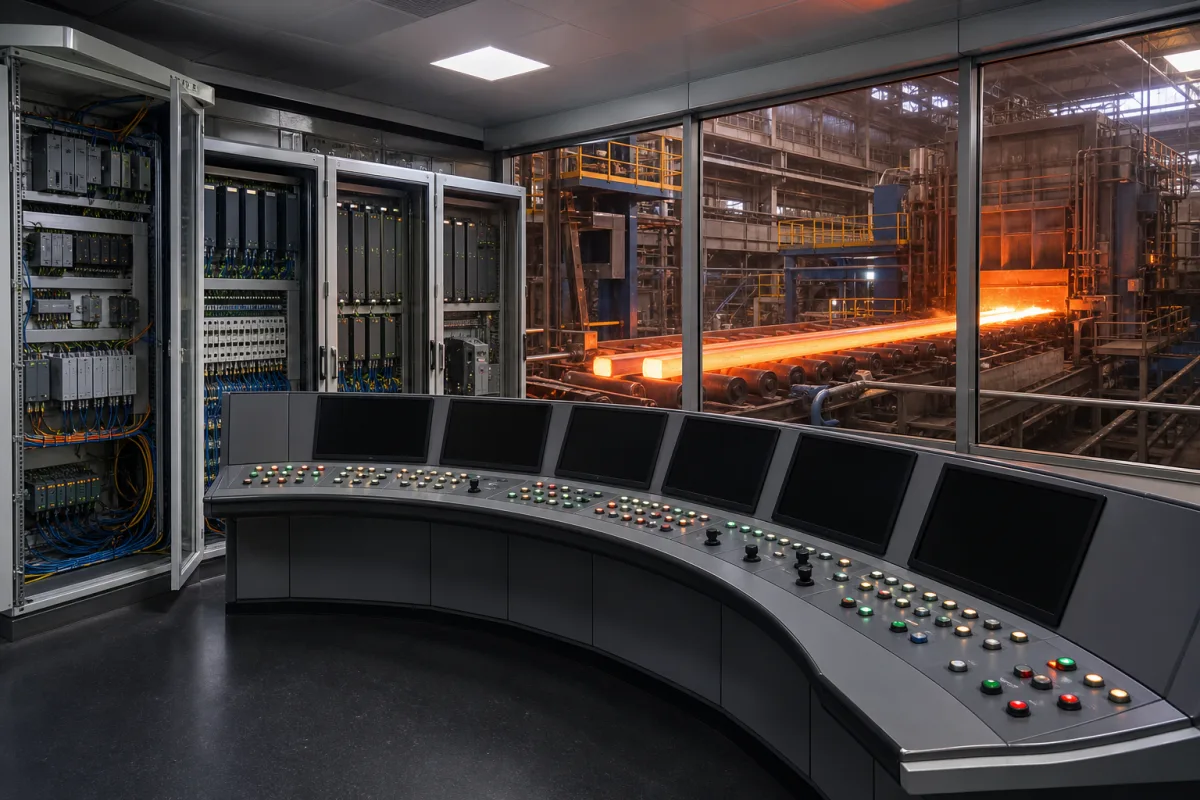
Process control system for electric arc furnace steelmaking: electrode control and Level 2 process models
Steel melt-shop process control · Electrode control, Level 2 energy models, model predictive control and the data a meltshop control system must log
An electric arc furnace process control system is the layer that runs the melt shop above the basic PLCs and drives: an electrode control system that holds the arcs to the set point, and process models (Level 2) that plan power, burner, oxygen and carbon use for each heat and log what happened. Ask three things first: what the electrode control and process models adjust, what saving the supplier claims and on what evidence, and which heat data the system must record.
Electrode control and Level 2 process-model systems for electric arc furnaces and ladle furnaces in steel melt shops, with their supervisory computers, HMIs and data logging. General industrial control systems (PLCs, CPUs, I/O modules and EtherCAT motion) are covered on the Industrial control systems page. Rolling-mill automation, electroplating line controls and electronic components are outside this page.
CNFX editorial research · Sources checked October 12, 2026 · 3 sources
Check what the electrode control and process models adjust
Jawahery and co-authors (Cybernetica, Outokumpu, University of Oulu and BFI) describe a dynamic, first-principles EAF model built for optimisation during operation, formulated as state variables and ordinary differential equations and adapted to process data by recursive parameter estimation. An MPC application based on it has run online on a 140-tonne EAF since August 2020; its optimisation shifts the furnace's nominal power profile over 15 intervals. The paper reviews other MPC schemes that adjust arc power, burner oxygen and natural gas, oxygen and carbon injection, and second-charge mass. [2]
Primetals Technologies describes its Melt Expert electrode control system for EAFs and ladle furnaces as giving dynamic control over melting and helping staff handle scrap fluctuations, with an integrated Foaming Slag Manager, a Dynamic Spray Cooling model and a diagnostics package showing melt diagnostics, electrode consumption and key performance indicators. It reported its 100th installation in August 2024, all within the previous four years. [3]
Editorial note: ask the supplier to list every set point the system writes to Level 1 (transformer tap, electrode impedance or current, burner and lance flows, carbon injection) and which ones the operator can override, because the saving depends on what the models are allowed to move.
Give the supplier the furnace type and size (tonnes per heat, transformer rating), charge practice (baskets, DRI or hot metal), existing Level 1 controls and electrode regulation, burners and injectors, measurements available (temperature, off-gas, weights), the KPIs to be reported, data history required, interfaces to the plant network, and the acceptance test that will prove the claimed saving.
02
Judge the saving claims and the evidence behind them
Kovačič and colleagues at Štore Steel and the University of Ljubljana modelled electric energy use on a 60 t EAF charged with three baskets of 22–30 t, 15–20 t and 6–15 t, each charging taking about three minutes. From 25 parameters across 3,248 consecutive heats in 2018, linear-regression and genetic-programming models predicted consumption with average relative deviations of 3.60% and 3.31%; validated on 278 heats from 2019 with delays below 20 minutes, they estimated that average electric energy use could be reduced by up to 1.04% and 1.16% by addressing maintenance and technological delays. [1]
The 140 t model study reports simulations indicating that industrial MPC derived from its model could save 1–2% of electrical energy. [2] Primetals' release states reduced energy and electrode consumption for Melt Expert users but gives no percentage. [3]
Editorial calculation: a 1% saving on an assumed 400 kWh per tonne is 4 kWh/t; on an assumed 500,000 t a year that is 2 GWh a year. Both inputs are assumed examples, not source figures; ask the supplier for its baseline and measured result on a furnace like yours. Three charges of about three minutes each put roughly 9 minutes of charging into each heat on the 60 t furnace studied. [1][2]
03
Map which layer moves which set point, and what data each needs
In the sources reviewed, the electrode loop acts on the arc, the process sub-models act on slag and cooling, and the energy and MPC models plan power over the heat; each depends on data the plant has to supply.
Layer
What it does in the sources
Data or evidence to ask for
Electrode control (Level 1)
Dynamic control of melting; handles scrap fluctuation. [3]
Explore company information and manufacturing capabilities, then discuss the scope of your project with a relevant supplier.
Share this page
Compiled and source-reviewed by the CNFX editorial team.
Each manufacturer above links to the page on that company's own website where the product is listed, with the date we checked it. How we source and review
· Page last updated 13 October 2026
Buyer questions
How much energy can EAF process control save?
Published studies estimate 1.04–1.16% from cutting delays on a 60 t EAF and 1–2% from model predictive control on a 140 t EAF. [1][2]
What does an electrode control system add?
Primetals describes dynamic control of melting with foaming-slag and spray-cooling models and diagnostics on electrode consumption and KPIs. [3]
How accurate are EAF energy models?
The Štore Steel models predicted electric energy with 3.31–3.60% average relative deviation over 3,248 heats. [1]
Sources and what still needs a direct check
Sources checked 2026-10-12. The two studies are open-access peer-reviewed papers in MDPI journals by plant and research authors; Primetals' release describes its own system.