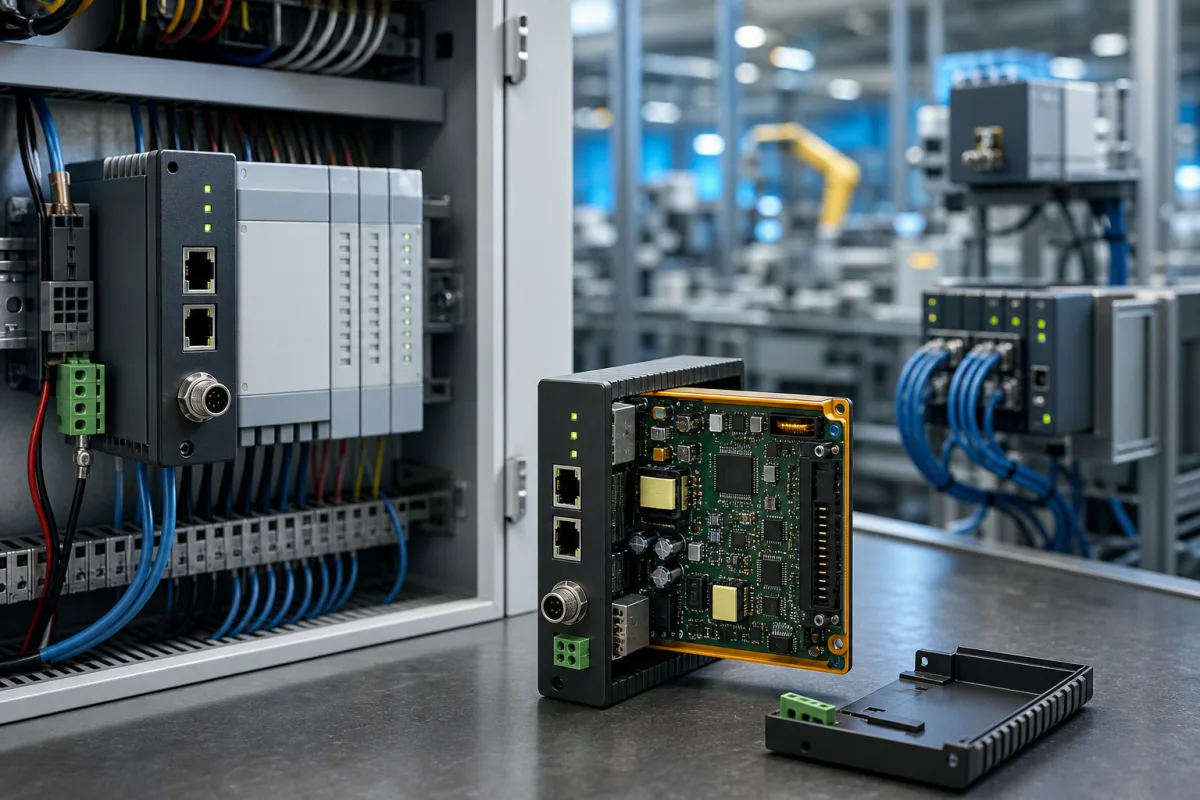
Communication module for wired industrial networks (fieldbus, RS-485, Ethernet-APL)
Wired industrial communication modules · embedded fieldbus and Ethernet-APL protocol modules and DIN-rail or plug-in RS-485 and Ethernet interface modules
A wired communication module is the board or DIN-rail unit that gives a field instrument, meter or controller its network port: an embedded module soldered or plugged into the device that runs a fieldbus protocol stack, or a separate interface module that converts between RS-485, Ethernet and the plant network. Ask three things first: which physical layer and cable length the link must cover, which protocol and version the module implements and whether it is certified, and how the module is powered and isolated.
Wired communication modules for industrial devices: embedded protocol modules (HART, PROFIBUS DP and PA, FOUNDATION Fieldbus, HART-IP over Ethernet-APL) and DIN-rail or plug-in interface modules for RS-485, Ethernet and power-line carrier links in instruments, meters and controllers. Pre-certified radio modules (Wi-Fi, Bluetooth, Zigbee, LoRa, cellular) are covered on the Wireless module (embedded radio module) page. Bare transceiver chips, network switches and complete PLCs are outside this page. Boxes that translate field protocols into IT or cloud traffic and buffer the data are a different purchase, handled on the Industrial IoT gateway page.
CNFX editorial research · Sources checked October 12, 2026 · 3 sources
Size the cable run and node count for the physical layer
TI's RS-485 design guide lists the standard's key features: a balanced, multipoint bus from a single 5 V supply, a –7 V to +12 V bus common-mode range, up to 32 unit loads, a 10 Mbps maximum data rate at 40 feet and a 4,000-foot maximum cable length at 100 kbps. On 22 AWG, 120 Ω twisted pair, cable resistance limits length at about 1,200 m. [1]
TI explains that one unit load is about 12 kΩ; transceivers with 1/8 unit load allow up to 256 on the bus, but failsafe biasing can take up to 20 unit loads, which leaves a maximum of 96 devices with 1/8-UL transceivers. Its rule of thumb keeps line length in metres times data rate in bit/s below 10⁷, which TI calls far more conservative than the cable-performance curve. [1]
Editorial calculation: by that rule of thumb, a 115.2 kbit/s RS-485 link stays below 10⁷ / 115,200 ≈ 87 m, and a 9.6 kbit/s link below about 1,040 m; TI's curve allows longer runs, so ask the module supplier for the length they qualify at your baud rate. [1]
The Ethernet-APL Engineering Guideline (version 1.14, 2022) sets 10 Mbit/s two-wire Ethernet with trunk segments of at most 1,000 m and spurs of at most 200 m for cable category IV; categories I to III allow 250, 500 and 750 m trunks with 50, 100 and 150 m spurs, and only one field device may connect to each spur. [2]
Give the supplier the host device and its processor interface (UART, SPI, I²C), the network and protocol with version, cable type and length, number of nodes, baud rate, supply voltage available, hazardous-area classification, isolation requirement, operating temperature range and the conformance or interoperability test the product must pass.
02
Check the protocol, version and certification the module carries
Microcyber lists embedded modules that convert a device's Modbus data to a fieldbus: Modbus to PROFIBUS DP (DPv0), to PROFIBUS PA (PA 3.02, with AI, AO, DI and DO function blocks), to HART (HART 7.9, 6 device variables and 4 dynamic variables) and to FOUNDATION Fieldbus (ITK 6.5.0, with Link Master and PID blocks). It states its modules help pass FCG and PNO interoperability tests. [3]
Microcyber's MC0312 module acts as Modbus-RTU master toward the host over a TTL UART and as HART-IP slave over Ethernet-APL (10BASE-T1L, IEEE 802.3cg), at 10 Mbps with bus-powered operation and cable lengths up to 1,000 m. It measures 35 mm × 35 mm, uses a 2.0 mm pitch, 28-pin double-row connector shared across its MC series, and provides 3.3 V and 5 V outputs. [3]
03
Match power class and isolation to the network
The Ethernet-APL guideline defines source power classes: given as maximum voltage and minimum output power: class A at 15 V DC and 0.54 W and class C at 15 V DC and 1.1 W for spurs, and class 3 at 50 V DC and 57.5 W for trunks; other combinations of source and load classes are prohibited, and intrinsic safety has to be checked separately. [2]
TI warns that ground potential differences between remote nodes can exceed a receiver's common-mode range, and that the robust way to tolerate such differences over long distances is galvanic isolation of the transceiver's signal and supply lines. [1]
Editorial calculation: a class C spur source delivers at least 1.1 W at up to 15 V DC; a field device module drawing more than that needs a different power arrangement. Check the module's stated consumption against the spur class. [2]
04
Serial interface, embedded fieldbus or APL: choosing the module form
Values come from the cited sources; confirm the figures for the exact part.
Type
Physical layer
Published data
RS-485 interface module
Balanced multidrop pair
32 unit loads; –7 to +12 V common mode; about 1,200 m on 22 AWG. [1]
Two module families are listed: embedded converters from Modbus to HART, PROFIBUS DP and PA, FOUNDATION Fieldbus and HART-IP over Ethernet-APL, and meter modules for Ethernet, Ethernet-to-RS485 and single- or three-phase power-line carrier.
Microcyber Corporation Fieldbus
Manufacturing site to be confirmed for the order
Lists embedded modules converting Modbus to HART, PROFIBUS DP and PA, FOUNDATION Fieldbus and HART-IP over Ethernet-APL, plus gateways and controller ICs.
Lists wired communication modules for meters: Ethernet communication module, Ethernet-to-RS485 converter, single- and three-phase power-line carrier modules and an LMN module.
Explore company information and manufacturing capabilities, then discuss the scope of your project with a relevant supplier.
Share this page
Compiled and source-reviewed by the CNFX editorial team.
Each manufacturer above links to the page on that company's own website where the product is listed, with the date we checked it. How we source and review
· Page last updated 13 October 2026
Buyer questions
How long can an RS-485 link be?
TI's guide gives a 4,000-foot maximum at 100 kbps, with cable resistance limiting 22 AWG, 120 Ω twisted pair at about 1,200 m; higher data rates shorten it. [1]
What cable lengths does Ethernet-APL allow?
The Ethernet-APL guideline allows trunk segments up to 1,000 m and spurs up to 200 m on cable category IV, with shorter limits for categories I to III. [2]
Can a Modbus device be given a fieldbus interface?
Microcyber lists embedded modules that convert Modbus to HART 7.9, PROFIBUS DP or PA 3.02, FOUNDATION Fieldbus (ITK 6.5.0) and HART-IP over Ethernet-APL. [3]
Sources and what still needs a direct check
Sources checked 2026-10-12. TI's design guide summarises the RS-485 standard; the Ethernet-APL guideline is the industry planning document for APL networks; Microcyber is a module maker and its data describe its own products.