Editorial Technical Reference

Drive Motors

This page explains how Drive Motors is classified within Machinery and Equipment Manufacturing. Technical values and manufacturer relationships are research references; confirm the current specification and supplier evidence for each order.

Technical Definition & Core Assembly

Electric motors that provide controlled motion along the X and Y axes in a gantry system.
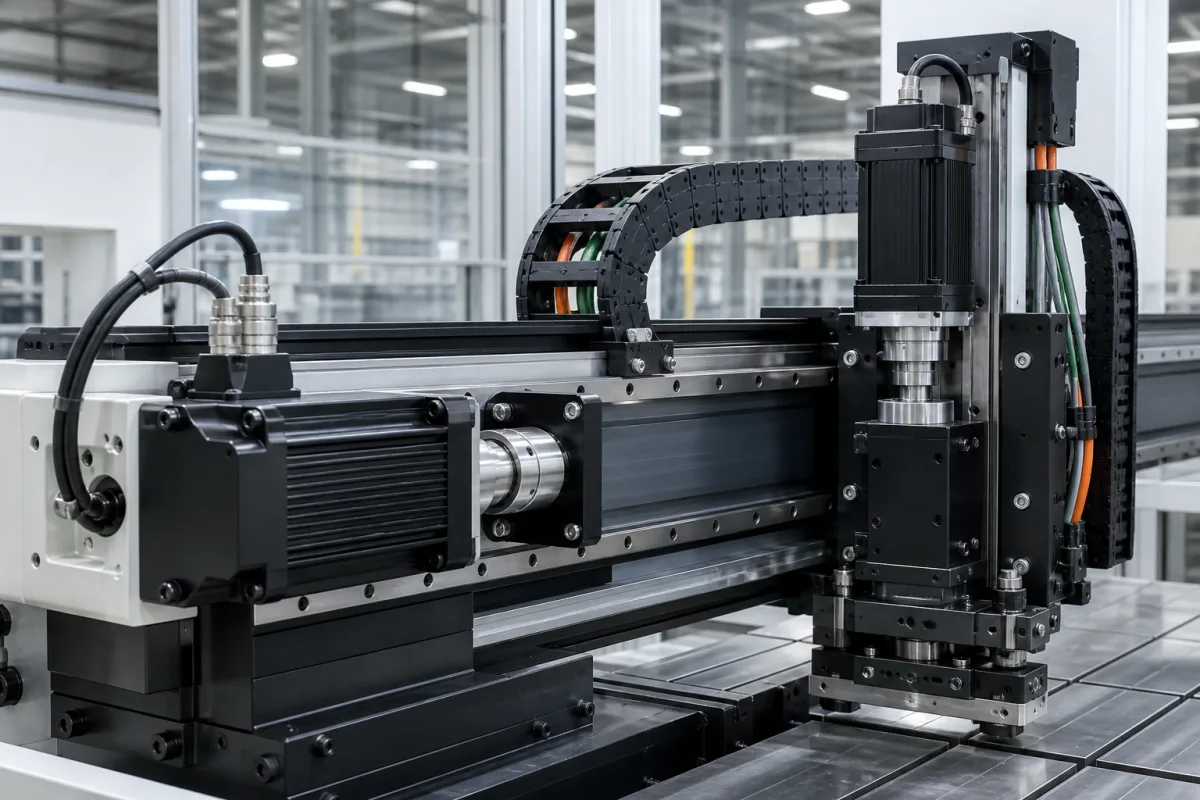
Representative product image. Confirm appearance and specifications with the manufacturer.

Product Specifications

Technical details and manufacturing context for Drive Motors

Definition
Drive motors are precision electric motors that convert electrical energy into mechanical motion to position and move components along the X and Y axes in a gantry system. They work in coordination with controllers and feedback systems to achieve accurate linear positioning for applications such as CNC machining, 3D printing, laser cutting, and automated assembly. These motors are typically servo or stepper types, selected based on the required torque, speed, and precision of the application. The rated torque output, specified in Newton-meters (Nm), is a key parameter that must be matched to the load and acceleration requirements of the gantry. Drive motors are integral to the motion control loop, receiving commands from the controller and providing feedback through encoders or resolvers to ensure precise positioning. They are used in multi-axis systems where coordinated movement along the X and Y axes is essential for tasks like cutting, printing, or assembly. The motors are housed in aluminum enclosures and contain copper windings, steel laminations, and permanent magnets. These components are designed for durability and efficient heat dissipation. When selecting drive motors, engineers must consider the motor's torque rating, inertia, and compatibility with the drive and controller. It is crucial to verify the specific motor model's performance data, such as rated torque, with the manufacturer, as actual values may vary. Additionally, the integration of the motor with mechanical transmission elements like ball screws or belts affects the overall system accuracy and repeatability. Proper installation, alignment, and maintenance are essential to ensure long-term reliability. Regular inspection for wear, overheating, or unusual noise can indicate potential issues. Failure to maintain the motor or operate within its rated parameters can lead to reduced performance or motor failure. Always consult the manufacturer's documentation for specific installation, operation, and maintenance guidelines.
Working Principle
Drive motors operate by generating rotational torque through electromagnetic induction when electrical current passes through windings in a magnetic field. This rotation is then converted to linear motion via mechanical transmission systems (such as ball screws, lead screws, or belts) to move the gantry along its axes. Servo or stepper motor types provide precise control over position, speed, and acceleration.
Common Materials
Copper windings, Steel laminations, Permanent magnets, Aluminum housing
Technical Parameters

What to specify in your RFQ

  • Rated torque output of the motor in Nm

These are the quantities to specify to the manufacturer when sizing or requesting a quote. The manufacturer's own documentation governs the exact figures and applicable standard.

Components / BOM
  • Stator Part
    Stationary part containing windings that create rotating magnetic field
    Material: Electrical steel laminations with copper windings
  • Rotor Part
    Rotating part that converts electromagnetic force into mechanical rotation
    Material: Permanent magnets or laminated steel with windings
  • Shaft Part
    Transmits rotational torque to the mechanical transmission system
    Material: Hardened steel
  • Bearings Part
    Support the rotor shaft and reduce friction during rotation
    Material: Steel with ceramic or polymer elements
  • Encoder
    Provides position feedback for closed-loop control in servo motors
    Material: Optical or magnetic sensors with electronic components

Applied To / Applications

This component is essential for the following industrial systems and equipment:

Industrial Ecosystem & Supply Chain Structure

Complementary Systems
Downstream Applications
Specialized Tooling

Application Fit & Sizing Matrix

Operational Limits
pressure: Ambient to 2 bar
other spec: IP65 rating, 0-100% relative humidity (non-condensing)
temperature: -20°C to +80°C
Media Compatibility
✓ Clean room environments ✓ General manufacturing floors ✓ Packaging lines
Unsuitable: Explosive atmospheres (ATEX Zone 0/20)
Sizing Data Required
  • Maximum load mass (kg)
  • Required acceleration/deceleration (m/s²)
  • Travel distance per axis (m)

Reliability & Engineering Risk Analysis

Failure Mode & Root Cause
Bearing Failure
Cause: Inadequate lubrication, contamination, misalignment, or excessive loading leading to wear, overheating, and eventual seizure or vibration-induced damage.
Winding Insulation Breakdown
Cause: Thermal aging from overheating, voltage spikes, moisture ingress, or contamination causing insulation degradation, short circuits, or ground faults.
Maintenance Indicators
  • Excessive vibration or unusual audible noise (e.g., grinding, humming) indicating bearing wear or imbalance.
  • Overheating detected via thermal imaging or touch, accompanied by burning smells or discoloration, signaling electrical or mechanical stress.
Engineering Tips
  • Implement a proactive lubrication program with the correct grease type and quantity, using automated systems if possible, and monitor bearing temperatures to prevent over/under-lubrication.
  • Ensure proper alignment and balance during installation and maintenance, using laser alignment tools, and conduct regular vibration analysis to detect and correct imbalances early.

Indicative industry ranges for design and RFQ preparation. Confirm the exact figures and applicable standard with the manufacturer before specifying.

Compliance & Manufacturing Standards

Applicable Standards
IEC 60034-1:2022 - Rotating Electrical Machines EN 60204-1:2018 - Safety of Machinery - Electrical Equipment

Quoted from the published standard.

Manufacturing Precision
  • Shaft Runout: ≤0.05mm at 1000 RPM
  • Mounting Face Flatness: ≤0.1mm per 100mm
Quality Inspection
  • Vibration Analysis - ISO 10816-3
  • Insulation Resistance Test - IEC 60034-27-1

Manufacturers of Drive Motors

Manufacturer profiles associated with Drive Motors.

Sourcing Drive Motors from China?
Tell us your specification and target quantity — we will match it against manufacturer records and come back with the factories that fit.
Request manufacturers We manufacture this

Manufacturer listings support early research and capability understanding. They are not certification, ranking, or transaction guarantees.

Technical documentation
Request current drawings, revision history, and a signed specification sheet.
Manufacturing capability
Verify equipment lists, process limits, capacity, and representative production evidence.
Inspection readiness
Confirm test methods, calibrated equipment, sampling plans, and traceable reports.
Supplier transparency
Check the legal entity, factory address, ownership, certifications, and direct contacts.

CNFX does not score or rank suppliers. Buyers must verify all claims and documents with the legal manufacturer before ordering.

Supply Chain Compatible Machinery & Devices

Automated Powder Coating System

Integrated industrial system for applying dry powder coatings to metal substrates.

Explore Specs →
Centrifugal Pump Impeller

The centrifugal pump impeller is a critical rotating component that converts mechanical energy from the motor into kinetic energy in fluid systems.

Explore Specs →
High-Precision CNC Laser Cutting Machine

Computer-controlled industrial machine using focused laser beams to cut sheet metal with micron-level accuracy.

Explore Specs →
Industrial-Grade Hydraulic Cylinder Piston Rod

This industrial-grade piston rod is a precision-ground cylindrical component designed for use in hydraulic cylinders.

Explore Specs →

Frequently Asked Questions

What are drive motors used for in a gantry system?

Drive motors provide controlled motion along the X and Y axes, converting electrical energy into mechanical movement to position components accurately for applications like CNC machining, 3D printing, and automated assembly.

What types of motors are commonly used as drive motors?

Servo and stepper motors are commonly used. Servo motors offer closed-loop control for high precision, while stepper motors provide open-loop control for simpler applications. The choice depends on the required torque, speed, and accuracy.

What is the significance of the rated torque specification?

Rated torque, measured in Nm, indicates the motor's continuous output capability. It must be matched to the load and acceleration requirements to ensure reliable operation without overheating or stalling.

How should I verify the motor's specifications?

Always consult the manufacturer's datasheet or technical documentation for the specific motor model. Verify rated torque, voltage, current, and other parameters to ensure compatibility with your gantry system.

Data Basis

Editorial classification, named public sources where available, and source-reviewed manufacturer records.

Preliminary Technical Classification
This page supports structured research, RFQ preparation, and supplier evaluation. It does not replace buyer-led supplier qualification, standards review, or technical approval.
Buyer enquiry

Request manufacturing insight for Drive Motors

Ask for use case, specification boundaries, supplier type, and RFQ preparation information for this product.

Where it goes
Straight to the CNFX editorial desk, and to the manufacturer if this product is linked to a claimed profile. Nothing is broadcast to a supplier list.
Your details stay here
We do not sell or rent enquiry data, and we do not add you to a mailing list. Used only to answer this request.
No commission, no middleman
CNFX is a directory. We take no cut of any order and never negotiate on a supplier's behalf.
What we don't claim
A listing is not an endorsement. Qualify every supplier and verify every figure yourself before ordering.

Your business information is used only to process this request.

Thank you! Your message has been sent. We'll respond within 1–3 business days.
Sorry, we couldn't send your message. Please try again, or email us at contact@cnfx.com.

Need to Manufacture Drive Motors?

Compare manufacturer profiles with relevant product and process capability.

Previous Product
Drive Motor & Gearbox
Next Product
Drive Pulley/Sprocket
Get QuotesChat