Industry-Verified Manufacturing Data (2026)

Drive Motors & Reducers

Based on aggregated insights from multiple verified factory profiles within the CNFX directory, the standard Drive Motors & Reducers used in the Machinery and Equipment Manufacturing sector typically supports operational capacities ranging from standard industrial configurations to heavy-duty production requirements.

Technical Definition & Core Assembly

A canonical Drive Motors & Reducers is characterized by the integration of Electric Motor and Gear Reducer. In industrial production environments, manufacturers listed on CNFX commonly emphasize Electrical steel laminations construction to support stable, high-cycle operation across diverse manufacturing scenarios.

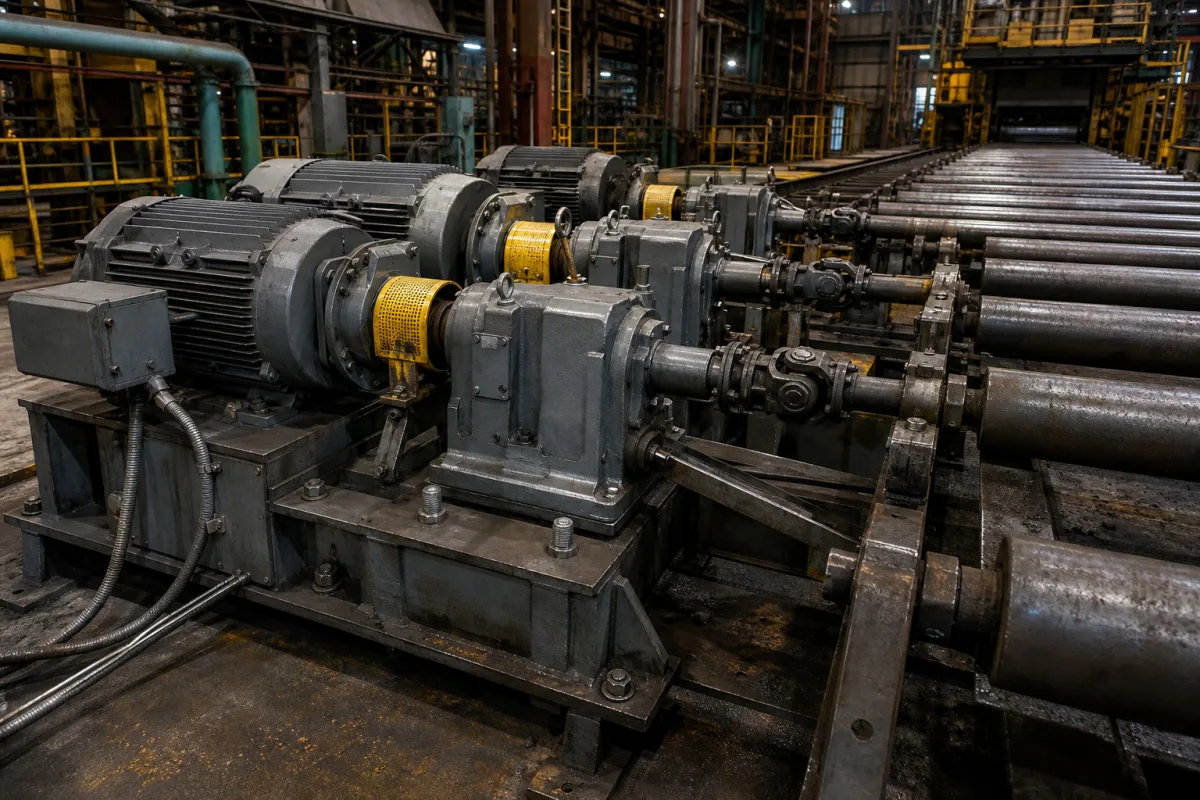
Power transmission components that provide controlled rotational motion to runout table rollers
Product Specifications

Technical details and manufacturing context for Drive Motors & Reducers

Definition
Drive motors and reducers are critical components of runout tables in industrial manufacturing lines. They work together to convert electrical energy into precise mechanical motion, driving the rollers that transport materials (such as metal sheets, plates, or coils) through processing stages. The motor provides rotational power, while the reducer (gear box) adjusts speed and increases torque to match the specific requirements of material handling, ensuring smooth, controlled movement with proper tension and alignment.
Working Principle
Electric motors (typically AC induction or servo motors) convert electrical energy into rotational mechanical energy. This rotation is transmitted to a reducer (gear box) that reduces the high-speed, low-torque output of the motor to a lower-speed, higher-torque output suitable for driving runout table rollers. The system may include variable frequency drives (VFDs) for speed control and torque regulation to accommodate different material types, weights, and processing requirements.
Common Materials
Electrical steel laminations, Copper windings, Steel gear components, Aluminum or cast iron housings
Technical Parameters
  • Motor power rating (kW) and reducer output torque (Nm) determine the system's capacity to handle material loads (kW & Nm) Standard Spec
Components / BOM
  • Electric Motor
    Converts electrical energy to rotational mechanical energy
    Material: Electrical steel, copper, aluminum
  • Gear Reducer
    Reduces motor speed and increases torque through gear trains
    Material: Steel gears, cast iron housing
  • Output Shaft
    Transmits reduced-speed torque to the roller drive mechanism
    Material: Alloy steel
  • Coupling
    Connects motor shaft to reducer input shaft while accommodating misalignment
    Material: Steel, elastomer
Engineering Reasoning
0.5-150 kW continuous power output, 0-1800 RPM rotational speed, 85-95% mechanical efficiency
Bearing temperature exceeding 120°C, gear tooth contact stress surpassing 1500 MPa, shaft deflection exceeding 0.1 mm per 100 mm length
Design Rationale: Thermal expansion mismatch between steel gears (11.7 μm/m·K) and aluminum housings (23.1 μm/m·K) causing bearing preload loss, Hertzian contact stress exceeding material yield strength at gear meshing points
Risk Mitigation (FMEA)
Trigger Lubricant viscosity breakdown at 90°C operating temperature
Mode: Gear tooth pitting and spalling due to boundary lubrication failure
Strategy: Integrated oil cooling system maintaining lubricant at 60°C with 3 μm filtration
Trigger Radial load exceeding 1.5 times rated capacity during roller jam
Mode: Bearing cage fracture and shaft bending exceeding 0.15 mm deflection
Strategy: Torque limiting coupling with 110% overload capacity and real-time load monitoring

Industry Taxonomies & Aliases

Commonly used trade names and technical identifiers for Drive Motors & Reducers.

Applied To / Applications

This component is essential for the following industrial systems and equipment:

Industrial Ecosystem & Supply Chain DNA

Complementary Systems
Downstream Applications
Specialized Tooling

Application Fit & Sizing Matrix

Operational Limits
pressure: N/A (mechanical component, not fluid pressure)
duty cycle: Continuous S1 to intermittent S5 (based on motor insulation class and cooling)
speed range: 0-1800 RPM (motor dependent, reducer ratios adjust output)
temperature: -20°C to 150°C (ambient to motor surface)
torque capacity: Up to 50,000 Nm (reducer dependent)
Media Compatibility
✓ Steel mill coolant/lubricant environments ✓ High particulate industrial atmospheres (with proper sealing) ✓ Outdoor/weather-protected installations (IP54 or higher)
Unsuitable: Submerged or high-pressure washdown without specific IP69K rating
Sizing Data Required
  • Required output torque at roller (Nm)
  • Desired roller speed (RPM)
  • Available input power source characteristics (voltage, phase, frequency)

Reliability & Engineering Risk Analysis

Failure Mode & Root Cause
Bearing failure
Cause: Inadequate lubrication leading to overheating and metal fatigue, or contamination from dust/moisture causing abrasive wear
Winding insulation breakdown
Cause: Thermal aging from excessive operating temperatures, voltage spikes, or moisture ingress compromising dielectric strength
Maintenance Indicators
  • Unusual high-pitched whining or grinding noises from motor/reducer housing
  • Excessive vibration detectable by hand or visible shaking during operation
Engineering Tips
  • Implement precision alignment procedures during installation and re-alignment checks during preventive maintenance to reduce bearing and gear loads
  • Establish condition-based lubrication program using ultrasonic or vibration analysis to optimize lubrication intervals and detect early degradation

Compliance & Manufacturing Standards

Reference Standards
ISO 1940-1:2003 (Balance quality requirements for rotors) ANSI/AGMA 2009-B01 (Gear reducers - Rating and application) DIN 3990 (Calculation of load capacity of cylindrical gears)
Manufacturing Precision
  • Shaft runout: ≤0.05mm
  • Gear tooth profile tolerance: ±0.02mm
Quality Inspection
  • Vibration analysis (to ISO 10816)
  • Hardness testing (Rockwell C scale)

Factories Producing Drive Motors & Reducers

Verified manufacturers with capability to produce this product in China

✓ 97% Supplier Capability Match Found

P Procurement Specialist from Canada Feb 28, 2026
★★★★★
"The technical documentation for this Drive Motors & Reducers is very thorough, especially regarding technical reliability."
Technical Specifications Verified
T Technical Director from United States Feb 25, 2026
★★★★★
"Reliable performance in harsh Machinery and Equipment Manufacturing environments. No issues with the Drive Motors & Reducers so far."
Technical Specifications Verified
P Project Engineer from United Arab Emirates Feb 22, 2026
★★★★★
"Testing the Drive Motors & Reducers now; the technical reliability results are within 1% of the laboratory datasheet."
Technical Specifications Verified
Verification Protocol

“Feedback is collected from verified sourcing managers during RFQ (Request for Quote) and factory evaluation processes on CNFX. These reports represent historical performance data and technical audit summaries from our B2B manufacturing network.”

9 sourcing managers are analyzing this specification now. Last inquiry for Drive Motors & Reducers from USA (1h ago).

Supply Chain Compatible Machinery & Devices

Heavy-Duty CNC Plasma Cutting Machine

Industrial machine for precision metal cutting using plasma arc technology

Explore Specs →
Automated Assembly Line System

Integrated production system for sequential component assembly operations

Explore Specs →
Automated Powder Coating System

Integrated industrial system for applying dry powder coatings to metal substrates.

Explore Specs →
Centrifugal Pump Impeller

Rotating component that transfers energy to fluid in centrifugal pumps.

Explore Specs →

Frequently Asked Questions

What are the key materials used in these drive motors and reducers?

Our drive motors and reducers utilize electrical steel laminations for efficient magnetic circuits, copper windings for optimal conductivity, steel gear components for durability, and aluminum or cast iron housings for robust protection.

What components are included in the bill of materials for these systems?

The complete BOM includes a coupling for connection, an electric motor for power generation, a gear reducer for torque multiplication and speed control, and an output shaft for transmitting motion to runout table rollers.

How do these drive systems benefit machinery manufacturing applications?

These drive motors and reducers provide precise controlled rotational motion essential for runout table rollers in machinery manufacturing, ensuring consistent performance, reliable power transmission, and extended equipment lifespan.

Can I contact factories directly on CNFX?

CNFX is an open directory, not a transaction platform. Each factory profile provides direct contact information and production details to help you initiate direct inquiries with Chinese suppliers.

Get Quote for Drive Motors & Reducers

Request technical pricing, lead times, or customized specifications for Drive Motors & Reducers directly from verified manufacturing units.

Your business information is encrypted and only shared with verified Drive Motors & Reducers suppliers.

Thank you! Your message has been sent. We'll respond within 1–3 business days.

Need to Manufacture Drive Motors & Reducers?

Connect with verified factories specializing in this product category

Add Your Factory Contact Us
Previous Product
Drive Motors
Next Product
Drive Mounting Interface