Industry-Verified Manufacturing Data (2026)

Forced Air Circulation System

Based on aggregated insights from multiple verified factory profiles within the CNFX directory, the standard Forced Air Circulation System used in the Machinery and Equipment Manufacturing sector typically supports operational capacities ranging from standard industrial configurations to heavy-duty production requirements.

Technical Definition & Core Assembly

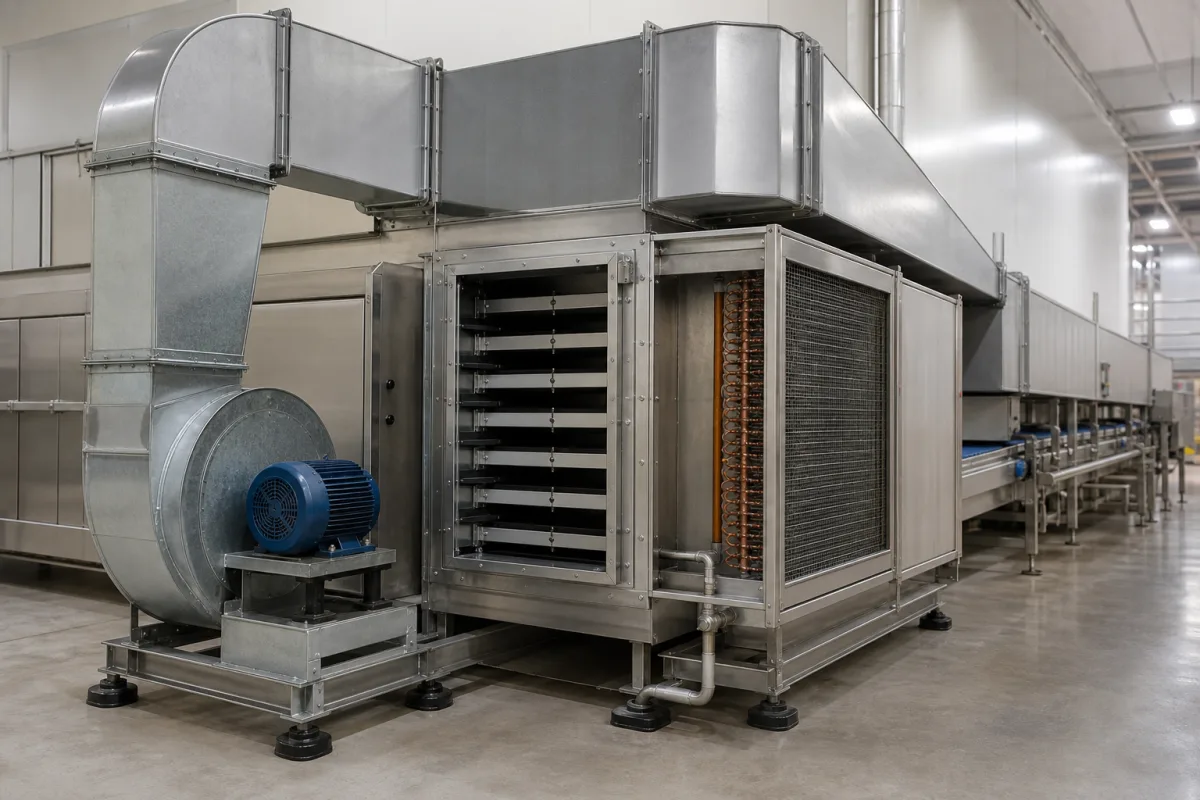
A canonical Forced Air Circulation System is characterized by the integration of Centrifugal/Axial Fans and Drive Motors. In industrial production environments, manufacturers listed on CNFX commonly emphasize Galvanized steel construction to support stable, high-cycle operation across diverse manufacturing scenarios.

A mechanical system that actively moves air through a controlled environment to ensure uniform temperature distribution and efficient heat transfer.
Product Specifications

Technical details and manufacturing context for Forced Air Circulation System

Definition
A critical component within a Controlled Cooling Tunnel that uses powered fans or blowers to circulate air at controlled velocities and directions, ensuring consistent cooling rates across products, preventing hot spots, and maintaining precise temperature gradients throughout the tunnel chamber.
Working Principle
Electric motors drive centrifugal or axial fans that draw air from the tunnel, pass it through heat exchangers or cooling elements, and then forcefully redistribute the conditioned air back into the tunnel via strategically placed ducts and nozzles to create uniform airflow patterns.
Common Materials
Galvanized steel, Stainless steel (food-grade applications), Aluminum alloys
Technical Parameters
  • Airflow capacity - volume of air moved per hour (m³/h) Per Request
Components / BOM
  • Centrifugal/Axial Fans
    Generate airflow by converting rotational energy into kinetic energy of air movement
    Material: Aluminum/stainless steel blades with steel housing
  • Drive Motors
    Provide mechanical power to rotate fan blades at controlled speeds
    Material: Copper windings with steel casing
  • Air Ducts/Nozzles
    Direct and distribute airflow evenly throughout the tunnel chamber
    Material: Galvanized steel or food-grade stainless steel
  • Dampers/Regulators
    Control airflow volume and direction through adjustable vanes or valves
    Material: Stainless steel with rubber seals
Engineering Reasoning
0.5-2.5 m/s air velocity, 15-35°C ambient temperature, 101.325 kPa atmospheric pressure
Air velocity drops below 0.3 m/s for >30 minutes, temperature differential exceeds 40°C across heat exchanger surfaces, bearing vibration amplitude exceeds 4.5 mm/s RMS
Design Rationale: Laminar flow transition to turbulent flow at Reynolds number >2300 causing pressure drop, thermal expansion coefficient mismatch (α=23×10⁻⁶/K aluminum vs α=11×10⁻⁶/K steel) inducing stress concentration, fatigue crack propagation at stress intensity factor K₁>35 MPa√m
Risk Mitigation (FMEA)
Trigger Bearing lubrication degradation due to oxidation at >80°C operating temperature
Mode: Shaft misalignment exceeding 0.05 mm radial displacement
Strategy: Ceramic hybrid bearings with PTFE retainer operating up to 150°C, shaft alignment laser monitoring with 0.01 mm resolution
Trigger Corrosion-induced pitting on aluminum fin surfaces at pH<6.5 condensate
Mode: Heat transfer coefficient reduction from 50 W/m²·K to <15 W/m²·K
Strategy: Micro-arc oxidation coating with 15 μm Al₂O₃ layer, condensate pH monitoring with automatic neutralization injection

Industry Taxonomies & Aliases

Commonly used trade names and technical identifiers for Forced Air Circulation System.

Applied To / Applications

This component is essential for the following industrial systems and equipment:

Industrial Ecosystem & Supply Chain DNA

Complementary Systems
Downstream Applications
Specialized Tooling

Application Fit & Sizing Matrix

Operational Limits
pressure: 0 to 2 bar gauge
flow rate: 100 to 10,000 CFM
temperature: -20°C to 150°C
slurry concentration: Not applicable - designed for clean air/gas only
Media Compatibility
✓ Clean air in HVAC systems ✓ Process gases in manufacturing ✓ Dry particulate transport
Unsuitable: Corrosive chemical environments without specialized coatings
Sizing Data Required
  • Required air flow rate (CFM)
  • System static pressure (inches H2O)
  • Ambient temperature range

Reliability & Engineering Risk Analysis

Failure Mode & Root Cause
Bearing failure
Cause: Inadequate lubrication, contamination from dust/debris, or misalignment leading to excessive vibration and heat generation
Motor winding insulation breakdown
Cause: Thermal cycling, moisture ingress, or voltage spikes causing insulation degradation and eventual short circuits
Maintenance Indicators
  • Unusual grinding or screeching noises from bearings or motor
  • Excessive vibration felt through the housing or mounting structure
Engineering Tips
  • Implement predictive maintenance with vibration analysis and infrared thermography to detect early bearing/motor issues
  • Maintain clean air intake filters and ensure proper ventilation around the motor to prevent overheating and contamination

Compliance & Manufacturing Standards

Reference Standards
ISO 5801:2017 - Industrial fans - Performance testing using standardized airways ANSI/AMCA 210-07 - Laboratory Methods of Testing Fans for Certified Aerodynamic Performance Rating DIN EN 13142:2013 - Ventilation for buildings - Components/products for residential ventilation
Manufacturing Precision
  • Impeller Balance: +/- 0.5 g·mm/kg
  • Housing Alignment: +/- 0.8 mm
Quality Inspection
  • Airflow Performance Verification Test
  • Vibration Analysis Test

Factories Producing Forced Air Circulation System

Verified manufacturers with capability to produce this product in China

✓ 95% Supplier Capability Match Found

P Procurement Specialist from Brazil Feb 12, 2026
★★★★★
"Standard OEM quality for Machinery and Equipment Manufacturing applications. The Forced Air Circulation System arrived with full certification."
Technical Specifications Verified
T Technical Director from Canada Feb 09, 2026
★★★★★
"Great transparency on the Forced Air Circulation System components. Essential for our Machinery and Equipment Manufacturing supply chain."
Technical Specifications Verified
P Project Engineer from United States Feb 06, 2026
★★★★★
"The Forced Air Circulation System we sourced perfectly fits our Machinery and Equipment Manufacturing production line requirements."
Technical Specifications Verified
Verification Protocol

“Feedback is collected from verified sourcing managers during RFQ (Request for Quote) and factory evaluation processes on CNFX. These reports represent historical performance data and technical audit summaries from our B2B manufacturing network.”

11 sourcing managers are analyzing this specification now. Last inquiry for Forced Air Circulation System from Turkey (1h ago).

Supply Chain Compatible Machinery & Devices

Automated Assembly Line System

Integrated production system for sequential component assembly operations

Explore Specs →
Automated Powder Coating System

Integrated industrial system for applying dry powder coatings to metal substrates.

Explore Specs →
Centrifugal Pump Impeller

Rotating component that transfers energy to fluid in centrifugal pumps.

Explore Specs →
High-Precision CNC Laser Cutting Machine

Computer-controlled industrial machine using focused laser beams to cut sheet metal with micron-level accuracy.

Explore Specs →

Frequently Asked Questions

What are the main applications of forced air circulation systems in machinery manufacturing?

These systems are essential for maintaining uniform temperature distribution in industrial processes, cooling machinery components, removing heat from manufacturing equipment, and ensuring proper ventilation in controlled environments like paint booths, drying chambers, and assembly areas.

What materials are recommended for food-grade forced air circulation systems?

For food-grade applications, we recommend 304 or 316 stainless steel construction for all components including ducts, nozzles, and fans. These materials meet FDA and USDA requirements, resist corrosion from cleaning chemicals, and prevent contamination in food processing environments.

How do centrifugal and axial fans differ in forced air circulation systems?

Centrifugal fans create higher pressure and are ideal for systems with ductwork resistance, while axial fans move larger volumes of air at lower pressure. Centrifugal fans are better for long duct runs and industrial applications, whereas axial fans work well for direct ventilation and shorter paths.

Can I contact factories directly on CNFX?

CNFX is an open directory, not a transaction platform. Each factory profile provides direct contact information and production details to help you initiate direct inquiries with Chinese suppliers.

Get Quote for Forced Air Circulation System

Request technical pricing, lead times, or customized specifications for Forced Air Circulation System directly from verified manufacturing units.

Your business information is encrypted and only shared with verified Forced Air Circulation System suppliers.

Thank you! Your message has been sent. We'll respond within 1–3 business days.

Need to Manufacture Forced Air Circulation System?

Connect with verified factories specializing in this product category

Add Your Factory Contact Us
Previous Product
Force/Torque Sensor
Next Product
Forcer/Coil assembly