Industry-Verified Manufacturing Data (2026)

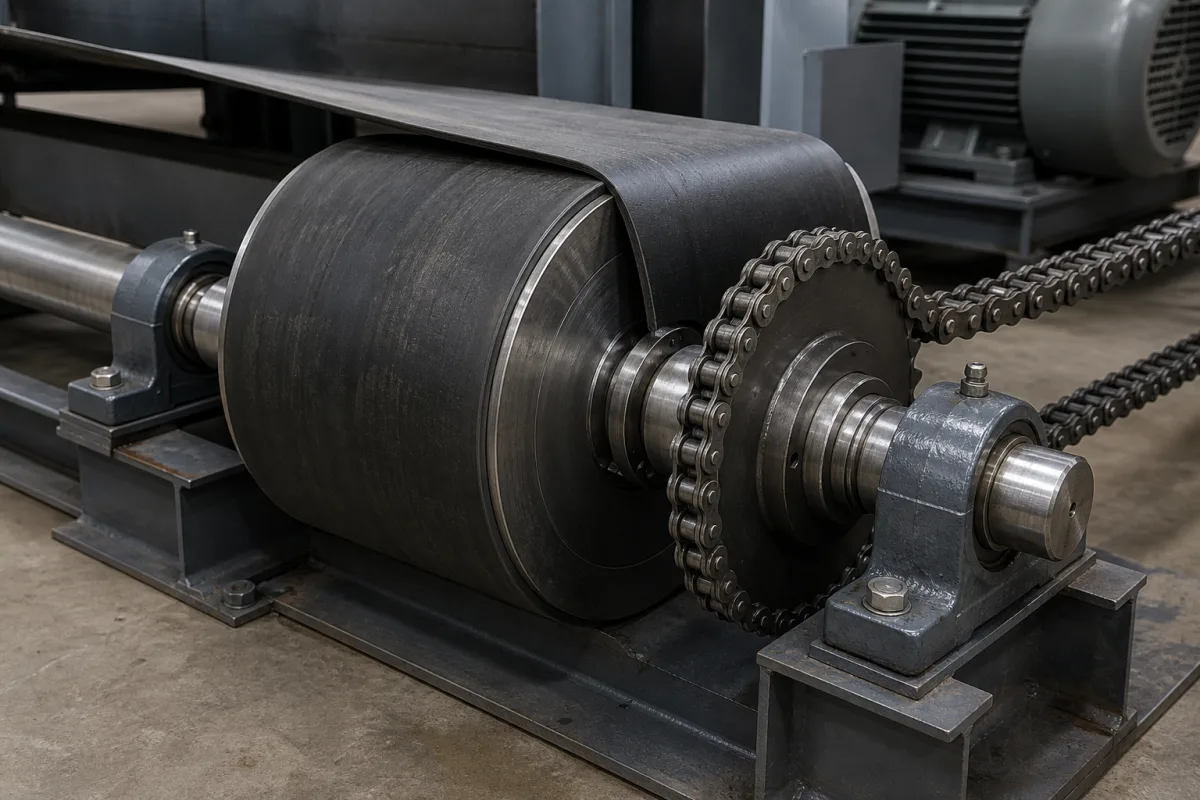
Drive Pulley/Sprocket

Based on aggregated insights from multiple verified factory profiles within the CNFX directory, the standard Drive Pulley/Sprocket used in the Machinery and Equipment Manufacturing sector typically supports operational capacities ranging from standard industrial configurations to heavy-duty production requirements.

Technical Definition & Core Assembly

A canonical Drive Pulley/Sprocket is characterized by the integration of Hub and Rim. In industrial production environments, manufacturers listed on CNFX commonly emphasize Carbon Steel construction to support stable, high-cycle operation across diverse manufacturing scenarios.

A mechanical component that transmits rotational motion and torque from a drive source to a driven element within a drive unit.
Product Specifications

Technical details and manufacturing context for Drive Pulley/Sprocket

Definition
The drive pulley/sprocket is a critical component within a drive unit that interfaces with belts or chains to transfer mechanical power from motors, engines, or other prime movers to machinery components. It converts rotational energy into linear or rotational motion for the driven equipment, ensuring synchronized operation and proper power transmission efficiency.
Working Principle
The drive pulley/sprocket operates by engaging with a belt or chain that wraps around its circumference. As the pulley/sprocket rotates due to input from the drive shaft, friction (for pulleys) or positive engagement (for sprockets) causes the belt or chain to move, transmitting torque and rotational speed to the driven pulley/sprocket or directly to the load. Proper tension and alignment are essential for efficient power transfer and minimal wear.
Common Materials
Carbon Steel, Alloy Steel, Cast Iron, Aluminum Alloy
Technical Parameters
  • Pitch diameter for pulleys or pitch circle diameter for sprockets, determining the speed ratio and torque transmission capability. (mm) Standard Spec
Components / BOM
  • Hub
    Provides the central mounting structure that connects the pulley/sprocket to the drive shaft via keyways, set screws, or other fastening methods.
    Material: Steel
  • Rim
    The outer circumferential section that directly engages with the belt (via grooves) or chain (via teeth), transmitting torque through friction or positive drive.
    Material: Steel or Cast Iron
  • Keyway
    A machined slot in the hub that accommodates a key to prevent rotational slippage between the pulley/sprocket and the shaft.
    Material: Steel
Engineering Reasoning
0.5-150 kN·m torque transmission, 50-3000 rpm rotational speed, 20-150°C operating temperature
Shear stress exceeds 400 MPa for steel alloys (yield strength threshold), surface contact pressure surpasses 2.5 GPa (Hertzian contact limit), fatigue cycles exceed 10^7 at 300 MPa alternating stress (S-N curve endurance limit)
Design Rationale: Hertzian contact fatigue from cyclic rolling/sliding contact exceeding material endurance limit, fretting corrosion at shaft interface due to micromotion exceeding 10 μm amplitude, bending fatigue from misalignment-induced cyclic bending moments
Risk Mitigation (FMEA)
Trigger Shaft-hub interference fit loss below 0.001 mm/mm interference ratio
Mode: Rotational slippage and fretting wear at 5-15 μm amplitude
Strategy: Hydraulic press-fit installation with 0.002-0.003 mm/mm interference ratio and keyway/spline secondary retention
Trigger Tooth root bending stress exceeding 250 MPa at pitch line velocity of 25 m/s
Mode: Progressive tooth fracture initiating at 30° fillet radius stress concentration
Strategy: ISO 6336:2019 calculation-based tooth profile optimization with 45° fillet radius and shot peening to induce 500 MPa compressive residual stress

Industry Taxonomies & Aliases

Commonly used trade names and technical identifiers for Drive Pulley/Sprocket.

Applied To / Applications

This component is essential for the following industrial systems and equipment:

Industrial Ecosystem & Supply Chain DNA

Complementary Systems
Downstream Applications
Specialized Tooling

Application Fit & Sizing Matrix

Operational Limits
pressure: Not applicable (mechanical component)
other spec: Max torque: 500-5000 Nm depending on size/material
temperature: -40°C to 150°C
Media Compatibility
✓ Steel chains ✓ Rubber belts ✓ Polymer timing belts
Unsuitable: High-corrosion saltwater environments
Sizing Data Required
  • Required torque transmission (Nm)
  • Shaft diameter (mm)
  • Belt/chain pitch or width (mm)

Reliability & Engineering Risk Analysis

Failure Mode & Root Cause
Wear and elongation
Cause: Abrasive wear from belt/sprocket contact, misalignment causing uneven loading, or material fatigue from cyclic stress leading to elongation and tooth deformation.
Bearing failure
Cause: Contamination ingress (dust, moisture), inadequate lubrication, or improper installation leading to excessive radial/axial loads on pulley/sprocket bearings.
Maintenance Indicators
  • Audible squealing, grinding, or clicking noises during operation indicating misalignment, bearing issues, or chain/belt slippage.
  • Visible wobble or irregular motion during rotation, suggesting shaft misalignment, imbalance, or excessive wear on teeth/grooves.
Engineering Tips
  • Implement precision laser alignment during installation and periodic checks to ensure parallel and angular alignment within manufacturer tolerances, reducing uneven wear and vibration.
  • Establish a condition-based lubrication program using high-temperature, anti-wear grease, and monitor for contamination to prevent bearing degradation and extend component life.

Compliance & Manufacturing Standards

Reference Standards
ISO 4183: Belt drives - Classical and narrow V-belts - Grooved pulleys ANSI/ASME B29.1: Precision Power Transmission Roller Chains, Attachments, and Sprockets DIN 2211: Belt drives - V-belts and V-ribbed belts - Grooved pulleys for industrial applications
Manufacturing Precision
  • Bore diameter tolerance: H7 (e.g., ±0.018mm for 50mm bore)
  • Tooth profile tolerance: ±0.1mm from theoretical involute curve
Quality Inspection
  • Hardness testing (Rockwell C scale) to verify heat treatment quality
  • Runout testing (e.g., ≤0.05mm TIR) to ensure rotational balance and alignment

Factories Producing Drive Pulley/Sprocket

Verified manufacturers with capability to produce this product in China

✓ 93% Supplier Capability Match Found

P Project Engineer from Germany Jan 05, 2026
★★★★★
"Impressive build quality. Especially the technical reliability is very stable during long-term operation."
Technical Specifications Verified
S Sourcing Manager from Brazil Jan 02, 2026
★★★★★
"As a professional in the Machinery and Equipment Manufacturing sector, I confirm this Drive Pulley/Sprocket meets all ISO standards."
Technical Specifications Verified
P Procurement Specialist from Canada Dec 30, 2025
★★★★★
"Standard OEM quality for Machinery and Equipment Manufacturing applications. The Drive Pulley/Sprocket arrived with full certification."
Technical Specifications Verified
Verification Protocol

“Feedback is collected from verified sourcing managers during RFQ (Request for Quote) and factory evaluation processes on CNFX. These reports represent historical performance data and technical audit summaries from our B2B manufacturing network.”

18 sourcing managers are analyzing this specification now. Last inquiry for Drive Pulley/Sprocket from Brazil (1h ago).

Supply Chain Compatible Machinery & Devices

Heavy-Duty CNC Plasma Cutting Machine

Industrial machine for precision metal cutting using plasma arc technology

Explore Specs →
Automated Assembly Line System

Integrated production system for sequential component assembly operations

Explore Specs →
Automated Powder Coating System

Integrated industrial system for applying dry powder coatings to metal substrates.

Explore Specs →
Centrifugal Pump Impeller

Rotating component that transfers energy to fluid in centrifugal pumps.

Explore Specs →

Frequently Asked Questions

What materials are best for drive pulleys in high-torque applications?

For high-torque applications, carbon steel and alloy steel drive pulleys are recommended due to their superior strength, durability, and resistance to wear under heavy loads.

How do I properly install the keyway on a drive pulley?

Ensure the keyway is precisely machined to match the shaft dimensions, use a proper fitting key, and secure with appropriate fasteners to prevent slippage and ensure efficient torque transmission.

What maintenance is required for drive sprockets in continuous operation?

Regular inspection for wear, proper lubrication of the hub and rim interface, and checking alignment with the driven element are essential to prevent premature failure and maintain optimal performance.

Can I contact factories directly on CNFX?

CNFX is an open directory, not a transaction platform. Each factory profile provides direct contact information and production details to help you initiate direct inquiries with Chinese suppliers.

Get Quote for Drive Pulley/Sprocket

Request technical pricing, lead times, or customized specifications for Drive Pulley/Sprocket directly from verified manufacturing units.

Your business information is encrypted and only shared with verified Drive Pulley/Sprocket suppliers.

Thank you! Your message has been sent. We'll respond within 1–3 business days.

Need to Manufacture Drive Pulley/Sprocket?

Connect with verified factories specializing in this product category

Add Your Factory Contact Us
Previous Product
Drive Pulley/Gear
Next Product
Drive Roll Assembly