Industry-Verified Manufacturing Data (2026)

Drive Pulley/Gear

Based on aggregated insights from multiple verified factory profiles within the CNFX directory, the standard Drive Pulley/Gear used in the Machinery and Equipment Manufacturing sector typically supports operational capacities ranging from standard industrial configurations to heavy-duty production requirements.

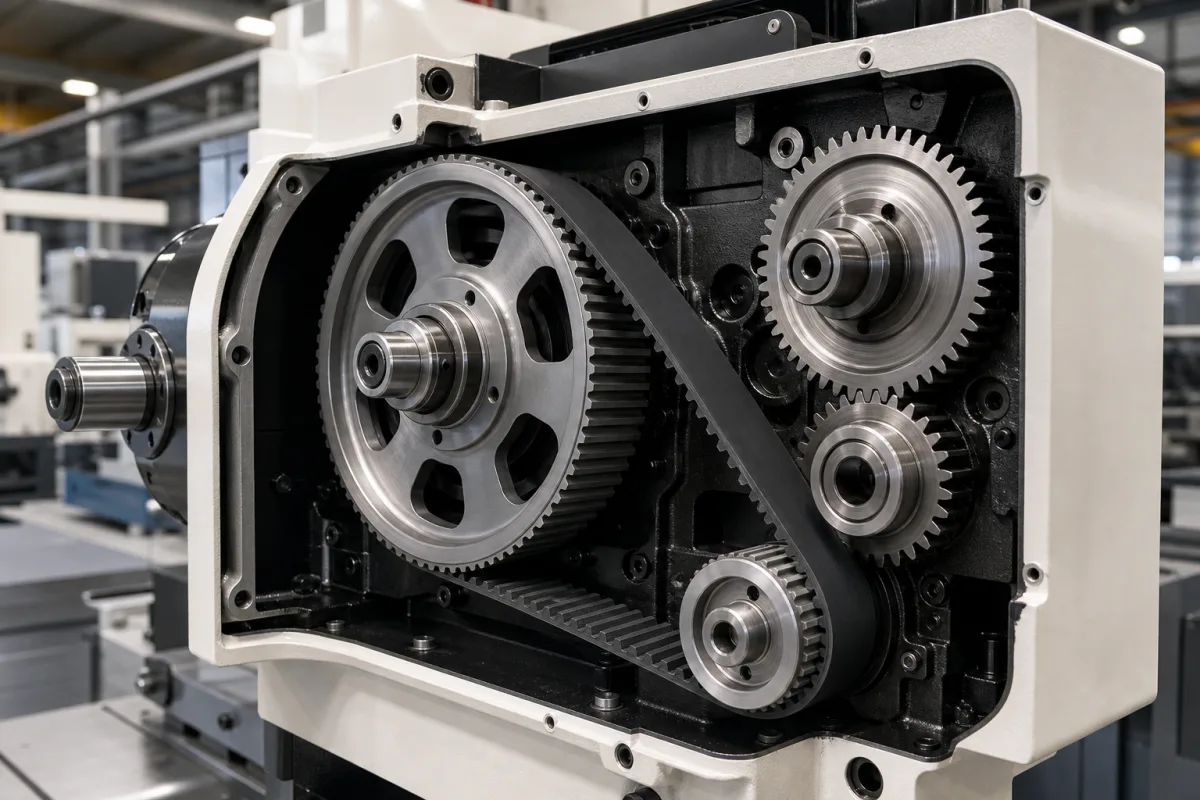
Technical Definition & Core Assembly

A canonical Drive Pulley/Gear is characterized by the integration of Hub and Rim (Pulley) or Tooth Profile (Gear). In industrial production environments, manufacturers listed on CNFX commonly emphasize Alloy Steel construction to support stable, high-cycle operation across diverse manufacturing scenarios.

A mechanical component that transmits rotational motion and torque from the motor to the main spindle assembly.
Product Specifications

Technical details and manufacturing context for Drive Pulley/Gear

Definition
The drive pulley or gear is a critical component of the main spindle system that serves as the primary interface for power transmission. It converts the rotational energy from the drive motor into the precise rotational motion required by the spindle shaft, enabling operations such as cutting, drilling, or milling. Its design directly influences the spindle's speed, torque capacity, and overall power transmission efficiency.
Working Principle
The component operates by engaging with a drive belt (in the case of a pulley) or meshing with another gear (in the case of a gear) connected to the motor. This engagement creates a mechanical linkage that transfers rotational force. The ratio between the driving component and the driven spindle component determines the final output speed and torque, following the principles of mechanical power transmission.
Common Materials
Alloy Steel, Case-Hardened Steel, Cast Iron
Technical Parameters
  • The pitch diameter or outer diameter, which is fundamental for determining speed ratios and compatibility with drive belts or mating gears. (mm) Customizable
Components / BOM
  • Hub
    Provides the central mounting interface to the spindle shaft, often featuring a keyway or splines for positive torque transmission.
    Material: Steel
  • Rim (Pulley) or Tooth Profile (Gear)
    The outer section designed to engage with the drive belt (pulley groove) or mate with another gear (gear teeth) to transmit motion.
    Material: Hardened Steel
  • Key or Spline
    A mechanical feature (keyway and key, or splined bore) that prevents rotational slippage between the component and the spindle shaft.
    Material: Steel
Engineering Reasoning
0.5-15 kN·m torque transmission, 50-3000 rpm rotational speed, -40°C to 120°C operating temperature
Material yield strength exceeded at 450 MPa stress, fatigue limit at 10^7 cycles under 250 MPa alternating stress, critical misalignment >0.15 mm/mm
Design Rationale: Contact fatigue (Hertzian stress exceeding 1.5 GPa), fretting corrosion at slip amplitudes >10 μm, torsional resonance at natural frequency 85±5 Hz
Risk Mitigation (FMEA)
Trigger Belt tension exceeding 2.5 kN causing 15% overstress
Mode: Surface pitting initiation at 0.1 mm depth, progressive spalling
Strategy: Torque-limiting coupling with 12 kN·m capacity, strain gauge monitoring at 1000 Hz sampling
Trigger Lubricant film breakdown at λ<1 (Stribeck curve boundary layer failure)
Mode: Adhesive wear rate >10^-6 mm³/N·m, seizure at 180°C flash temperature
Strategy: Forced oil circulation at 3 L/min flow rate, PTFE composite bushings with μ=0.08

Industry Taxonomies & Aliases

Commonly used trade names and technical identifiers for Drive Pulley/Gear.

Applied To / Applications

This component is essential for the following industrial systems and equipment:

Industrial Ecosystem & Supply Chain DNA

Complementary Systems
Downstream Applications
Specialized Tooling

Application Fit & Sizing Matrix

Operational Limits
pressure: Up to 10 bar (static), 5 bar (dynamic)
other spec: Max torque: 500 Nm, Max speed: 3000 RPM, Max belt tension: 1000 N
temperature: -40°C to 150°C
Media Compatibility
✓ Industrial lubricants (grease/oil) ✓ Dry air environments ✓ Clean mechanical transmission systems
Unsuitable: Abrasive slurry or corrosive chemical environments
Sizing Data Required
  • Required torque transmission (Nm)
  • Operating speed range (RPM)
  • Belt/pulley diameter ratio and center distance

Reliability & Engineering Risk Analysis

Failure Mode & Root Cause
Tooth wear and pitting
Cause: Inadequate lubrication leading to metal-to-metal contact, misalignment causing uneven load distribution, or contamination from abrasive particles in the lubricant.
Fatigue cracking and tooth breakage
Cause: Cyclic loading exceeding material endurance limit, improper heat treatment during manufacturing, or stress concentrations from design flaws or manufacturing defects.
Maintenance Indicators
  • Unusual grinding, clicking, or whining noises during operation indicating gear mesh issues
  • Visible wear patterns, pitting, or cracks on gear teeth during inspection
Engineering Tips
  • Implement precision alignment procedures during installation and regular alignment checks to ensure proper gear mesh and load distribution
  • Establish and maintain a rigorous lubrication program with correct lubricant type, proper application frequency, and contamination control measures

Compliance & Manufacturing Standards

Reference Standards
ISO 5296:2012 - Synchronous belt drives - Pulleys ANSI/AGMA 2004-B89 - Gear Classification and Inspection Handbook DIN 2211 - Belt drives - V-belts and V-ribbed belts, endless wedge belts and corresponding pulleys
Manufacturing Precision
  • Bore diameter: H7 tolerance (e.g., +/-0.018mm for 50mm bore)
  • Tooth profile accuracy: AGMA Quality 10 (e.g., tooth spacing error < 0.025mm)
Quality Inspection
  • Runout measurement (radial/axial) with dial indicator
  • Hardness testing (Rockwell C scale) at multiple surface points

Factories Producing Drive Pulley/Gear

Verified manufacturers with capability to produce this product in China

✓ 98% Supplier Capability Match Found

T Technical Director from Singapore Jan 18, 2026
★★★★★
"As a professional in the Machinery and Equipment Manufacturing sector, I confirm this Drive Pulley/Gear meets all ISO standards."
Technical Specifications Verified
P Project Engineer from Germany Jan 15, 2026
★★★★☆
"Standard OEM quality for Machinery and Equipment Manufacturing applications. The Drive Pulley/Gear arrived with full certification. (Delivery took slightly longer than expected, but technical support was excellent.)"
Technical Specifications Verified
S Sourcing Manager from Brazil Jan 12, 2026
★★★★★
"Great transparency on the Drive Pulley/Gear components. Essential for our Machinery and Equipment Manufacturing supply chain."
Technical Specifications Verified
Verification Protocol

“Feedback is collected from verified sourcing managers during RFQ (Request for Quote) and factory evaluation processes on CNFX. These reports represent historical performance data and technical audit summaries from our B2B manufacturing network.”

10 sourcing managers are analyzing this specification now. Last inquiry for Drive Pulley/Gear from Germany (10m ago).

Supply Chain Compatible Machinery & Devices

Hydraulic Press

Industrial machine using hydraulic pressure to compress, form, or assemble materials

Explore Specs →
Heavy-Duty CNC Plasma Cutting Machine

Industrial machine for precision metal cutting using plasma arc technology

Explore Specs →
Automated Assembly Line System

Integrated production system for sequential component assembly operations

Explore Specs →
Automated Powder Coating System

Integrated industrial system for applying dry powder coatings to metal substrates.

Explore Specs →

Frequently Asked Questions

What materials are best for drive pulleys in heavy machinery?

Alloy steel offers excellent strength-to-weight ratio, case-hardened steel provides superior surface hardness for wear resistance, and cast iron is cost-effective for high-inertia applications.

How do I choose between a pulley and gear for my machinery?

Pulleys with belts are ideal for longer center distances and vibration damping, while gears provide precise torque transmission and higher efficiency for compact, high-load applications.

What maintenance do drive pulleys and gears require?

Regular inspection for wear, proper lubrication of gears, tension checks for pulley belts, and alignment verification to prevent premature failure and ensure optimal performance.

Can I contact factories directly on CNFX?

CNFX is an open directory, not a transaction platform. Each factory profile provides direct contact information and production details to help you initiate direct inquiries with Chinese suppliers.

Get Quote for Drive Pulley/Gear

Request technical pricing, lead times, or customized specifications for Drive Pulley/Gear directly from verified manufacturing units.

Your business information is encrypted and only shared with verified Drive Pulley/Gear suppliers.

Thank you! Your message has been sent. We'll respond within 1–3 business days.

Need to Manufacture Drive Pulley/Gear?

Connect with verified factories specializing in this product category

Add Your Factory Contact Us
Previous Product
Drive Pulley
Next Product
Drive Pulley/Sprocket