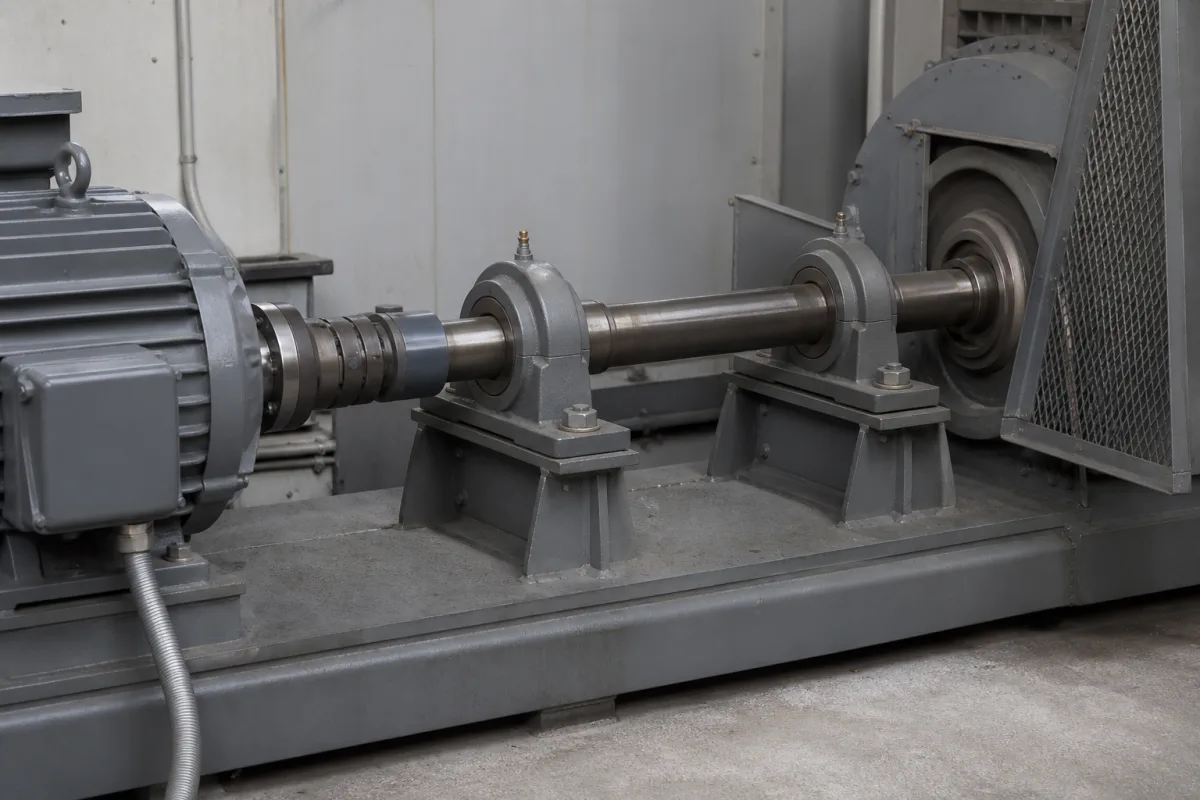
Wheel drive shaft and bearings: the shaft and pillow-block bearing set that carries an overhung centrifugal wheel
The shaft and pillow-block bearings that carry an overhung centrifugal wheel · first critical speed margin, L10 bearing life, ball or spherical roller bearings, and when the wheel sits on the motor shaft instead
A wheel drive shaft and bearing set is the turned and ground shaft, carried in two pillow-block bearings on a pedestal, that takes power from a motor coupling or belt sheave and holds a centrifugal wheel overhung beyond the inner bearing. It has to stay well below its first critical speed, carry the wheel's weight and unbalance, belt pull and thrust for the specified bearing life, and keep the bearings aligned on the shaft. Some centrifugal wheels, including direct-drive blast wheels, do without it and sit on the motor shaft.
Shafts and their pair of pillow-block bearings that carry an overhung centrifugal wheel, such as arrangement 1 fan pedestals and belt-driven wheel units, specified by critical speed, bearing type and L10 life. Complete wheel shot blasting machines and their blast wheels are covered on the Wheel shot blasting machines page; motor-to-shaft coupling alignment and bases are covered on the Direct-coupled fan motor assembly page; heavy split bearing housings are covered on the Heavy-duty split bearing housings page.
CNFX editorial research · Sources checked October 12, 2026 · 4 sources
Keep the shaft's first critical speed 25% or 42% above the wheel's top speed
PennBarry specifies turned, ground and polished shafting for its VCR centrifugal fans, with the first critical shaft speed at least 125% of maximum operating speed for Class I and II fans and at least 142% for Class III and IV fans. Its arrangement 1 mounts two bearings on a pedestal with the wheel overhung into the housing, for belt or direct drive. [1]
Editorial calculation: the table applies PennBarry's two margins to example speeds; 3,450 rpm is the speed of the direct-drive blast wheels in Gibson's 48 × 84 spinner hanger machine. [4]
Editorial calculation of the static bearing loads from an overhung wheel, ignoring belt pull, unbalance and thrust: with wheel weight W hung a distance a beyond the inner bearing and a bearing span L, the inner bearing carries W(L + a)/L downward and the outer bearing W·a/L upward. A 1,000 N wheel 200 mm outboard of a 500 mm span puts 1,400 N on the inner bearing and lifts the outer one by 400 N, so the inner bearing sees more than the whole wheel weight.
Maximum wheel speed
Minimum first critical speed, Class I–II (×1.25)
Minimum first critical speed, Class III–IV (×1.42)
1,200 rpm
1,500 rpm
1,704 rpm
1,800 rpm
2,250 rpm
2,556 rpm
3,450 rpm
4,313 rpm
4,899 rpm
Ask for the calculated first critical speed of the shaft with the wheel fitted, the maximum operating speed it is compared with, and the overhang and bearing span used.
02
Specify bearing life as L10 hours at maximum speed and power
Greenheck defines L10, after the ABMA, as the life that 90% of a group of identical bearings reach before metal fatigue appears; L50, the average life, is five times L10. Its recommended specification asks for air-handling-quality, grease-lubricated ball or roller bearings selected for an L10 of 80,000 hours at maximum operating speed and horsepower. [2]
Values in the table are Greenheck's, with years counted for fans running seven days a week, 52 weeks a year. [2] PennBarry's standard L10 on Class I and II VCR fans is 20,000 hours, with 40,000 and 80,000 hours optional, and 40,000 hours standard on Class III and IV fans, rated at the fan's maximum catalogued speed. [1] Editorial calculation: 20,000 h running continuously is about 2.3 years (20,000 / 8,760).
Greenheck lists the inputs to a bearing selection: shaft diameter and weight, lubricant viscosity, motor power, sheave pitch diameter, fan speed, wheel weight, bearing and wheel positions on the shaft, thrust loads and the direction of belt pull. It warns that a specification reading only "200,000-hour bearing life" without L10 or L50 invites different interpretations. [2]
L10 life
Equivalent L50
Years at 8 h/day
Years at 24 h/day
20,000 h
100,000 h
—
—
80,000 h
400,000 h
27.5
9.2
100,000 h
500,000 h
34.3
11.4
200,000 h
1,000,000 h
68.6
22.8
03
Choose ball or spherical roller bearings and how they lock to the shaft
PennBarry fits single-row ball bearings in one-piece cast-iron pillow blocks, double-row spherical roller bearings in one-piece cast-iron pillow blocks, or spherical roller bearings in two-piece split pillow blocks. [1]
Greenheck limits ball bearings with stamped steel housings and rubber sleeves to shafts of ¾ in and smaller with motors of 1 hp and less. Above that it uses air-handling-quality ball, spherical or tapered roller pillow-block or flange bearings, which are 100% vibration tested and bore-checked, with low swivel torque so ball and tapered roller inserts can self-align in the housing; spherical rollers self-align inside the bearing. It favours a concentric clamp-style locking collar over set screws, because tightening a set screw pushes the shaft off centre. [2]
Where the wheel is driven directly, the separate shaft and bearing set can disappear: in DISA Goff's 2460 spinner hanger the blast wheel hub is keyed and taper-lock bushed onto the motor shaft, so wheel removal means releasing the bushing and inspecting the motor shaft keyway for wear. [3]
04
Data for a wheel shaft and bearing set enquiry
Paste it into your enquiry below or into an email to a maker, then replace every bracket.
Wheel: [type; weight; diameter; maximum speed]
Drive: [coupling or belt; sheave pitch diameter; belt pull direction]
Geometry: [bearing span; overhang from inner bearing]
Shaft: [diameter; material; finish]
Critical speed: [required margin over maximum speed]
Bearings: [ball or spherical roller; one-piece or split housing; locking method]
Life: [L10 hours at maximum speed and power]
Temperature: [gas temperature at the wheel]
Explore company information and manufacturing capabilities, then discuss the scope of your project with a relevant supplier.
Share this page
Compiled and source-reviewed by the CNFX editorial team.
Each manufacturer above links to the page on that company's own website where the product is listed, with the date we checked it. How we source and review
· Page last updated 13 October 2026
Buyer questions
How far below its critical speed should a fan or wheel shaft run?
PennBarry keeps the first critical speed at least 125% of maximum speed for Class I and II fans and at least 142% for Class III and IV. [1]
Is 80,000-hour L10 the same as 80,000-hour average life?
No. Greenheck states L50 average life is five times L10, so an L10 of 80,000 h equals an L50 of 400,000 h. [2]
Does every centrifugal wheel need its own shaft and bearings?
No. In DISA Goff's direct-drive blast wheels the hub is mounted on the motor shaft with a taper-lock bushing. [3]
Sources and what still needs a direct check
Sources checked 2026-10-12. Shaft and bearing criteria come from PennBarry's VCR centrifugal fan bulletin and Greenheck's fan bearing application guide FA/103-25; the direct-drive blast wheel examples from DISA Goff's 2460 and Gibson's 48 × 84 spinner hanger manuals.