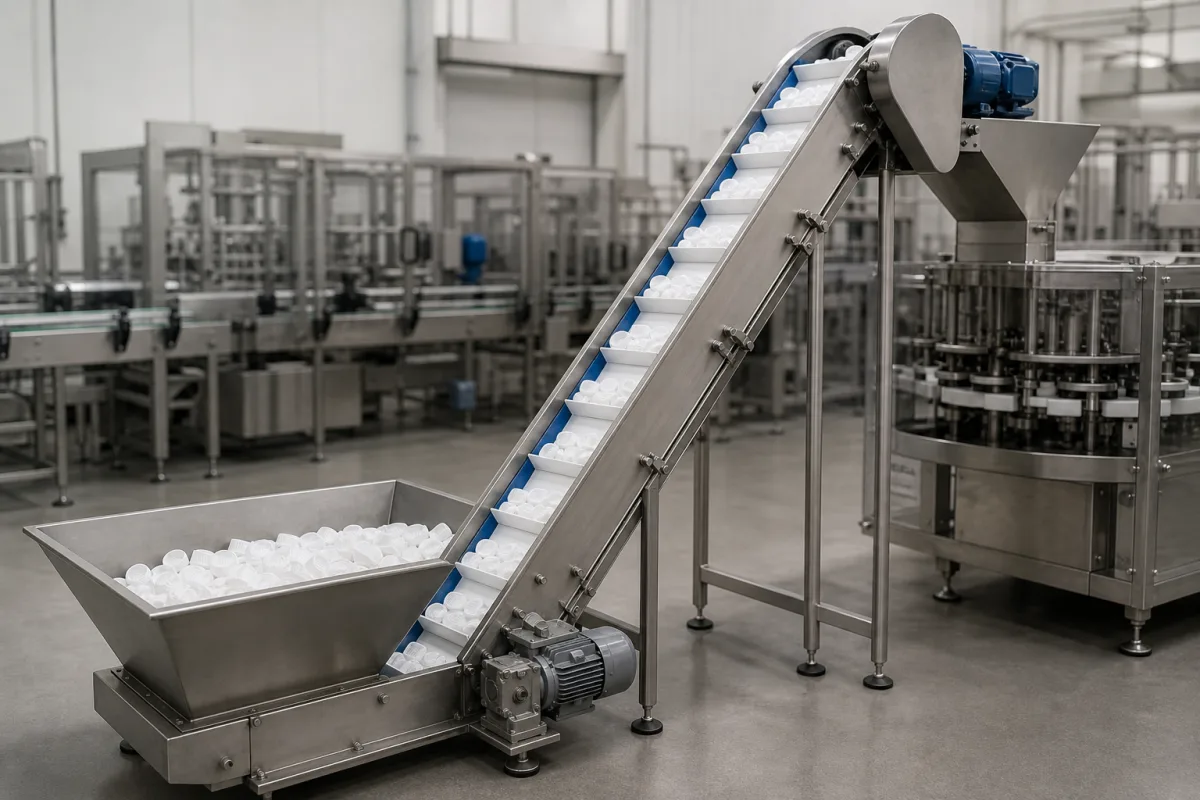
The bulk hopper and incline elevator that keep a cap feeder topped up
The illustrated unit is a stainless floor hopper full of white caps, with a cleated incline belt carrying them up to a discharge chute above a rotary machine. Its job is storage and metering, not orientation: it holds a bulk load of caps and feeds the sorter or bowl downstream a few at a time. Feeding-system makers Hoosier Feeder and RNA describe these prefeeders and hoppers in their catalogues, and a dealer listing of a Shibuya Hoppmann elevating prefeeder gives one unit's full dimensions.
Covers hopper elevators and prefeeders that store loose caps, closures or small parts in bulk and meter them into a vibratory bowl feeder, centrifugal feeder or cap sorter on demand: hopper capacity, belt and cleats, level-sensor control, loading and discharge heights. Cleated-belt elevators that orient caps on the belt are on the Cap sorter and elevator page (596); crown cork elevators on 3382; single-file cap conveyors to the capper on 5491; choosing bowl, centrifugal or flexible feeders on 2805. Bucket elevators for bulk materials and conveyor belting carry the same name and are outside this page.
CNFX editorial research · Sources checked October 13, 2026 · 3 sources
RNA (Rhein-Nadel Automation) sets out in its hopper catalogue what a hopper adds in front of a feeder bowl. The Hoppmann EP-15 listing describes the control that does it: a standard bowl level sensor that ensures proper product metering.
Hoosier Feeder describes its hopper elevators the same way, as delivering a steady, controlled flow of materials to the next phase of automation.
For caps the gentle-handling point is the one to check on trials: a bowl or sorter that is overfilled keeps caps circulating and rubbing against each other longer than one fed on demand (editorial reading).
Effect (RNA hopper catalogue)
What RNA says
Metered filling
Metered filling of the feeder bowl prevents variations in running speed due to fluctuating filling levels
Gentle part handling
The process holds only the parts needed to meet the required performance data
Availability
Less entanglement of parts with each other and less jamming in the orienting tools
Autonomy
Including a hopper increases the autonomy of a sorting system considerably
02
Hopper size, belt and cleats: what makers list
Hopper volume sets how long the line runs between refills; belt width and cleat size set how many caps each cleat lifts and what fits under the hopper gate.
The litre figures for Hoosier's cubic-foot sizes are converted at 28.3 L per cu ft (Editorial calculation).
Run time between refills is hopper volume divided by the line's cap consumption in volume terms; neither maker gives caps per cubic foot, so that figure has to come from a bulk-fill test with the actual cap (editorial note).
Item
Hoosier Feeder hopper elevators
Shibuya Hoppmann EP-15 (dealer listing)
RNA BU-W belt-type hoppers
Hopper capacity
4, 15 or 28 cu ft (about 113, 425 or 793 L)
15 cu ft
5 to 200 L; filling weight 15 to 100 kg
Belt
10, 14 or 20 in wide; urethane fabric or modular plastic
8 in wide
Based on RNA's FP120 belt feeder; 1 or 2 m/min
Cleats
Size and spacing chosen for the application
2 in high, 5½ in apart; maximum opening above belt 8 × 2 in
—
Construction
Sealed hopper with hinged Lexan covers, cleanout chute; sanitary models available
Stainless steel; ¼ hp variable-speed gearmotor
Top-mounted components in stainless steel brushed on both sides; suited to FDA applications
Discharge
Scalable to different discharge heights
11 × 7½ in outlet
Horizontal filling of downstream systems
The Hoppmann data are from a used-equipment dealer's listing of a 1999 EP-15 and describe that unit, not a current catalogue model.
03
Loading at the floor, discharging over the bowl
The point of an elevating prefeeder is that an operator tips caps in at floor level while the discharge sits above the bowl or sorter rim.
The EP-15 lifts its parts about 3 ft 7½ in from infeed to exit (Editorial calculation). Where a cap sorter sits higher, Hoosier's scalable discharge height or a Z-frame or noseover elevator is the route; RNA's belt-type hoppers instead feed horizontally into equipment at about the same level.
The illustration shows the incline-elevator form, with the hopper at floor level and the belt discharging into the top of the rotary machine.
Item
Figure
Source
Elevator infeed height
3 ft 2½ in
Hoppmann EP-15 listing
Elevator exit height
6 ft 10 in
Hoppmann EP-15 listing
Infeed opening
3 ft 4 in × 2 ft 2 in
Hoppmann EP-15 listing
Overall size
8 ft L × 3 ft 6½ in W × 9 ft 3 in H
Hoppmann EP-15 listing
Prefeeder types offered
Vibratory hopper, incline elevator, Z-frame, live bottom hopper, noseover elevator
Hoosier Feeder
04
What to give a hopper elevator supplier
Paste it into your enquiry below or into an email to a maker, then replace every bracket.
Give the cap or part type and size, a sample quantity for bulk-fill and handling trials, the feeder or sorter it will supply and its consumption rate, required time between refills, how the bulk caps arrive (bags, octabins), floor space, infeed height the operator can load at, discharge height over the bowl or sorter, and hygiene requirements. Ask for hopper volume, belt type and width, cleat height and pitch, gate opening, level-sensor type and control logic, construction material and finish, and how the hopper empties for a cap changeover.
2 companies list this product among what they make. Company figures are quoted from each
company's own website; every card states where the relationship came from.
Suzhou Huibao Automation Equipment Co., Ltd.
card
Lists caps elevator conveyors and plastic lid elevator feeders. Location TBC.
Explore company information and manufacturing capabilities, then discuss the scope of your project with a relevant supplier.
Share this page
Compiled and source-reviewed by the CNFX editorial team.
Each manufacturer above links to the page on that company's own website where the product is listed, with the date we checked it. How we source and review
· Page last updated 13 October 2026
Buyer questions
Why put a hopper elevator in front of a cap feeder bowl?
RNA says metered filling prevents running-speed variations from fluctuating bowl levels, handles parts more gently, reduces jams in the orienting tools and increases the sorting system's autonomy. [2]
What hopper sizes are available?
Hoosier Feeder lists pre-configured hopper elevators of 4, 15 and 28 cu ft with 10, 14 or 20 in belts; RNA's belt-type hoppers run from 5 to 200 litres. [1][2]
How does the elevator know when to feed?
The Shibuya Hoppmann EP-15 described in a dealer listing uses a standard bowl level sensor to meter parts into the bowl. [3]
Sources and what still needs a direct check
Sources checked 2026-10-13. Prefeeder and hopper catalogues from two feeding-system makers, Hoosier Feeder and RNA, and a dealer listing describing a Shibuya Hoppmann elevating prefeeder.