Editorial Technical Reference

Environmental Control Enclosure

This page explains how Environmental Control Enclosure is classified within Machinery and Equipment Manufacturing. Technical values and manufacturer relationships are research references; confirm the current specification and supplier evidence for each order.

Technical Definition & Core Assembly

A protective housing that maintains stable environmental conditions for precision measurement equipment.
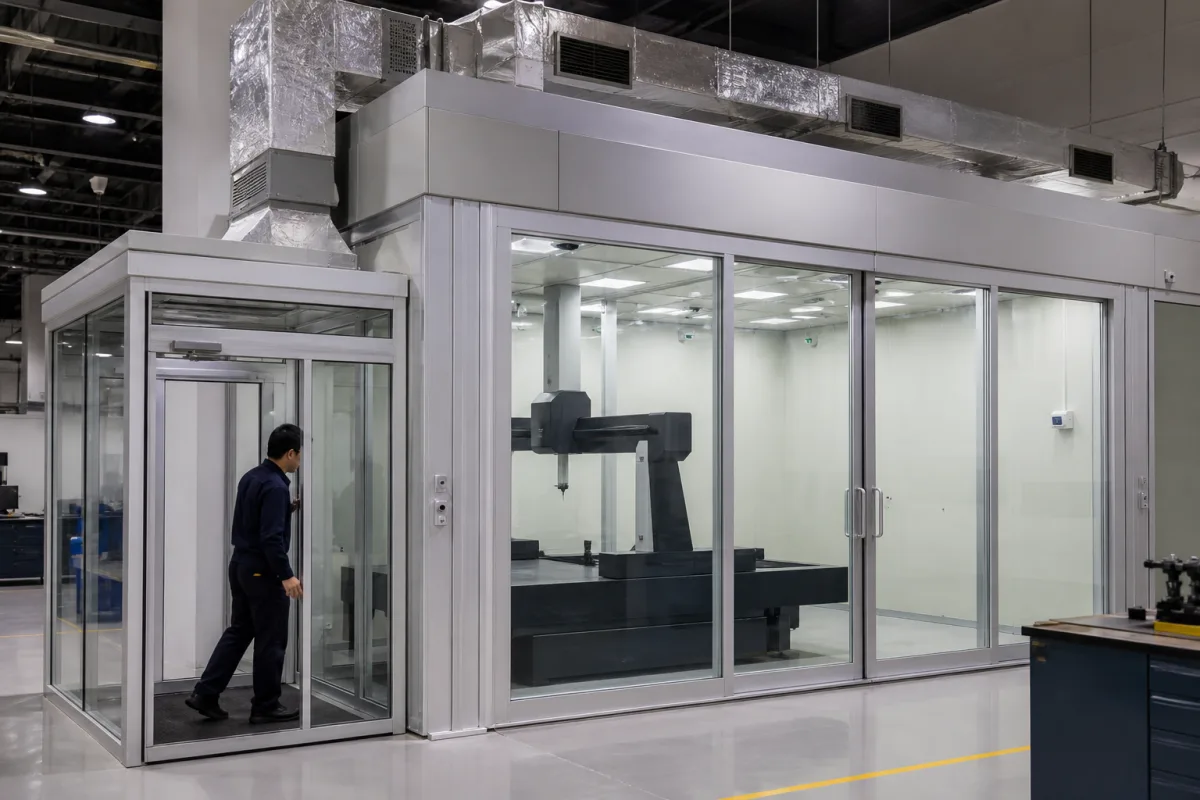
Representative product image. Confirm appearance and specifications with the manufacturer.

Product Specifications

Technical details and manufacturing context for Environmental Control Enclosure

Definition
The Environmental Control Enclosure is a component of an Automated Coordinate Measuring Machine (CMM) System, designed to isolate the measurement area from external environmental fluctuations. It ensures consistent temperature, humidity, and cleanliness, which are critical for accurate dimensional measurements. The enclosure is constructed from aluminum alloy, insulated panels, and tempered glass, providing structural integrity and thermal insulation. It features a controlled micro-environment achieved through insulation, temperature regulation, and air filtration, minimizing thermal expansion/contraction and particulate contamination that could affect measurement accuracy. Key parameters include internal dimensions of 600×800×600 mm (custom sizes available), a temperature range of 15–35°C with ±0.5°C stability, relative humidity range of 40–60% RH with ±5% stability, and an IP rating of IP54–IP65 per IEC 60529. The enclosure operates on a 100–240 V AC power supply (50/60 Hz) with a typical power consumption of ≤500 W. The material is stainless steel grade 304 (ASTM A240), and the weight ranges from 80–120 kg depending on options. The ambient operating temperature is 0–40°C, and the noise level is ≤55 dB(A) at 1 m distance per ISO 3746. This enclosure is intended for use in precision measurement environments where environmental control is essential. It is important to verify model-specific values and standards with the legal manufacturer or supplier, as the listed parameters are reference ranges for directory purposes. The enclosure does not include the CMM itself but provides the necessary environment for its operation. Maintenance signals include temperature or humidity deviations beyond specified stability, increased particulate accumulation, or unusual noise from the regulation systems. Failure boundaries include loss of temperature or humidity control, which could compromise measurement accuracy. Selection inputs include the required internal dimensions, environmental control specifications, and integration with the CMM system.
Working Principle
The enclosure creates a controlled micro-environment by using insulated panels to reduce heat transfer, a temperature regulation system to maintain setpoint, and air filtration to remove particulates. This minimizes thermal expansion/contraction of the measurement equipment and reduces contamination, ensuring consistent conditions for accurate dimensional measurements. The system operates within specified temperature and humidity ranges, with stability maintained to ±0.5°C and ±5% RH, respectively.
Common Materials
Aluminum alloy, Insulated panels, Tempered glass
Technical Parameters
ParameterTypical rangeNotes & selection driver
Internal Dimensions (W×H×D)600×800×600 mmCustom sizes available
Temperature Range15–35 °CMaintains ±0.5°C stability
Temperature Stability±0.5 °CWithin setpoint
Relative Humidity Range40–60 % RHNon-condensing
Humidity Stability±5 % RHWithin setpoint
IP RatingIP54–IP65Dust and water protectedIEC 60529
Power Supply100–240 V AC50/60 Hz
Power Consumption≤500 WTypical
Material304 Stainless SteelCorrosion resistantASTM A240
Weight80–120 kgDepends on options
Operating Temperature (Ambient)0–40 °CFor external environment
Noise Level≤55 dB(A)At 1 m distanceISO 3746

Ranges are indicative industry figures for RFQ preparation, not a supplier commitment. Confirm every value and standard with the legal manufacturer before ordering.

Components / BOM
  • Enclosure Body
    The enclosure itself: houses the equipment and provides the sealing and ingress rating.
  • Thermal Insulation Layer Part
    Minimizes heat transfer between interior and exterior environments
    Material: Polyurethane foam
  • Temperature Control System
    Maintains stable internal temperature through heating/cooling elements
    Material: Stainless steel heating elements
  • Observation Window
    Allows visual inspection of measurement process without opening enclosure
    Material: Tempered glass
  • Access Door
    Provides entry for loading/unloading workpieces while maintaining seal integrity
    Material: Aluminum alloy with rubber gasket

Industrial Ecosystem & Supply Chain Structure

Complementary Systems
Downstream Applications
Specialized Tooling

Application Fit & Sizing Matrix

Operational Limits
pressure: 0.8 to 1.2 bar (internal pressure differential)
other spec: Humidity control: 20-80% RH, Particle filtration: ISO Class 5 equivalent, Flow rate: 10-50 CFM (adjustable)
temperature: -20°C to +50°C (operating), -40°C to +70°C (storage)
Media Compatibility
✓ Cleanroom air (ISO Class 5-8) ✓ Inert gases (N2, Argon) ✓ Dry compressed air (dew point -40°C)
Unsuitable: Corrosive chemical vapors (HCl, H2S) or explosive atmospheres (ATEX Zone 0)
Sizing Data Required
  • Equipment heat load (W)
  • Required internal volume (L)
  • Environmental stability class (e.g., ±0.5°C, ±5% RH)

Reliability & Engineering Risk Analysis

Failure Mode & Root Cause
Corrosion
Cause: Exposure to moisture, condensation, or corrosive atmospheric contaminants leading to material degradation and structural weakening.
Seal Failure
Cause: Deterioration of gaskets or seals due to thermal cycling, UV exposure, or chemical attack, resulting in loss of environmental integrity.
Maintenance Indicators
  • Visible condensation or moisture accumulation inside the enclosure
  • Audible air leakage or hissing from seals indicating pressure loss
Engineering Tips
  • Implement regular seal integrity testing using pressure decay or ultrasonic leak detection methods
  • Apply corrosion-resistant coatings and ensure proper drainage to prevent moisture accumulation

Indicative industry ranges for design and RFQ preparation. Confirm the exact figures and applicable standard with the manufacturer before specifying.

Compliance & Manufacturing Standards

Applicable Standards
ISO 14644-1:2015 Cleanrooms and associated controlled environments

Quoted from the published standard.

Manufacturing Precision
  • Seal Integrity: +/-0.5 Pa pressure differential
  • Panel Flatness: 0.2mm per meter
Quality Inspection
  • HEPA/ULPA Filter Leak Test (EN 1822)
  • Environmental Chamber Performance Verification (IEST-RP-CC006.3)

Manufacturers of Environmental Control Enclosure

Manufacturer profiles associated with Environmental Control Enclosure.

Sourcing Environmental Control Enclosure from China?
Tell us your specification and target quantity — we will match it against manufacturer records and come back with the factories that fit.
Request manufacturers We manufacture this

Manufacturer listings support early research and capability understanding. They are not certification, ranking, or transaction guarantees.

Technical documentation
Request current drawings, revision history, and a signed specification sheet.
Manufacturing capability
Verify equipment lists, process limits, capacity, and representative production evidence.
Inspection readiness
Confirm test methods, calibrated equipment, sampling plans, and traceable reports.
Supplier transparency
Check the legal entity, factory address, ownership, certifications, and direct contacts.

CNFX does not score or rank suppliers. Buyers must verify all claims and documents with the legal manufacturer before ordering.

Supply Chain Compatible Machinery & Devices

Automated Powder Coating System

Integrated industrial system for applying dry powder coatings to metal substrates.

Explore Specs →
Centrifugal Pump Impeller

The centrifugal pump impeller is a critical rotating component that converts mechanical energy from the motor into kinetic energy in fluid systems.

Explore Specs →
High-Precision CNC Laser Cutting Machine

Computer-controlled industrial machine using focused laser beams to cut sheet metal with micron-level accuracy.

Explore Specs →
Industrial-Grade Hydraulic Cylinder Piston Rod

This industrial-grade piston rod is a precision-ground cylindrical component designed for use in hydraulic cylinders.

Explore Specs →

Frequently Asked Questions

What is the purpose of the Environmental Control Enclosure?

It isolates the measurement area of an Automated Coordinate Measuring Machine from external environmental fluctuations, ensuring stable temperature, humidity, and cleanliness for accurate dimensional measurements.

What are the key specifications of this enclosure?

Key specifications include internal dimensions of 600×800×600 mm (custom sizes available), temperature range 15–35°C with ±0.5°C stability, relative humidity 40–60% RH with ±5% stability, IP rating IP54–IP65 (IEC 60529), power supply 100–240 V AC, power consumption ≤500 W, material stainless steel 304 (ASTM A240), weight 80–120 kg, ambient operating temperature 0–40°C, and noise level ≤55 dB(A) at 1 m (ISO 3746).

How does the enclosure maintain stable environmental conditions?

It uses insulation, temperature regulation systems, and air filtration to create a controlled micro-environment, minimizing thermal expansion/contraction and particulate contamination that could affect measurement accuracy.

What should I verify before purchasing this enclosure?

Verify model-specific values and standards with the legal manufacturer or supplier, as the listed parameters are reference ranges. Confirm compatibility with your CMM system and required environmental control specifications.

Data Basis

Editorial classification, named public sources where available, and source-reviewed manufacturer records.

Preliminary Technical Classification
This page supports structured research, RFQ preparation, and supplier evaluation. It does not replace buyer-led supplier qualification, standards review, or technical approval.
Buyer enquiry

Request manufacturing insight for Environmental Control Enclosure

Ask for use case, specification boundaries, supplier type, and RFQ preparation information for this product.

Where it goes
Straight to the CNFX editorial desk, and to the manufacturer if this product is linked to a claimed profile. Nothing is broadcast to a supplier list.
Your details stay here
We do not sell or rent enquiry data, and we do not add you to a mailing list. Used only to answer this request.
No commission, no middleman
CNFX is a directory. We take no cut of any order and never negotiate on a supplier's behalf.
What we don't claim
A listing is not an endorsement. Qualify every supplier and verify every figure yourself before ordering.

Your business information is used only to process this request.

Thank you! Your message has been sent. We'll respond within 1–3 business days.
Sorry, we couldn't send your message. Please try again, or email us at contact@cnfx.com.

Need to Manufacture Environmental Control Enclosure?

Compare manufacturer profiles with relevant product and process capability.

Previous Product
Z-axis Ram/Spindle
Last Product
Get QuotesChat