Structured Manufacturing Data (2026)

Ergonomic Floor Matting

Based on aggregated insights from structured factory profiles within the CNFX directory, the standard Ergonomic Floor Matting used in the Machinery and Equipment Manufacturing sector typically supports operational capacities ranging from standard industrial configurations to heavy-duty production requirements.

Technical Definition & Core Assembly

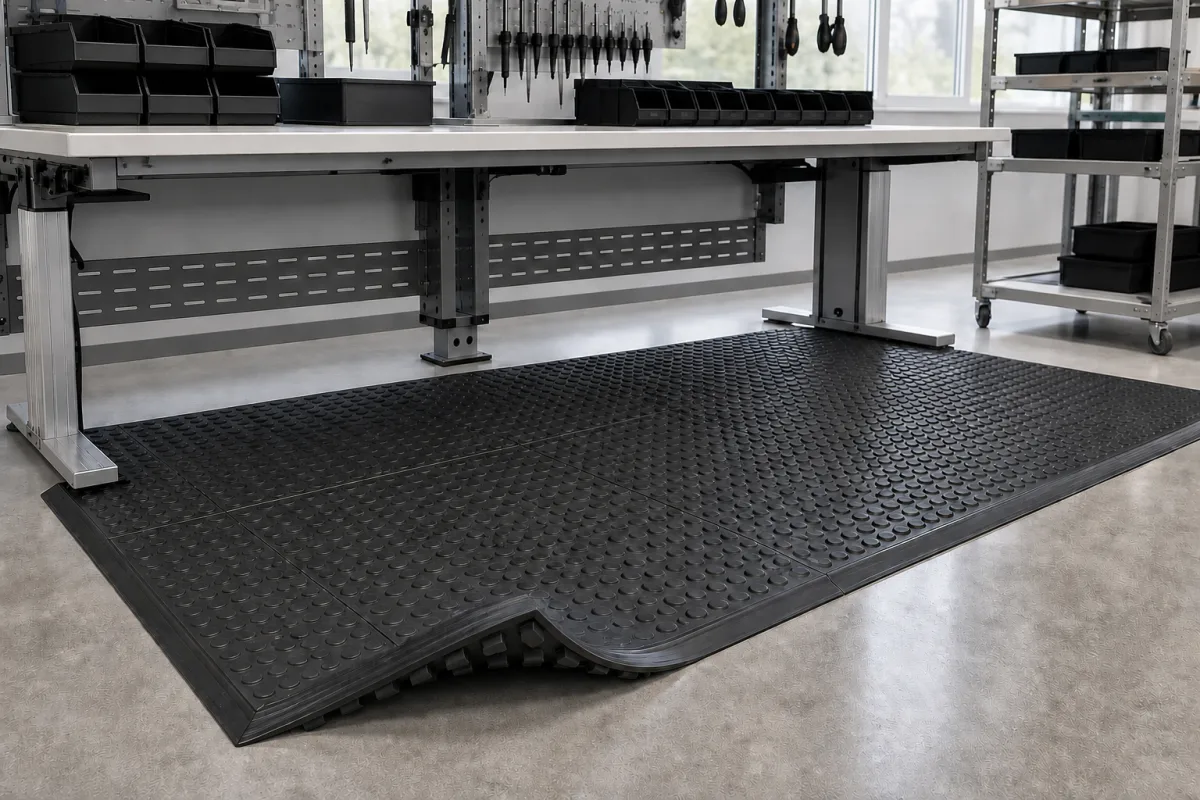
A canonical Ergonomic Floor Matting is characterized by the integration of Surface Layer and Core Cushion. In industrial production environments, manufacturers listed on CNFX commonly emphasize Rubber construction to support stable, high-cycle operation across diverse manufacturing scenarios.

Specialized floor covering designed to reduce fatigue and improve comfort for workers in assembly stations

Product Specifications

Technical details and manufacturing context for Ergonomic Floor Matting

Definition
A specialized floor covering component of the Interior Assembly Station designed to provide ergonomic support for workers during prolonged standing operations. It reduces physical fatigue, improves comfort, and enhances productivity by minimizing strain on legs, feet, and back through cushioning and anti-fatigue properties.
Working Principle
Utilizes compressible materials that create slight instability, encouraging subtle muscle movements in the legs and feet to improve blood circulation and reduce static posture fatigue. The matting absorbs impact and provides thermal insulation from cold floors.
Common Materials
Rubber, Polyurethane foam, PVC
Technical Parameters
  • Thickness range typically 10-25mm for optimal ergonomic benefit (mm) Customizable
Components / BOM
  • Surface Layer Part
    Provides slip resistance, easy cleaning surface, and wear resistance
    Material: Textured rubber or PVC
  • Core Cushion Part
    Primary shock absorption and ergonomic support layer
    Material: Closed-cell foam or rubber
  • Base Layer Part
    Stability and floor protection, prevents mat movement
    Material: Non-slip rubber or vinyl

Industry Taxonomies & Aliases

Commonly used trade names and technical identifiers for Ergonomic Floor Matting.

Applied To / Applications

This component is essential for the following industrial systems and equipment:

Industrial Ecosystem & Supply Chain Structure

Complementary Systems
Downstream Applications
Specialized Tooling

Application Fit & Sizing Matrix

Operational Limits
pressure: Up to 500 psi static load
other spec: Slip resistance rating: R10-R13, Chemical resistance: pH 3-11
temperature: -20°C to 80°C
Media Compatibility
✓ Concrete floors ✓ Epoxy-coated surfaces ✓ Vinyl flooring
Unsuitable: High-temperature foundry environments (>100°C)
Sizing Data Required
  • Workstation dimensions (LxW)
  • Expected foot traffic density
  • Required anti-fatigue thickness (mm)

Reliability & Engineering Risk Analysis

Failure Mode & Root Cause
Surface Delamination
Cause: Adhesive failure due to chemical exposure, moisture ingress, or improper installation leading to separation of top wear layer from base material
Compression Set/Permanent Deformation
Cause: Excessive static loading beyond design limits, prolonged exposure to heavy equipment or foot traffic causing loss of rebound and thickness reduction
Maintenance Indicators
  • Visible curling, lifting, or separation at edges/seams indicating adhesive failure
  • Audible cracking or crunching sounds when walked upon, signaling internal foam breakdown or moisture saturation
Engineering Tips
  • Implement regular rotation (quarterly) to distribute wear patterns evenly and prevent localized compression damage
  • Use compatible chemical-resistant mats in areas with spill exposure and ensure proper subfloor preparation with moisture barriers before installation

Compliance & Manufacturing Standards

Reference Standards
ISO 9001:2015 - Quality Management Systems ASTM F1637 - Standard Practice for Safe Walking Surfaces CE EN 13501-1 - Fire classification of construction products
Manufacturing Precision
  • Thickness: +/- 1.5mm
  • Flatness: 0.5mm per meter
Quality Inspection
  • Slip Resistance Test (ASTM F1679)
  • Compression Set Test (ASTM D395)

Factories Producing Ergonomic Floor Matting

Manufacturer profiles with relevant production capability in China

Manufacturer listings support early research and capability understanding. They are not certification, ranking, or transaction guarantees.

Technical documentation
4/5
Manufacturing capability
4/5
Inspection readiness
5/5
Supplier transparency
3/5

These scores are example evaluation dimensions, not real customer ratings, country-specific buyer feedback, or live inquiry activity.

Supply Chain Compatible Machinery & Devices

Hydraulic Press

Industrial machine using hydraulic pressure to compress, form, or assemble materials

Explore Specs →
Heavy-Duty CNC Plasma Cutting Machine

Industrial machine for precision metal cutting using plasma arc technology

Explore Specs →
Automated Assembly Line System

Integrated production system for sequential component assembly operations

Explore Specs →
Automated Powder Coating System

Integrated industrial system for applying dry powder coatings to metal substrates.

Explore Specs →

Frequently Asked Questions

How does ergonomic floor matting reduce worker fatigue in machinery manufacturing?

Our ergonomic floor matting features a multi-layer design with polyurethane foam cushioning that absorbs impact and reduces pressure on joints, allowing workers to stand comfortably for longer periods at assembly stations, which decreases fatigue and improves productivity.

What materials are used in your industrial floor matting and why?

We use rubber for durability and slip resistance, polyurethane foam for superior cushioning and comfort, and PVC for chemical resistance and easy cleaning. This combination provides optimal performance in machinery manufacturing environments.

How do I maintain and clean ergonomic floor matting in an industrial setting?

Our floor matting requires minimal maintenance. Simply sweep or vacuum regularly, and spot clean with mild detergent and water. The PVC surface resists oils and chemicals common in machinery manufacturing, ensuring long-lasting performance with easy upkeep.

Can I contact factories directly on CNFX?

CNFX is an open directory, not a transaction platform. Each factory profile provides direct contact information and production details to help you initiate direct inquiries with Chinese suppliers.

Data Basis

CNFX manufacturer profiles, technical classification, publicly available product information, and ongoing plausibility checks.

Preliminary Technical Classification
This page supports structured research, RFQ preparation, and supplier evaluation. It does not replace buyer-led supplier qualification, standards review, or technical approval.

Request Manufacturing Insight for Ergonomic Floor Matting

Ask for use case, specification boundaries, supplier type, and RFQ preparation information for Ergonomic Floor Matting.

Your business information is used only to process this request.

Thank you! Your message has been sent. We'll respond within 1–3 business days.

Need to Manufacture Ergonomic Floor Matting?

Compare manufacturer profiles with relevant product and process capability.

Create Manufacturer Profile Contact Us
Previous Product
Equalizer Bar
Next Product
Ergonomic Work Bench