Structured Manufacturing Data (2026)

Interior Assembly Station

Based on aggregated insights from structured factory profiles within the CNFX directory, the standard Interior Assembly Station used in the Motor Vehicle Manufacturing sector typically supports operational capacities ranging from standard industrial configurations to heavy-duty production requirements.

Technical Definition & Core Assembly

A canonical Interior Assembly Station is characterized by the integration of Body Fixture / Carrier and Tool Balancer / Reel. In industrial production environments, manufacturers listed on CNFX commonly emphasize Steel (frame/structure) construction to support stable, high-cycle operation across diverse manufacturing scenarios.

A specialized workstation within an automotive final assembly line dedicated to installing interior components into vehicle bodies.

Product Specifications

Technical details and manufacturing context for Interior Assembly Station

Definition
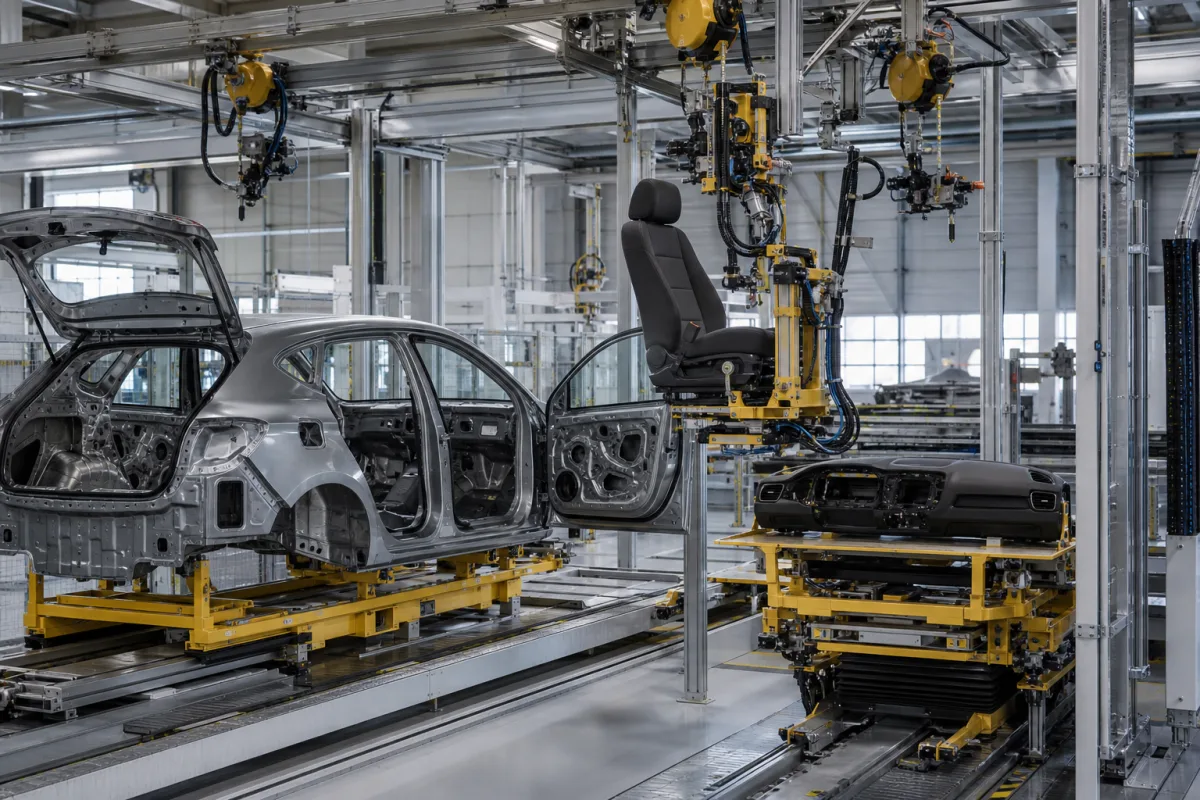
The Interior Assembly Station is a critical component of the Automotive Final Assembly System where workers or automated systems install the complete interior package into the vehicle body-in-white. This includes seats, dashboard/instrument panel, center console, door panels, headliner, carpeting, and various trim pieces. The station is designed with ergonomic considerations, tooling fixtures, and part presentation systems to ensure efficient, precise, and high-quality installation of all interior components before the vehicle proceeds to final testing and inspection.
Working Principle
The station operates by receiving a vehicle body on a conveyor or carrier. Operators or robots, guided by work instructions and often assisted by automated tooling (like torque guns, suction cups, or alignment pins), sequentially install pre-assembled interior modules and components. The station may include part sequencing racks, kitting carts, and error-proofing systems (e.g., andon lights, vision systems) to ensure correct part placement and fastening to specified torque values.
Common Materials
Steel (frame/structure), Aluminum (fixtures/guards), Polyurethane (ergonomic mats), Polycarbonate (safety guarding)
Technical Parameters
  • Station footprint (Length x Width) to accommodate vehicle body and operator workspace. (mm) Customizable
Components / BOM
  • Body Fixture / Carrier
    Precisely locates and secures the vehicle body during assembly operations.
    Material: Steel, Aluminum
  • Tool Balancer / Reel
    Manages hoses and cables for power tools (e.g., electric torque guns), reducing operator fatigue.
    Material: Steel, Plastic
  • Part Presentation Rack
    Holds and sequences interior components (seats, dashboards) for efficient pick-and-place by operators.
    Material: Steel, Plastic Bins
  • Ergonomic Floor Matting
    Provides anti-fatigue standing surface for operators.
    Material: Polyurethane, Rubber

Industry Taxonomies & Aliases

Commonly used trade names and technical identifiers for Interior Assembly Station.

Industrial Ecosystem & Supply Chain Structure

Complementary Systems
Downstream Applications
Specialized Tooling

Application Fit & Sizing Matrix

Operational Limits
pressure: Max 10 bar (145 psi) pneumatic system pressure
other spec: Max 500 kg (1100 lb) vehicle body weight capacity, 0.5-2.0 m/s conveyor speed range
temperature: 15-35°C (59-95°F) ambient operating range
Media Compatibility
✓ Automotive interior trim components (dashboards, door panels) ✓ Seat assemblies and upholstery systems ✓ Electrical harnesses and infotainment modules
Unsuitable: High-particulate environments (e.g., foundry operations, heavy machining areas)
Sizing Data Required
  • Vehicle body dimensions and model variants
  • Required cycle time (vehicles per hour)
  • Number of interior components to be installed per station

Reliability & Engineering Risk Analysis

Failure Mode & Root Cause
Mechanical wear in linear guides
Cause: Contamination from assembly debris and inadequate lubrication leading to abrasive particle ingress and increased friction
Electrical contact degradation in control systems
Cause: Oxidation and pitting from environmental humidity combined with frequent cycling causing arcing and contact erosion
Maintenance Indicators
  • Unusual grinding or scraping noises during linear motion operations
  • Inconsistent positioning accuracy or repeated calibration failures
Engineering Tips
  • Implement predictive maintenance using vibration analysis on moving components and thermal imaging on electrical connections
  • Establish contamination control protocols including regular cleaning schedules and environmental monitoring for humidity and particulate levels

Compliance & Manufacturing Standards

Reference Standards
ISO 9001:2015 Quality Management Systems ANSI/ASME B46.1-2019 Surface Texture DIN 8580:2003-09 Manufacturing Processes
Manufacturing Precision
  • Positioning Accuracy: +/-0.5mm
  • Surface Flatness: 0.2mm per meter
Quality Inspection
  • Dimensional Verification with CMM
  • Load Testing to 150% Rated Capacity

Factories Producing Interior Assembly Station

Manufacturer profiles with relevant production capability in China

Manufacturer listings support early research and capability understanding. They are not certification, ranking, or transaction guarantees.

Technical documentation
4/5
Manufacturing capability
4/5
Inspection readiness
5/5
Supplier transparency
3/5

These scores are example evaluation dimensions, not real customer ratings, country-specific buyer feedback, or live inquiry activity.

Supply Chain Compatible Machinery & Devices

Automotive Battery Management System

Electronic control system for monitoring and managing vehicle battery packs.

Explore Specs →
Automotive Wireless Power Transfer System

Wireless charging system for electric vehicles using electromagnetic induction.

Explore Specs →
Automotive Solid-State Battery Pack

High-energy-density solid-state battery system for electric vehicles

Explore Specs →
Automotive Active Grille Shutter System

Aerodynamic system with motorized shutters for vehicle thermal and efficiency management.

Explore Specs →

Frequently Asked Questions

What are the key components of an interior assembly station?

Key components include a body fixture/carrier to secure the vehicle, ergonomic floor matting for operator comfort, part presentation racks for component organization, and tool balancers/reels for efficient tool management.

How does this station improve automotive assembly line efficiency?

It streamlines interior installation by providing organized component access, ergonomic positioning for operators, and integrated tool management, reducing installation time and improving quality control in final assembly.

What safety features are included in the design?

Safety features include polycarbonate guarding for impact protection, aluminum fixtures with rounded edges, non-slip polyurethane matting, and ergonomic design to reduce operator strain and prevent workplace injuries.

Can I contact factories directly on CNFX?

CNFX is an open directory, not a transaction platform. Each factory profile provides direct contact information and production details to help you initiate direct inquiries with Chinese suppliers.

Data Basis

CNFX manufacturer profiles, technical classification, publicly available product information, and ongoing plausibility checks.

Preliminary Technical Classification
This page supports structured research, RFQ preparation, and supplier evaluation. It does not replace buyer-led supplier qualification, standards review, or technical approval.

Request Manufacturing Insight for Interior Assembly Station

Ask for use case, specification boundaries, supplier type, and RFQ preparation information for Interior Assembly Station.

Your business information is used only to process this request.

Thank you! Your message has been sent. We'll respond within 1–3 business days.

Need to Manufacture Interior Assembly Station?

Compare manufacturer profiles with relevant product and process capability.

Create Manufacturer Profile Contact Us
Previous Product
Instrument Panel
Next Product
Isolated Power Supply