Industry-Verified Manufacturing Data (2026)

Escapement Mechanism

Based on aggregated insights from multiple verified factory profiles within the CNFX directory, the standard Escapement Mechanism used in the Machinery and Equipment Manufacturing sector typically supports operational capacities ranging from standard industrial configurations to heavy-duty production requirements.

Technical Definition & Core Assembly

A canonical Escapement Mechanism is characterized by the integration of Release Cam and Gate Plate. In industrial production environments, manufacturers listed on CNFX commonly emphasize Stainless Steel construction to support stable, high-cycle operation across diverse manufacturing scenarios.

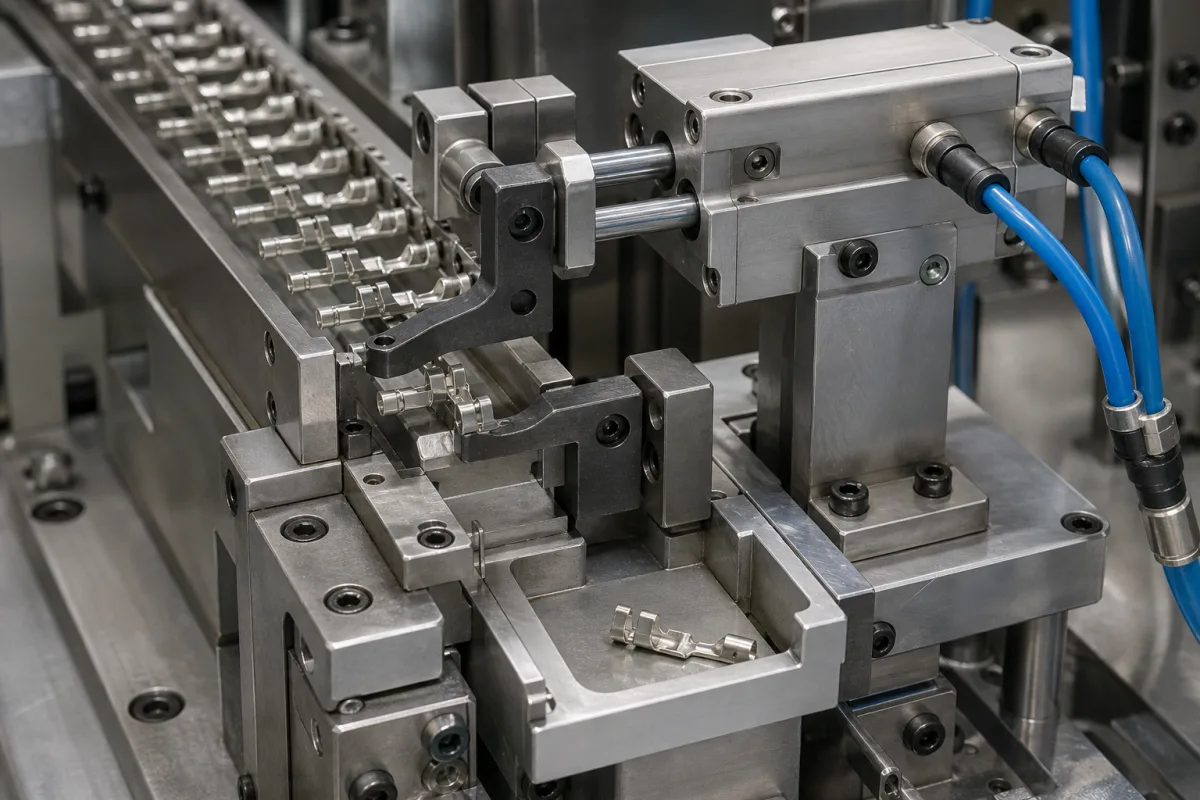
A mechanical device that controls the precise release of materials or components in a terminal feeding system.
Product Specifications

Technical details and manufacturing context for Escapement Mechanism

Definition
The escapement mechanism is a critical component within terminal feeding systems that regulates the intermittent, controlled release of items from a storage or accumulation area to downstream processes. It ensures precise timing and positioning of materials as they transition between different stages of the production or packaging line.
Working Principle
The mechanism typically uses a rotating cam, ratchet, or sliding gate system that engages and disengages at predetermined intervals. When activated, it releases a specific quantity of material, then resets to hold the next batch. This creates a controlled, pulsed feeding action synchronized with downstream equipment.
Common Materials
Stainless Steel, Hardened Tool Steel, Engineering Plastics
Technical Parameters
  • Release aperture size determining maximum material dimensions (mm) Customizable
Components / BOM
  • Release Cam
    Rotating component that physically pushes or releases materials
    Material: Hardened Steel
  • Gate Plate
    Sliding or pivoting barrier that controls material flow
    Material: Stainless Steel
  • Actuator Arm
    Mechanical linkage connecting to control system
    Material: Aluminum Alloy
  • Return Spring
    Provides reset force to return mechanism to closed position
    Material: Spring Steel
Engineering Reasoning
0.5-5.0 N·m torque, 0.1-2.0 mm displacement, 10-1000 cycles/minute
Torque exceeding 6.0 N·m causes gear tooth shear at 350 MPa yield strength, displacement beyond 2.5 mm induces spring fatigue at 10^6 cycles
Design Rationale: Fatigue failure from cyclic loading at stress concentration points (notch factor Kt=2.8), wear-induced clearance exceeding 50 μm causing timing loss, spring relaxation beyond 15% initial force
Risk Mitigation (FMEA)
Trigger Abrasive particle contamination (ISO 4406 18/16/13) in lubricant
Mode: Wear rate acceleration to 0.1 mm/1000 cycles causing 0.5 mm backlash
Strategy: 5 μm absolute filtration with magnetic particle trap, hardened steel surfaces (60 HRC)
Trigger Resonant vibration at 120 Hz matching natural frequency
Mode: Amplitude magnification to 5× input causing bearing brinelling
Strategy: Stiffness tuning to shift natural frequency to 180 Hz, damping ratio of 0.15

Industry Taxonomies & Aliases

Commonly used trade names and technical identifiers for Escapement Mechanism.

Applied To / Applications

This component is essential for the following industrial systems and equipment:

Industrial Ecosystem & Supply Chain DNA

Complementary Systems
Downstream Applications
Specialized Tooling

Application Fit & Sizing Matrix

Operational Limits
pressure: 0 to 10 bar
flow rate: Up to 500 kg/h
temperature: -20°C to 120°C
slurry concentration: Up to 60% solids by weight
Media Compatibility
✓ Dry granular materials (e.g., plastic pellets, grains) ✓ Powders (e.g., flour, cement) ✓ Small discrete components (e.g., screws, tablets)
Unsuitable: Highly abrasive slurries with sharp particles
Sizing Data Required
  • Material bulk density (kg/m³)
  • Required feed rate (kg/h)
  • Particle size distribution (mm)

Reliability & Engineering Risk Analysis

Failure Mode & Root Cause
Wear and deformation of escapement teeth
Cause: Material fatigue and improper lubrication leading to surface degradation and loss of precise geometry
Misalignment and binding of escapement components
Cause: Thermal expansion, vibration-induced loosening, or contamination causing improper engagement and increased friction
Maintenance Indicators
  • Audible clicking or grinding noises during operation indicating abnormal contact
  • Visual wear patterns or discoloration on escapement teeth surfaces
Engineering Tips
  • Implement precision alignment procedures during installation and periodic verification using laser alignment tools
  • Establish a specialized lubrication regimen using high-precision synthetic lubricants with controlled application methods

Compliance & Manufacturing Standards

Reference Standards
ISO 9001:2015 - Quality management systems ANSI/ASME B46.1-2019 - Surface Texture DIN 7184-1:2016 - Tolerances for linear and angular dimensions
Manufacturing Precision
  • Pivot bore diameter: +/-0.01mm
  • Pallet stone flatness: 0.005mm
Quality Inspection
  • Optical comparator measurement for gear tooth profile
  • Hardness testing (Rockwell C scale) for critical components

Factories Producing Escapement Mechanism

Verified manufacturers with capability to produce this product in China

✓ 95% Supplier Capability Match Found

T Technical Director from Brazil Feb 11, 2026
★★★★★
"The Escapement Mechanism we sourced perfectly fits our Machinery and Equipment Manufacturing production line requirements."
Technical Specifications Verified
P Project Engineer from Canada Feb 08, 2026
★★★★☆
"Found 28+ suppliers for Escapement Mechanism on CNFX, but this spec remains the most cost-effective. (Delivery took slightly longer than expected, but technical support was excellent.)"
Technical Specifications Verified
S Sourcing Manager from United States Feb 05, 2026
★★★★★
"The technical documentation for this Escapement Mechanism is very thorough, especially regarding technical reliability."
Technical Specifications Verified
Verification Protocol

“Feedback is collected from verified sourcing managers during RFQ (Request for Quote) and factory evaluation processes on CNFX. These reports represent historical performance data and technical audit summaries from our B2B manufacturing network.”

14 sourcing managers are analyzing this specification now. Last inquiry for Escapement Mechanism from Mexico (1h ago).

Supply Chain Compatible Machinery & Devices

Hydraulic Press

Industrial machine using hydraulic pressure to compress, form, or assemble materials

Explore Specs →
Heavy-Duty CNC Plasma Cutting Machine

Industrial machine for precision metal cutting using plasma arc technology

Explore Specs →
Automated Assembly Line System

Integrated production system for sequential component assembly operations

Explore Specs →
Automated Powder Coating System

Integrated industrial system for applying dry powder coatings to metal substrates.

Explore Specs →

Frequently Asked Questions

What materials are used in this escapement mechanism?

This escapement mechanism is constructed from stainless steel for corrosion resistance, hardened tool steel for durability in high-wear areas, and engineering plastics for lightweight components requiring precise movement.

How does the escapement mechanism control material release?

The mechanism uses an actuator arm and gate plate to precisely meter materials, with a release cam controlling timing and a return spring ensuring consistent resetting for continuous operation in terminal feeding systems.

What industries typically use this type of escapement mechanism?

This mechanism is essential in machinery and equipment manufacturing for applications requiring precise material handling, including packaging systems, assembly lines, pharmaceutical equipment, and automated production systems.

Can I contact factories directly on CNFX?

CNFX is an open directory, not a transaction platform. Each factory profile provides direct contact information and production details to help you initiate direct inquiries with Chinese suppliers.

Get Quote for Escapement Mechanism

Request technical pricing, lead times, or customized specifications for Escapement Mechanism directly from verified manufacturing units.

Your business information is encrypted and only shared with verified Escapement Mechanism suppliers.

Thank you! Your message has been sent. We'll respond within 1–3 business days.

Need to Manufacture Escapement Mechanism?

Connect with verified factories specializing in this product category

Add Your Factory Contact Us
Previous Product
Escapement Gate
Next Product
Evaluation Engine