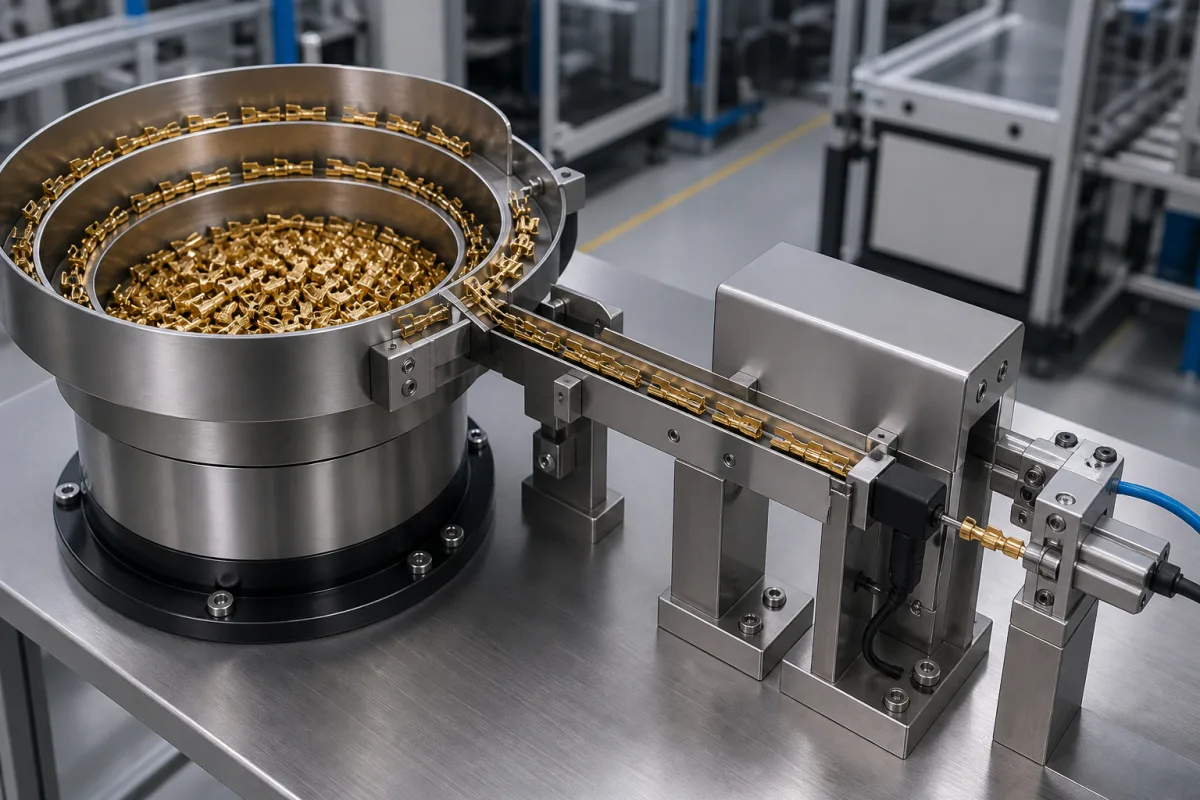
Loose-piece terminal feeding system: vibratory bowl, orienting gate and linear track that deliver single terminals and ferrules to a crimp head
Feeding loose-piece terminals, pin contacts and wire-end ferrules one at a time to a crimp head · bowl orientation, inverting gates, chuck hand-off and multi-bowl changeover
A crimping machine fed from a reel takes its terminals already lined up on a carrier strip. The feeder on this page serves the other case: terminals, pin contacts and ferrules that arrive loose in bulk, in random orientation, and have to be turned the right way round and released singly at the rate the crimp head consumes them.
Feeding systems for loose-piece (bulk) electrical terminals, pin and socket contacts and wire-end ferrules: vibratory bowls and hoppers, orienting tracks and gates, linear vibratory tracks, escapements and belt cassettes that present single parts to a crimp head. Fully automatic and semi-automatic cut-strip-crimp machines that crimp reel-fed strip terminals are covered on the Automated wire harness crimping machine page; force monitoring of the crimp stroke is covered on the Force monitoring system for crimping and pressing page; general vibratory bowl feeders with their drive bases are covered on the Vibratory bowl feeder page, linear tracks and escapements for assembly machines on the Feeding mechanism page, and reel and bowl supply for terminal insertion machines on the Vibratory bowl feeder and reel stand page.
CNFX editorial research · Sources checked October 12, 2026 · 4 sources
Whether a loose terminal will orient in a bowl: a heavy end or shoulder sorts reliably, a shoulderless size 22D socket contact comes out right way round about half the time
The deciding question for a loose-piece feeder is the shape of the part, and the four routes below differ in what they ask of it.
The example given for the hard case is a female pin contact to MIL-C-39029/57-357, contact size 22D, with a hollow mating end and no shoulder: in conventional bowl feeders about 50 % of these arrive in the desired orientation, the rest are sorted and recirculated repeatedly, and that recirculation lowers throughput and can damage the contacts. [1]
AMP gives the reason loose-piece feeding exists at all: terminals made on automatic screw machines can only be produced as individual pieces, not in strip form. [2]
Feeding route
What it needs from the part
Published detail
Vibratory bowl with internal helical track, sorting gate and exit chute
A heavy end or a shoulder near one end, so vibration sets parts into the track the right way and the gate recirculates the rest [1]
Described in US 6,230,395 as the arrangement of machines for loose electrical pin contacts [1]
Hopper plus inverting feeder
Nothing beyond an elongated shape: a sensor reads which end is up and a rotating disk inverts the wrong ones before release [1]
Disk turns about 135 to 175°, preferably about 165°, to invert a part over the outlet chute; parts leave one at a time to the crimping chuck [1]
Belt cassette (magazine)
Parts loaded into individual cells of a belt wound in the cassette; the crimping machine pulls the belt and parts are removed at a discharge station [2]
Housing parts vacuum-formed from plastic as thin as 0.03 in [2]
Strip or belt carrier from the part maker
A part that can be made and supplied in a fixed-orientation carrier [1]
US 6,230,395 notes that some components cannot be adapted to it and that carriers can leave excessive scrap [1]
Send drawings or samples of each terminal; say which end must face the crimp head and whether the parts are stamped strip terminals cut loose, screw-machined contacts or ferrules.
02
From the outlet chute into the crimp jaws: a chuck that catches the contact, pivots about 45° and pushes it into a four-indenter crimp station
In Bejerano's crimping machine the feeder hands over a single oriented contact, and the rest of the transfer is mechanical. [1]
In stand-by the machine holds one contact in the jaws, the next in the disk chamber and further contacts queued end-to-end in the inlet chute, so the crimp cycle does not wait for orientation. [1] In the Zoller + Fröhlich machine the conductor end is located by a centering device relative to the crimp head, and the cable can be stripped either outside the machine or by a stripping head built into it. [3]
Step
What happens
1. Release
The rotatable disk, turned to about 165° when the sensor reports a reversed part, drops one contact into the outlet chute [1]
2. Capture
A vertical positioning chute below the outlet chute deposits the contact into a positioning chuck, which grips its first end [1]
3. Align
An actuator pivots the chuck about 45° forward so the contact is perpendicular to the station front face and in line with the insertion port [1]
4. Present
A second actuator extends the chuck to place the contact's second end in the open crimping jaws [1]
5. Crimp
The operator inserts the conductor through the port in the front face, inclined about 45° for line of sight; four indenters converge as the jaw levers rotate, with an adjustable cam stop setting crimp depth [1]
Say whether the operator inserts the wire by hand or the machine centres and strips it, and how many parts must be queued ahead of the crimp head.
03
One vibration drive under four or five bowls: changing ferrule size without re-tooling the crimper
Zoller + Fröhlich's crimping machine patent mounts ferrule feeding bowls (four or five in its figures, 8a to 8e) on one cover plate above a single shared vibration drive, with the control unit selecting which bowl conveys; all bowls deliver into one feed to a single crimp head. Bowls can sit side by side on a pitch circle or be stacked, and can swing out for loading. The listed bowl assignments are cable cross-sections of 0.34, 0.50, 0.75, 1.00, 1.50, 2.50 and 4.00 mm² (the unit appears as “mm” in the patent text). [3] The patent's case against the alternatives is that converting one machine for each cross-section costs set-up time and risks the wrong cable size, while a machine per size costs investment. [3]
At the single-size end, Rittal sells a vibratory bowl feeder as an accessory for its L8 crimping machine, for loose wire-end ferrules of 0.5 to 1.5 mm², with a net weight of 0.77 kg. [4]
List every terminal or ferrule size the feeder must hold at once, how often you change between them, and whether stripping is done in the same machine.
04
What to send when specifying a loose-piece terminal feeder
Paste it into your enquiry below or into an email to a maker, then replace every bracket.
Parts: [terminal or ferrule type; drawing or samples; plating; mass; length; which end leads]
Supply: [loose bulk, cassette or strip; parts per fill]
Rate: [parts per minute needed at the crimp head]
Sizes: [number of terminal or ferrule sizes held at once; changeover frequency]
Interface: [crimping machine make and model; feed point; sensor and gate signals]
Track: [material in contact with the part; noise limit]
Explore company information and manufacturing capabilities, then discuss the scope of your project with a relevant supplier.
Share this page
Compiled and source-reviewed by the CNFX editorial team.
Each manufacturer above links to the page on that company's own website where the product is listed, with the date we checked it. How we source and review
· Page last updated 13 October 2026
Buyer questions
Why do some loose terminals not orient well in a vibratory bowl?
Bowl sorting relies on a heavy end or a shoulder near one end; for a shoulderless size 22D socket contact, conventional bowls deliver only about 50 % in the right orientation. [1]
Why are some terminals supplied loose instead of on a strip?
Terminals made on automatic screw machines can only be produced as individual pieces. [2]
How does a fed contact get into the crimp jaws?
In one patented machine a chuck catches the contact under the outlet chute, pivots about 45° to line it up with the insertion port, and extends to place it in four-indenter jaws. [1]
Can one feeder serve more than one ferrule size?
Zoller + Fröhlich patented feeding bowls on one shared vibration drive, selected by the control unit, assigned to cable cross-sections from 0.34 to 4.00 mm². [3]
Sources and what still needs a direct check
Sources checked 2026-10-12. Orientation, feeding routes and the hand-off to the crimp jaws come from patents by Abraham Bejerano and AMP; multi-bowl ferrule feeding from a Zoller + Fröhlich patent and a Rittal accessory sheet.