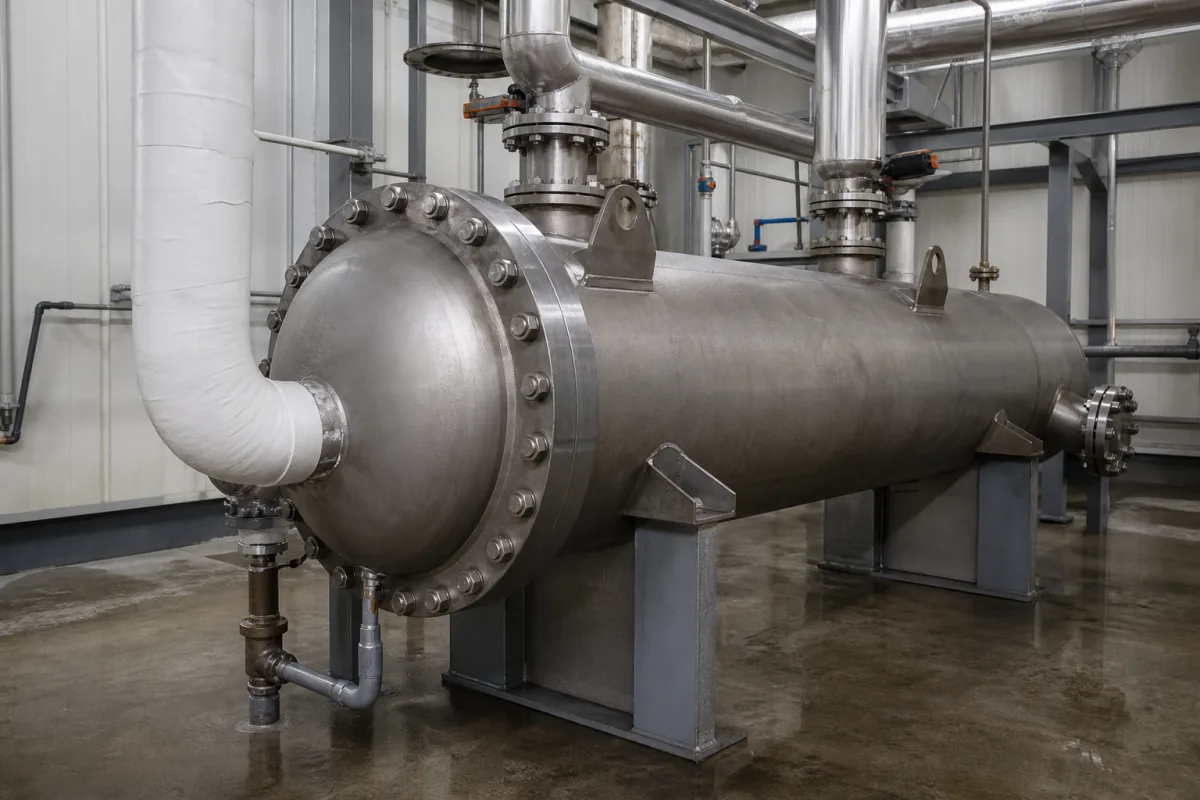
Refrigeration evaporators — shell-and-tube chillers (dry expansion and flooded) and air-cooling unit coolers · capacity at stated conditions, refrigerant, passes and baffles, water velocity, freeze protection, fin spacing, defrost type, suction-temperature correction
An evaporator is the heat exchanger in a refrigeration system where liquid refrigerant boils and absorbs heat — from water or brine in a shell-and-tube chiller, or from room air in a fan-coil unit cooler. Ask three things first: what it must cool and at what temperatures, which decides between a liquid chiller and an air cooler; the capacity required at your refrigerant and suction temperature; and the construction details — passes, baffles, fin spacing and defrost — that keep it working at those conditions.
Refrigeration evaporators — dry-expansion (DX) and flooded shell-and-tube chillers, and air-cooling unit coolers for cold rooms and warehouses — for HFC, HFO, CO₂ and other refrigerants. Brazed-plate heat exchangers, condensers, complete chillers and condensing units, and evaporators for chemical concentration (process evaporators) are outside this page except where compared.
CNFX editorial research · Sources checked October 11, 2026 · 4 sources
Choose a shell-and-tube chiller or an air unit cooler
ACR News explains that shell-and-tube chillers cool a closed recirculating fluid using refrigerant. In the dry or direct-expansion (DX) type, refrigerant from the expansion device passes into a bundle of tubes inside a steel shell and progressively evaporates, while water flows over the tubes and leaves colder than it entered; ACR News calls an inlet and outlet at the same end "a more common arrangement", and says these are "normally used" with positive-displacement compressors such as reciprocating, rotary or screw machines. In the flooded (hooded) type, water runs through the tubes and refrigerant surrounds them in the shell, with about 50–75% of the tubes immersed in liquid and free space above so liquid mist can settle before vapour leaves through the suction outlet; a semi-flooded variant immerses only the bottom row. Where water must go below 0 °C, an antifreeze additive is used, with freeze points beyond −50 °C described as attainable. [1]
For room air, Heatcraft's large warehouse unit coolers use aluminium-fin, copper-tube coils with fans, a stainless-steel cabinet option and standard-refrigerant (R-404A, R-407A/C/F, R-448A/449A, R-507A) or CO₂ (R-744) coil designs. [2]
Give the supplier the duty (water, brine or room air), entering and leaving or room temperatures, flow rate, required capacity, refrigerant and saturated suction temperature, DX or flooded type, passes and baffle arrangement, allowable pressure drop, antifreeze type and concentration, tube and fin materials, fin spacing and defrost method for air coolers, design pressure and pressure-equipment code, connections, dimensions and weight limits, and quantity.
02
Correct capacity to your conditions and construction
In a DX shell-and-tube chiller, ACR News says baffle plates support the tubes and force water to change direction, increasing turbulence, velocity and heat transfer; water crossing the tubes should flow at no less than 0.6 m/s (2 ft/s) to keep tubes clean and below 3 m/s (10 ft/s) to avoid erosion; more baffles raise capacity but also pump pressure drop. Refrigerant must reach all tubes evenly or unevaporated liquid can flood the compressor; single-pass bundles need full evaporation in one length, two-pass designs halve bundle length, and different end heads give up to six passes. [1] Heatcraft's unit-cooler guide rates capacity at stated conditions — for example 115,827 Btu/h (33,945 W) for one 6-fin-per-inch model at 10 °F temperature difference, 25 °F suction and 80% relative humidity — covers 42,000 to 410,000 Btu/h with 3 to 6 fins per inch, offers air, electric and hot-gas defrost, and gives capacity correction factors for low-temperature electric and hot-gas defrost units of 1.15 at 20 °F (−7 °C) suction, 1.04 at −10 °F, 1.0 at −20 °F, 0.9 at −30 °F and 0.8 at −40 °F (−40 °C), for reference only. [2]
Editorial calculation: a low-temperature unit cooler rated 100 kW at −20 °F suction would deliver about 90 kW at −30 °F and 80 kW at −40 °F using those factors, so a cold-room load of 90 kW at −30 °F needs at least a 100 kW unit at the −20 °F rating point. Confirm with the maker's own data at your conditions. [2]
03
Compare what suppliers offer
The manufacturer cards below state what each reviewed source shows.
When requesting quotations, ask each supplier for rated capacity at your exact conditions, refrigerant compatibility, pressure-equipment certification and the selection software or tables used.
04
Check US efficiency minimums for walk-in unit coolers
For unit coolers sold into US walk-in coolers and freezers, the Department of Energy's rule at 10 CFR 431.306 sets a minimum annual walk-in energy factor (AWEF). The table in the rule gives 9.00 Btu/W-h for a medium-temperature unit cooler; for a low-temperature unit cooler the minimum is 4.15 Btu/W-h at a net capacity of 15,500 Btu/h or more, and 1.575 × 10⁻⁵ × q_net + 3.91 below that, where q_net is the net capacity determined and certified under the DOE test and certification rules. Walk-in process cooling refrigeration systems are excluded. [3] The same section requires evaporator fan motors under 1 horsepower and below 460 volts in walk-ins to be electronically commutated or 3-phase motors. [3]
Editorial calculation: a low-temperature unit cooler with a certified net capacity of 10,000 Btu/h would need an AWEF of at least 1.575 × 10⁻⁵ × 10,000 + 3.91 ≈ 4.07 Btu/W-h under that formula. [3] Editorial note: for a cold room in the US market, ask the supplier for the certified AWEF and net capacity of the exact unit-cooler model and refrigerant, and for the evaporator fan motor type; outside the US, ask which national efficiency rule applies instead.
05
Match the unit-cooler series to your room capacity
Kelvion's cubic air cooler page, aimed at supermarkets, warehouses, halls and slaughterhouses, lists each series by capacity: SG Commercial 0.4–65 kW, VRS 5–55 kW, VNS 9–66 kW, GSX & GBX 6.4–184 kW and CSX & CBX 7.4–175 kW. It says VRS fans can blow through or draw through while VNS fans blow through, and both have a hinged drip tray. GSX & GBX come with 750+ defined options offered for short delivery times, against 8,000+ options for the bespoke CSX & CBX. A further FLF/FLH series for heat absorption covers 10–240 kW with 4 or 6 mm fin spacing, air inlet hoods for weather protection and availability for natural refrigerants. The page offers selection software and a factsheet per series. [4]
Editorial calculation: Heatcraft's 42,000–410,000 Btu/h warehouse unit-cooler range is about 12.3–120 kW (× 0.000293 kW per Btu/h), and its 3–6 fins per inch equal about 8.5–4.2 mm fin spacing (25.4 mm ÷ FPI). [2] The Kelvion page gives ranges only, without the suction temperature, temperature difference or refrigerant behind them, so ask each supplier for capacity at your room conditions. [4]
06
Trace the evaporator
This is a functional reference built from the sources cited; it is not one maker's design.
Fill the specification fields with values for your project
An evaporator quotation needs values for your project. The table explains each field, gives published values where a reviewed source states them, and says what to obtain from the supplier.
The manufacturers below list refrigeration evaporators on their own websites; each card links to the page reviewed. Confirm ratings, materials and approvals for your order.
Demofei Heat Exchanger (Pinghu) Co., Ltd.
Manufacturing site to be confirmed for the order
Lists ceiling-type, double-coil and work-room evaporators; its production-sites page lists a plant in Pinghu, China, set up in 2018.
Explore company information and manufacturing capabilities, then discuss the scope of your project with a relevant supplier.
Share this page
Compiled and source-reviewed by the CNFX editorial team.
Published product pages show what a company offers, not tested performance. Confirm the legal seller, factory and scope for your order. How we source and review
· Page last updated 13 October 2026
Buyer questions
What is the difference between DX and flooded shell-and-tube evaporators?
In DX, refrigerant evaporates inside the tubes and water flows over them; in flooded types, water runs in the tubes and refrigerant surrounds them in the shell. [1]
What water velocity suits a shell-and-tube chiller?
At least 0.6 m/s to keep tubes clean and below 3 m/s to avoid erosion. [1]
How does suction temperature change unit-cooler capacity?
Heatcraft's factors run from 1.15 at 20 °F to 0.8 at −40 °F suction, relative to −20 °F. [2]
What efficiency must a walk-in unit cooler meet in the US?
The US Department of Energy's 10 CFR 431.306 sets a minimum AWEF of 9.00 Btu/W-h for medium-temperature unit coolers and 4.15 Btu/W-h for low-temperature unit coolers of 15,500 Btu/h net capacity or more. [3]
What capacity range do cubic cold-room air coolers cover?
Kelvion's cubic air cooler page lists series from 0.4–65 kW (SG Commercial) up to 6.4–184 kW (GSX & GBX), without stating the rating conditions. [4]
Sources and what still needs a direct check
Sources checked 2026-10-11. ACR News is a refrigeration trade publication; the Heatcraft technical guide describes its own unit coolers.