Industry-Verified Manufacturing Data (2026)

Refrigeration System

Based on aggregated insights from multiple verified factory profiles within the CNFX directory, the standard Refrigeration System used in the Machinery and Equipment Manufacturing sector typically supports operational capacities ranging from standard industrial configurations to heavy-duty production requirements.

Technical Definition & Core Assembly

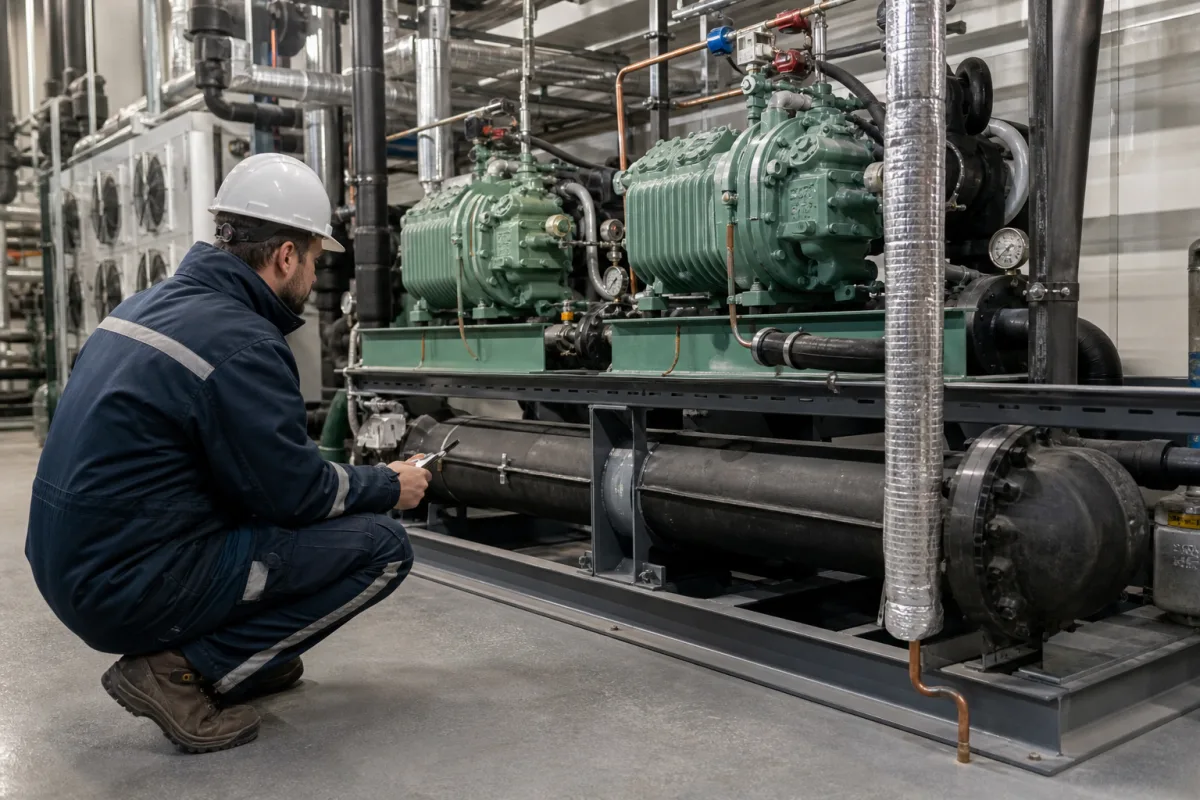
A canonical Refrigeration System is characterized by the integration of Compressor and Condenser. In industrial production environments, manufacturers listed on CNFX commonly emphasize Copper tubing construction to support stable, high-cycle operation across diverse manufacturing scenarios.

A system that provides controlled cooling to maintain low temperatures required for the lyophilization process in pharmaceutical manufacturing.
Product Specifications

Technical details and manufacturing context for Refrigeration System

Definition
The refrigeration system is a critical component of the Automated Pharmaceutical Lyophilization System that removes heat from the product chamber and condenser to create and maintain the vacuum freeze-drying environment necessary for preserving sensitive pharmaceutical compounds. It ensures precise temperature control during primary drying (sublimation) and secondary drying (desorption) phases.
Working Principle
The refrigeration system operates on vapor-compression cycle principles, where a refrigerant circulates through a closed loop. It compresses gaseous refrigerant, condenses it to liquid in a heat exchanger, expands it through an expansion valve to create cooling, and evaporates it in the evaporator to absorb heat from the lyophilization chamber and condenser.
Common Materials
Copper tubing, Stainless steel components, Refrigerant (R404A/R507)
Technical Parameters
  • Cooling capacity of the refrigeration system (kW) Per Request
Components / BOM
  • Compressor
    Compresses refrigerant gas to increase pressure and temperature
    Material: Cast iron or steel housing with copper windings
  • Condenser
    Rejects heat from high-pressure refrigerant, converting it to liquid
    Material: Copper tubes with aluminum fins
  • Expansion Valve
    Controls refrigerant flow and pressure drop for cooling effect
    Material: Brass or stainless steel
  • Evaporator
    Absorbs heat from lyophilization chamber, evaporating refrigerant
    Material: Stainless steel plates or coils
Engineering Reasoning
1.5-3.0 MPa (15-30 bar) at -40°C to -60°C evaporator temperature
Compressor discharge pressure exceeding 4.2 MPa (42 bar) or evaporator temperature rising above -25°C for >30 minutes
Design Rationale: Refrigerant R404A phase change failure due to insufficient subcooling (<3K) causing flash gas formation in expansion valve, reducing cooling capacity by >40%
Risk Mitigation (FMEA)
Trigger Oil migration from compressor to evaporator exceeding 8% mass fraction
Mode: Heat transfer coefficient degradation from 850 W/m²·K to <300 W/m²·K
Strategy: Oil separator with 99.7% efficiency and automatic oil return system with 0.5 L/min capacity
Trigger Condenser fouling resistance exceeding 0.00035 m²·K/W
Mode: Condensing temperature rise from 35°C to >55°C, increasing compressor power by 25%
Strategy: Automated tube cleaning system with 2.5 mm diameter brushes operating at 0.3 m/s velocity

Industry Taxonomies & Aliases

Commonly used trade names and technical identifiers for Refrigeration System.

Applied To / Applications

This component is essential for the following industrial systems and equipment:

Industrial Ecosystem & Supply Chain DNA

Complementary Systems
Downstream Applications
Specialized Tooling

Application Fit & Sizing Matrix

Operational Limits
pressure: Up to 10 bar (refrigerant side), 1-3 bar (process side)
flow rate: 5-50 m³/h (coolant circulation)
temperature: -60°C to +20°C (typical lyophilization cooling range)
slurry concentration: Up to 25% solids (for indirect cooling applications)
Media Compatibility
✓ Pharmaceutical-grade water/glycol mixtures ✓ Silicone-based heat transfer fluids ✓ Food-grade propylene glycol solutions
Unsuitable: Corrosive chemical environments with chlorides or strong acids
Sizing Data Required
  • Total heat load (kW) from lyophilization process
  • Required cooling temperature setpoint and stability (±°C)
  • Available utility connections (electrical power, cooling water)

Reliability & Engineering Risk Analysis

Failure Mode & Root Cause
Compressor mechanical failure
Cause: Lubrication breakdown due to refrigerant contamination, moisture ingress, or oil degradation leading to bearing wear, piston scoring, or valve plate damage
Refrigerant leakage
Cause: Corrosion of copper tubing or aluminum fins from moisture and acidic byproducts, vibration-induced fatigue cracks at joints, or improper brazing/soldering during installation/repair
Maintenance Indicators
  • Unusual metallic grinding or knocking sounds from compressor indicating mechanical wear or component failure
  • Frost or ice accumulation on suction lines or compressor body signaling refrigerant undercharge, restriction, or moisture in system
Engineering Tips
  • Implement oil analysis program to monitor acid number, moisture content, and metallic wear particles in compressor lubricant, with scheduled changes based on condition rather than fixed intervals
  • Install vibration monitoring on compressor and critical rotating components with trending to detect imbalance, misalignment, or bearing degradation before catastrophic failure

Compliance & Manufacturing Standards

Reference Standards
ISO 5149:2014 (Refrigerating systems and heat pumps) ANSI/ASHRAE 15:2022 (Safety Standard for Refrigeration Systems) EN 378:2016 (Refrigerating systems and heat pumps)
Manufacturing Precision
  • Compressor shaft runout: ≤0.02 mm
  • Evaporator coil fin spacing: ±0.1 mm
Quality Inspection
  • Pressure Leak Test (Helium or Nitrogen)
  • Refrigerant Charge Verification (Mass/Volume measurement)

Factories Producing Refrigeration System

Verified manufacturers with capability to produce this product in China

✓ 96% Supplier Capability Match Found

P Project Engineer from Australia Jan 25, 2026
★★★★★
"Testing the Refrigeration System now; the Cooling Capacity (kW) results are within 1% of the laboratory datasheet."
Technical Specifications Verified
S Sourcing Manager from Singapore Jan 22, 2026
★★★★★
"Impressive build quality. Especially the Cooling Capacity (kW) is very stable during long-term operation."
Technical Specifications Verified
P Procurement Specialist from Germany Jan 19, 2026
★★★★★
"As a professional in the Machinery and Equipment Manufacturing sector, I confirm this Refrigeration System meets all ISO standards."
Technical Specifications Verified
Verification Protocol

“Feedback is collected from verified sourcing managers during RFQ (Request for Quote) and factory evaluation processes on CNFX. These reports represent historical performance data and technical audit summaries from our B2B manufacturing network.”

15 sourcing managers are analyzing this specification now. Last inquiry for Refrigeration System from Brazil (1h ago).

Supply Chain Compatible Machinery & Devices

Automated Assembly Line System

Integrated production system for sequential component assembly operations

Explore Specs →
Automated Powder Coating System

Integrated industrial system for applying dry powder coatings to metal substrates.

Explore Specs →
Centrifugal Pump Impeller

Rotating component that transfers energy to fluid in centrifugal pumps.

Explore Specs →
High-Precision CNC Laser Cutting Machine

Computer-controlled industrial machine using focused laser beams to cut sheet metal with micron-level accuracy.

Explore Specs →

Frequently Asked Questions

What temperature range does this refrigeration system maintain for lyophilization processes?

This system maintains precise low temperatures typically ranging from -50°C to -80°C, specifically designed for pharmaceutical lyophilization requirements.

Why are stainless steel components used in this refrigeration system?

Stainless steel components ensure corrosion resistance, meet pharmaceutical hygiene standards, and maintain system integrity in controlled manufacturing environments.

How does this system integrate with pharmaceutical freeze-drying equipment?

The system connects directly to lyophilization chambers through copper tubing, providing controlled cooling to maintain consistent vacuum and temperature conditions throughout the freeze-drying cycle.

Can I contact factories directly on CNFX?

CNFX is an open directory, not a transaction platform. Each factory profile provides direct contact information and production details to help you initiate direct inquiries with Chinese suppliers.

Get Quote for Refrigeration System

Request technical pricing, lead times, or customized specifications for Refrigeration System directly from verified manufacturing units.

Your business information is encrypted and only shared with verified Refrigeration System suppliers.

Thank you! Your message has been sent. We'll respond within 1–3 business days.

Need to Manufacture Refrigeration System?

Connect with verified factories specializing in this product category

Add Your Factory Contact Us
Previous Product
Reflector Assembly
Next Product
Refrigeration Unit