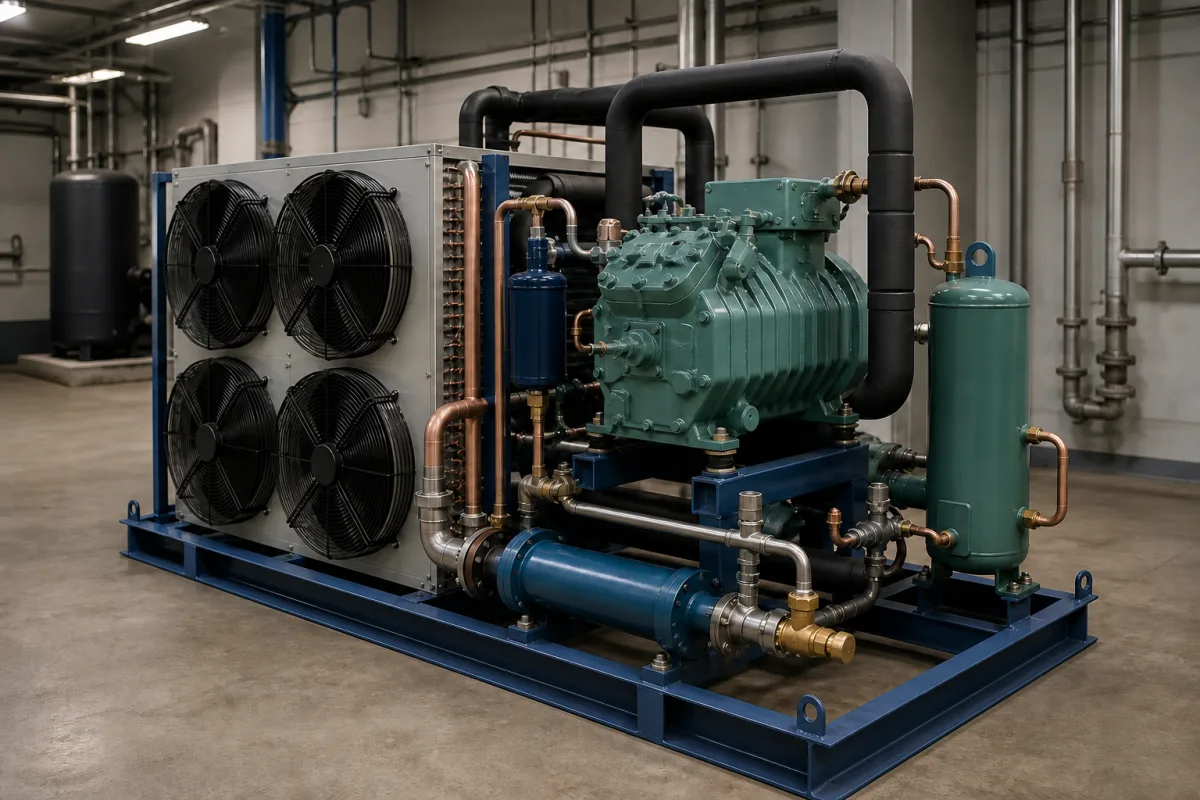
Condensing units for cold rooms · Refrigerant and operating envelope, US walk-in efficiency classes, piping, evacuation and charge
A refrigeration condensing unit combines a compressor and a fan-cooled condenser on a base frame, and may include a liquid receiver, pressure switches and service valves, and is piped to an evaporator in a cold room or process. Ask three things first: which refrigerants and evaporating temperatures the unit is approved for at your ambient, what efficiency it is rated to where a regulation applies, and how the suction piping, evacuation and refrigerant charge will be done on site.
Air-cooled condensing units for stationary commercial and industrial refrigeration such as cold rooms and walk-in coolers and freezers. Transport refrigeration units for trucks and vans, process water chillers, packaged monoblock units and household appliances are outside this page.
CNFX editorial research · Sources checked October 11, 2026 · 4 sources
Danfoss's instructions for its Optyma condensing units describe a compressor and fan-cooled condenser on a base frame, optionally with a liquid receiver, pressure switch, connecting box and service valves, and require the units to be used only within their application envelope of evaporating against ambient temperature. Its medium-temperature line with MTZ compressors is approved for R404A, R507, R134a, R407C, R407A, R452A, R448A and R449A, the low-temperature line with NTZ compressors for R404A, R452A and R507A, and any flammable refrigerant such as hydrocarbons is forbidden in these units. [2]
The same instructions require EN 378-2:2016 or the applicable local regulation to be met, any added receiver or pressure component to comply with the Pressure Equipment Directive 2014/68/EU, and high-pressure safety devices such as a pressure switch or relief valve. Units are shipped under 1 to 2 bar of nitrogen, must not be stored below −35 °C or above 50 °C, need unrestricted airflow, must never see more than 50 °C ambient during the off-cycle, should be sheltered outdoors and mounted with a slope of no more than 3°. [2]
In the United States the refrigerant choice is also capped by global warming potential (GWP). Under 40 CFR 84.54(c), the U.S. EPA rule on hydrofluorocarbons, no person may install a cold storage warehouse system using a regulated HFC or blend with a GWP of 700 or greater from July 27, 2026; from January 1, 2032 the limit becomes a GWP below 150 for systems with a refrigerant charge capacity of 200 lb or more (other than the high-temperature side of a cascade), below 300 for systems under 200 lb, and below 300 on the high-temperature side of cascade systems. Remote condensing units in retail food refrigeration face a GWP limit of 1,400 from July 27, 2026 and the same 150/300 split from January 1, 2032. [4] Editorial calculation: 200 lb is about 91 kg of charge, so for a unit installed in the US from 2032, confirm with the supplier both the refrigerant's GWP and whether the total system charge, including the field piping, crosses that line. Editorial note: refrigerants on Danfoss's approved list for these units, such as R404A and R507, need checking against these GWP limits for any US installation. [2][4]
Give the supplier the room or process temperature, cooling load, refrigerant required or allowed, ambient design temperature, indoor or outdoor location, evaporator type and expansion device, pipe run and height difference, power supply, noise limit and any efficiency regulation that applies.
02
Check the efficiency class where a regulation applies
In the United States, 10 CFR 431.306 sets minimum annual walk-in energy factors (AWEF) for walk-in refrigeration systems. Dedicated condensing systems for medium temperature need at least 5.61 Btu/W-h indoors and 7.60 outdoors (from June 5, 2017); for low temperature at 6,500 Btu/h net capacity or more, 2.40 indoors and 3.15 outdoors (from July 10, 2020), with formulas based on net capacity for smaller low-temperature systems. [1]
The same section requires condenser fan motors under 1 horsepower in walk-ins to be electronically commutated, permanent split capacitor or 3-phase motors, and wall, ceiling and door insulation of at least R-25 for coolers and R-32 for freezers. [1]
Editorial calculation: dividing by 3.412 Btu per watt-hour, an AWEF of 7.60 Btu/W-h corresponds to about 2.23 W of heat removed per watt of input, 5.61 to about 1.64, and the low-temperature 2.40 and 3.15 to about 0.70 and 0.92. The low-temperature formulas meet the fixed values at 6,500 Btu/h (about 1.9 kW): 9.091 × 10⁻⁵ × 6,500 + 1.81 ≈ 2.40. These are annualised ratings, not the efficiency at a single operating point.
03
Plan suction piping, evacuation and charge
Danfoss asks for suction lines sloped toward the compressor with gas velocity of 8 to 12 m/s in vertical risers, falling to no less than 4 m/s in horizontal runs, so oil returns; U-traps or double risers may be needed, with no more than 4 m of riser without a second trap, and the suction line insulated. Additional oil may be needed for line lengths beyond 20 m out and back. [2]
For evacuation it specifies 500 µm Hg (0.67 mbar) measured in the system and held for 4 hours, with a two-stage vacuum pump, and expects the filter dryer to bring moisture from as much as 100 ppm at commissioning to below 20 ppm. The low-side test pressure must not exceed 1.1 × Ps on the compressor nameplate. Refrigerant charge should be kept below 2.5 kg per cylinder where possible; above that, a pump-down cycle or suction accumulator is needed to prevent liquid flood-back. [2]
Editorial calculation: on a four-cylinder compressor, that guidance points to about 10 kg of charge before pump-down or an accumulator is required.
04
Compare what suppliers offer
The supplier linked to this page lists stationary refrigeration units; its card links to the page reviewed.
Ask any supplier for the compressor make and type, approved refrigerants and the operating envelope, the rated capacity at your evaporating and ambient temperatures, pressure equipment documentation, and any efficiency certification required in the destination market.
05
Check the COP or SEPR floor for units sold in the UK and EU
Outside the US, Commission Regulation (EU) 2015/1095, as published on the UK government's legislation.gov.uk, sets minimum efficiency for condensing units. From 1 July 2018, medium-temperature units must reach a COP of at least 1.40 from 0.2 to 1 kW rated capacity and 1.60 above 1 up to 5 kW, then a seasonal energy performance ratio (SEPR) of 2.55 above 5 up to 20 kW and 2.65 above 20 up to 50 kW. Low-temperature units need a COP of 0.80 from 0.1 to 0.4 kW and 0.95 above 0.4 up to 2 kW, then an SEPR of 1.60 above 2 up to 8 kW and 1.70 above 8 up to 20 kW. Units charged with a refrigerant of global warming potential below 150 may fall short of these values by no more than 10 %. [3]
The same annex lists what the manufacturer's manuals and free-access website must publish: the intended evaporating temperature (−10 °C for medium, −35 °C for low temperature); for smaller units the rated COP at full load and 32 °C ambient plus the COP at 25 °C ambient; for larger units the SEPR, annual electricity consumption in kWh per year, and capacity, power input and COP at rating points B, C and D; for units meant for ambients above 35 °C, the COP at full load and 43 °C ambient; and the refrigerants the unit is intended for. [3]
Editorial note: ask each supplier for these declared values from its published product information, and compare quotes at the same evaporating and ambient temperature rather than at a nominal capacity alone.
06
Trace the unit components
This is a functional reference built from the sources cited; it is not one maker's specification.
Fill the specification fields with values for your room
A condensing unit quotation needs values for your room or process. The table explains each field, gives published values where a reviewed source states them, and says what to obtain from the supplier.
Field
What it means and published values
Ask the supplier for
Cooling Capacity (kW)
At stated evaporating and ambient temperatures.
Capacity at your conditions.
Refrigerant
Must be on the approved list. [2] US installs: GWP limits of 700 (cold storage) or 1,400 (retail remote condensing units) from July 27, 2026; 150/300 from 2032. [4]
Explore company information and manufacturing capabilities, then discuss the scope of your project with a relevant supplier.
Share this page
Compiled and source-reviewed by the CNFX editorial team.
Published product pages show what a company offers, not tested performance. Confirm the legal seller, factory and scope for your order. How we source and review
· Page last updated 13 October 2026
Buyer questions
What efficiency must a walk-in condensing unit meet in the US?
10 CFR 431.306 requires an AWEF of at least 7.60 Btu/W-h for medium-temperature outdoor dedicated condensing systems and 3.15 for low-temperature outdoor units of 6,500 Btu/h or more. [1]
How fast must suction gas flow in a riser?
Danfoss's Optyma instructions call for 8 to 12 m/s in vertical risers and at least 4 m/s in horizontal pipes for oil return. [2]
How deep should the system be evacuated?
Danfoss specifies 500 µm Hg (0.67 mbar), measured in the system and held for 4 hours. [2]
What minimum efficiency must a condensing unit meet in the UK and EU?
Regulation (EU) 2015/1095, published on legislation.gov.uk, sets floors from 1 July 2018 such as a COP of 1.60 for medium-temperature units above 1 up to 5 kW and an SEPR of 2.55 above 5 up to 20 kW, with lower values for low-temperature units. [3]
Which refrigerant GWP limits apply to new cold-room condensing units in the US?
40 CFR 84.54 bars installing cold storage warehouse systems with HFCs of GWP 700 or more from July 27, 2026, and from January 1, 2032 requires GWP below 150 at 200 lb charge or more and below 300 under 200 lb. [4]
Sources and what still needs a direct check
Sources checked 2026-10-11. 10 CFR 431.306 (DOE) and 40 CFR 84.54 (EPA) are US federal regulations and apply to equipment installed in the US. Danfoss is a maker; its instructions apply to its Optyma condensing units.