Industry-Verified Manufacturing Data (2026)

Distribution Header

Based on aggregated insights from multiple verified factory profiles within the CNFX directory, the standard Distribution Header used in the Machinery and Equipment Manufacturing sector typically supports operational capacities ranging from standard industrial configurations to heavy-duty production requirements.

Technical Definition & Core Assembly

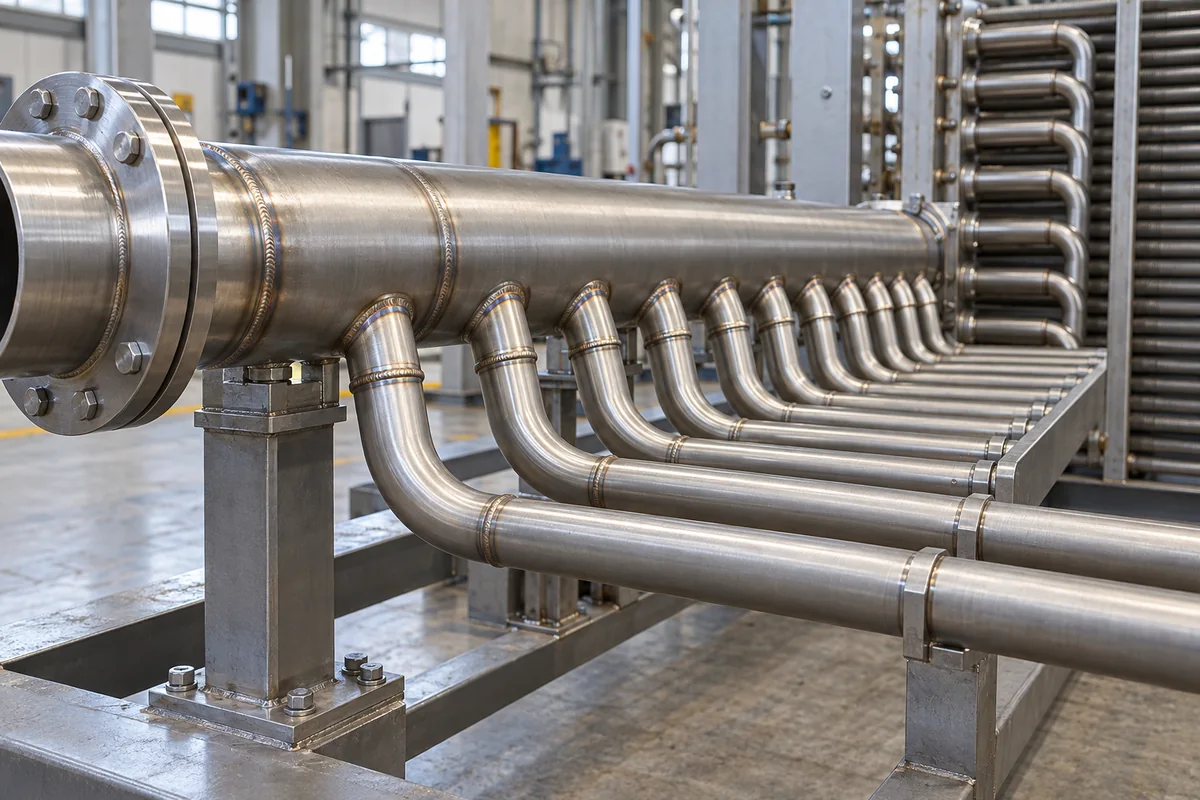
A canonical Distribution Header is characterized by the integration of Header Body/Shell and Inlet Nozzle/Flange. In industrial production environments, manufacturers listed on CNFX commonly emphasize Stainless Steel (e.g., 304, 316L) construction to support stable, high-cycle operation across diverse manufacturing scenarios.

A component of an evaporator that evenly distributes the feed liquid or vapor to multiple tubes or channels.
Product Specifications

Technical details and manufacturing context for Distribution Header

Definition
The Distribution Header is a critical part of an evaporator system, typically located at the inlet section. Its primary function is to receive the incoming fluid (liquid or vapor) and ensure its uniform distribution across the multiple parallel tubes, plates, or channels within the evaporator's heat exchange section. This uniform flow is essential for maximizing heat transfer efficiency, preventing dry spots, scaling, or uneven concentration, and ensuring consistent product quality and process stability.
Working Principle
The fluid enters the header through a single inlet. The internal geometry of the header (e.g., a large-diameter pipe, a manifold with baffles, or a specially designed chamber) is engineered to reduce flow velocity and turbulence, allowing the fluid to stabilize. The pressure is equalized within the header before the fluid exits through multiple outlet ports, each connected to an individual tube or channel. This design ensures each parallel flow path receives an approximately equal share of the total feed, promoting balanced thermal and mass transfer performance across the entire evaporator surface.
Common Materials
Stainless Steel (e.g., 304, 316L), Carbon Steel, Duplex Stainless Steel, Nickel Alloys
Technical Parameters
  • The internal diameter or cross-sectional dimensions of the header body, critical for determining flow capacity and pressure drop. (mm) Customizable
Components / BOM
  • Header Body/Shell
    The main pressure vessel that contains and distributes the fluid.
    Material: Stainless Steel
  • Inlet Nozzle/Flange
    Connection point for the main feed pipe.
    Material: Stainless Steel
  • Outlet Nozzles/Tube Stubs
    Multiple connection points for individual evaporator tubes or channels.
    Material: Stainless Steel
  • Internal Baffles/Diffusers
    Optional components to guide flow and improve distribution uniformity.
    Material: Stainless Steel
  • Support Brackets
    Secures the header to the evaporator structure.
    Material: Carbon Steel
Engineering Reasoning
0.5-3.0 bar differential pressure, 5-95°C fluid temperature, 0.1-5.0 m/s inlet velocity
Cracking at 4.2 bar differential pressure, erosion failure at 8.0 m/s inlet velocity, thermal stress cracking at ΔT>120°C across header body
Design Rationale: Pressure-induced hoop stress exceeding yield strength of 316L stainless steel (205 MPa), fluid velocity exceeding erosion-corrosion threshold for copper-nickel alloys (6 m/s in seawater), thermal expansion mismatch between header (α=16.0×10⁻⁶/°C) and tube sheet (α=11.7×10⁻⁶/°C)
Risk Mitigation (FMEA)
Trigger Two-phase flow at inlet causing maldistribution
Mode: Uneven flow distribution leading to localized dryout in evaporator tubes
Strategy: Installation of phase separator upstream with minimum 0.5 m vertical separation distance
Trigger Chloride stress corrosion cracking at >50 ppm Cl⁻ concentration
Mode: Intergranular cracking initiating at weld heat-affected zones
Strategy: Material substitution to duplex stainless steel (UNS S32205) with PREN>35

Industry Taxonomies & Aliases

Commonly used trade names and technical identifiers for Distribution Header.

Applied To / Applications

This component is essential for the following industrial systems and equipment:

Industrial Ecosystem & Supply Chain DNA

Complementary Systems
Downstream Applications
Specialized Tooling

Application Fit & Sizing Matrix

Operational Limits
pressure: Up to 10 bar (150 psi)
flow rate: 0.5 to 50 m³/h
temperature: -40°C to 200°C
slurry concentration: Up to 30% solids by weight
Media Compatibility
✓ Water/glycol mixtures ✓ Refrigerants (R134a, R410A) ✓ Food-grade liquids (milk, juice)
Unsuitable: Highly corrosive acids (e.g., concentrated sulfuric acid)
Sizing Data Required
  • Total system flow rate (m³/h)
  • Number of tubes/channels to feed
  • Required pressure drop across header (bar)

Reliability & Engineering Risk Analysis

Failure Mode & Root Cause
Corrosion-induced wall thinning
Cause: Exposure to corrosive process fluids (e.g., acids, chlorides) or atmospheric conditions without adequate protective coatings or material selection, leading to material degradation and reduced structural integrity.
Fatigue cracking at welded joints or branch connections
Cause: Cyclic thermal expansion/contraction or pressure fluctuations causing stress concentration at weld seams, leading to crack initiation and propagation over time.
Maintenance Indicators
  • Visible external corrosion, pitting, or weeping at seams and connections indicating material loss
  • Audible hammering or vibration noises suggesting water hammer, flow-induced vibration, or internal component failure
Engineering Tips
  • Implement regular ultrasonic thickness testing at high-risk areas (welds, bends, supports) to monitor wall thinning and schedule proactive replacement before failure
  • Install expansion loops or flexible connectors to absorb thermal movement and reduce stress on fixed connections, and ensure proper support spacing to prevent sagging and vibration

Compliance & Manufacturing Standards

Reference Standards
ISO 9001:2015 - Quality Management Systems ASME B31.3 - Process Piping PED 2014/68/EU - Pressure Equipment Directive
Manufacturing Precision
  • Bore Diameter: +/-0.05mm
  • Flange Flatness: 0.1mm per 100mm diameter
Quality Inspection
  • Hydrostatic Pressure Test
  • Ultrasonic Thickness Testing

Factories Producing Distribution Header

Verified manufacturers with capability to produce this product in China

✓ 93% Supplier Capability Match Found

P Procurement Specialist from Germany Jan 27, 2026
★★★★★
"Reliable performance in harsh Machinery and Equipment Manufacturing environments. No issues with the Distribution Header so far."
Technical Specifications Verified
T Technical Director from Brazil Jan 24, 2026
★★★★★
"Testing the Distribution Header now; the technical reliability results are within 1% of the laboratory datasheet."
Technical Specifications Verified
P Project Engineer from Canada Jan 21, 2026
★★★★★
"Impressive build quality. Especially the technical reliability is very stable during long-term operation."
Technical Specifications Verified
Verification Protocol

“Feedback is collected from verified sourcing managers during RFQ (Request for Quote) and factory evaluation processes on CNFX. These reports represent historical performance data and technical audit summaries from our B2B manufacturing network.”

16 sourcing managers are analyzing this specification now. Last inquiry for Distribution Header from UAE (1h ago).

Supply Chain Compatible Machinery & Devices

Hydraulic Press

Industrial machine using hydraulic pressure to compress, form, or assemble materials

Explore Specs →
Heavy-Duty CNC Plasma Cutting Machine

Industrial machine for precision metal cutting using plasma arc technology

Explore Specs →
Automated Assembly Line System

Integrated production system for sequential component assembly operations

Explore Specs →
Automated Powder Coating System

Integrated industrial system for applying dry powder coatings to metal substrates.

Explore Specs →

Frequently Asked Questions

What materials are commonly used for Distribution Headers in evaporator systems?

Distribution Headers are typically manufactured from materials like Stainless Steel (304, 316L), Carbon Steel, Duplex Stainless Steel, and Nickel Alloys to withstand corrosive environments and high temperatures in evaporator applications.

How does a Distribution Header improve evaporator efficiency?

A Distribution Header ensures even distribution of feed liquid or vapor across multiple tubes or channels, preventing dry spots and hot spots, which enhances heat transfer efficiency and reduces energy consumption in evaporator systems.

What are the key components of a Distribution Header assembly?

A complete Distribution Header assembly includes a Header Body/Shell, Inlet Nozzle/Flange, multiple Outlet Nozzles/Tube Stubs for tube connections, Internal Baffles/Diffusers for flow distribution, and Support Brackets for structural stability.

Can I contact factories directly on CNFX?

CNFX is an open directory, not a transaction platform. Each factory profile provides direct contact information and production details to help you initiate direct inquiries with Chinese suppliers.

Get Quote for Distribution Header

Request technical pricing, lead times, or customized specifications for Distribution Header directly from verified manufacturing units.

Your business information is encrypted and only shared with verified Distribution Header suppliers.

Thank you! Your message has been sent. We'll respond within 1–3 business days.

Need to Manufacture Distribution Header?

Connect with verified factories specializing in this product category

Add Your Factory Contact Us
Previous Product
Distribution Chamber/Manifold
Next Product
Distribution Manifold