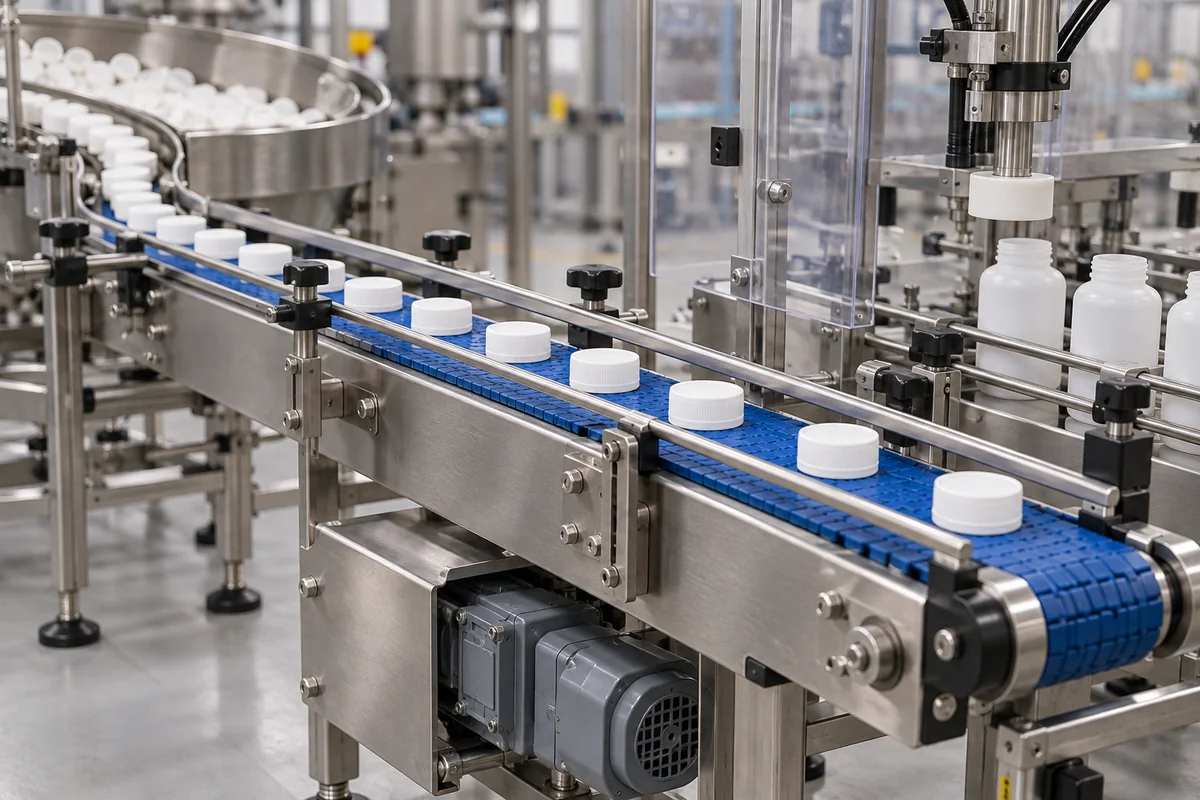
Cap and lid feed conveyor: single-file transport from the sorter to the capper's pick-off point
The narrow single-file conveyor and chute that carry oriented caps or lids from the sorter to the pick-off point · 38/46 mm belts, 15.2 mm pitch, back-pressure and feed-rate control
Once a sorter has turned caps or lids the right way up, they still have to reach the machine that places them, one at a time, in the same orientation and with a steady supply behind the pick-off point. That job falls to a feed conveyor and the chute at its end: a narrow belt between guide rails that runs the caps single file, and an inclined chute or track that holds a short column of them for the capper or coding head to take. The belt has to be narrow and fine-pitched enough to carry small, light closures without tipping them; the chute end has to keep the column moving without crushing or jamming the cap at the front.
Single-file belt conveyors, chutes and tracks that carry oriented caps, closures and lids from a cap sorter or hopper to the pick-off or positioning point of a capping, lidding or coding machine. Cleated-belt cap elevators and orienting sorters are covered on the Cap sorter and elevator page; bulk and unit-load belt conveyors on the Belt conveyor page; drive and end drums on the Conveyor belt roller page. Container infeed starwheels, cappers and bulk cap hoppers are outside this page.
CNFX editorial research · Sources checked October 12, 2026 · 3 sources
A 38 mm or 46 mm molded-to-width belt at 15.2 mm pitch, running over 22.2 mm nosebars
Intralox molds its Series 1100 flush grid belt to width at 1.5 in (38 mm) and 1.8 in (46 mm) for light, tall or slim items, with a 0.60 in (15.2 mm) pitch that it says reduces chordal action and lets the belt run over 0.875 in (22.2 mm) nosebars for tight transfers. [1] The grid has 26% open area, openings from about 4.3 × 2.5 mm to 7.9 × 2.5 mm, flush edges, and moulded tracking tabs to support the belt under heavy side loading. [1]
Intralox restricts these belts to its EZ Track sprockets, one per shaft at either width, supplies them in 3 m increments with snap-lock headed nylon rods of 4.6 mm diameter, and asks buyers to confirm belt measurements and stock with Intralox before designing equipment. [1] Editorial note: on a 38 mm belt the guide rails, not the belt edges, set the lane, so rail spacing and height have to be set for the cap diameter and height being run and reset at changeover.
Where the conveyor ends: back-pressure on the front cap above 400 caps per minute, a bent chute and two air jets
In Pneumatic Scale's US4932824, caps run single file down an inclined chute to a pick-off position at its lower end, where jigs moving across take them one at a time. The patent states that the incline makes the caps press on each other down the chute and that at speeds over 400 caps per minute a great deal of pressure is exerted on the bottom caps. [2]
Its answer is geometric: a bent portion near the lower end of the chute, with room for only two caps between the bend and the end wall, so that the force of the column is directed into the end wall rather than along the supporting finger. [2] A lateral opening matching the cap diameter lets the jig take the bottom cap, an inclined finger with a lip holds it until then, two air-jet nozzles blow down on its top, and guides constrain the cap sideways as it moves onto the jig. [2]
Editorial calculation: at 400 caps per minute with caps touching in a single row, the belt has to deliver at least 400 × the cap diameter per minute; for an assumed 38 mm cap that is 400 × 0.038 m = 15.2 m/min, and a belt that only matches this rate leaves no reserve to refill the chute after a stop.
03
Matching cap supply to the station: a controlled infeed rate, a divider against jams and timed interruptions
US3970218 describes the supply end of the same problem: caps fall from a hopper at a controlled feed rate into a plurality of guide channels, run single file, are spaced by a stop device and reoriented if needed, and the infeed rate is controlled to match the depletion of oriented caps from the compartment feeding the delivery chute. [3]
A divider temporarily blocks some caps so that they drop single file onto an inclined ramp without jamming, an adjustable pivot accommodates caps of different sizes, a ramp that depresses under load trips a switch to signal that a compartment is full, and timers limit how long infeed and outfeed are interrupted while caps are being reoriented. [3] Editorial note: on a belt-fed line the same functions appear as a full-chute sensor that stops or slows the sorter and a low-level sensor that warns before the capper runs out.
04
Data for a cap or lid feed conveyor enquiry
Paste it into your enquiry below or into an email to a maker, then replace every bracket.
Closures: [type; diameter and height range; material; weight]
Rate: [caps or lids per minute at the station]
Layout: [sorter outlet height and position; distance to pick-off; inclines and curves]
Belt: [width; pitch; material; nosebar or sprocket transfer]
Chute end: [pick-off method; back-pressure relief; full and low-level sensing]
Changeover: [guide-rail adjustment; parts per size]
Hygiene: [washdown; materials in contact with closures]
1 company lists this product among what they make. Company figures are quoted from each
company's own website; every card states where the relationship came from.
Guangzhou Bimeigao Intelligent System Technology Co., Ltd.
Manufacturing site to be confirmed for the order
Lists feeding conveyors for its coding and inspection lines: the BMG-300L air-suction reversing feeder, BMG-300 reversing wheel feeder, BMG-300 aluminium reversing feeder and a friction feeder with counting and collection; its site also shows a high-speed easy-open lid coding system.
Explore company information and manufacturing capabilities, then discuss the scope of your project with a relevant supplier.
Share this page
Compiled and source-reviewed by the CNFX editorial team.
Each manufacturer above links to the page on that company's own website where the product is listed, with the date we checked it. How we source and review
· Page last updated 13 October 2026
Buyer questions
How narrow can a cap feed belt be?
Intralox molds its Series 1100 flush grid belt to 38 mm and 46 mm widths, with a 15.2 mm pitch that runs over 22.2 mm nosebars. [1]
Why do caps jam at the end of a feed chute?
Pneumatic Scale's US4932824 says that above 400 caps per minute the column exerts a great deal of pressure on the bottom caps; it uses a bend that leaves room for two caps and air jets at the pick-off. [2]
How is cap supply matched to the capper?
US3970218 controls the hopper infeed rate to match the depletion of oriented caps, with a load-operated switch signalling a full compartment and timers limiting interruptions. [3]
How strong is a narrow modular cap belt?
Intralox rates its acetal Series 1100 mold-to-width belts at 578 N (38 mm) and 667 N (46 mm) with nylon rods. [1]
Sources and what still needs a direct check
Sources checked 2026-10-12. Belt dimensions and ratings come from Intralox's Series 1100 mold-to-width product data; chute-end pressure and pick-off design from Pneumatic Scale's US4932824; supply-rate control from US3970218. Values apply to the products and embodiments named.