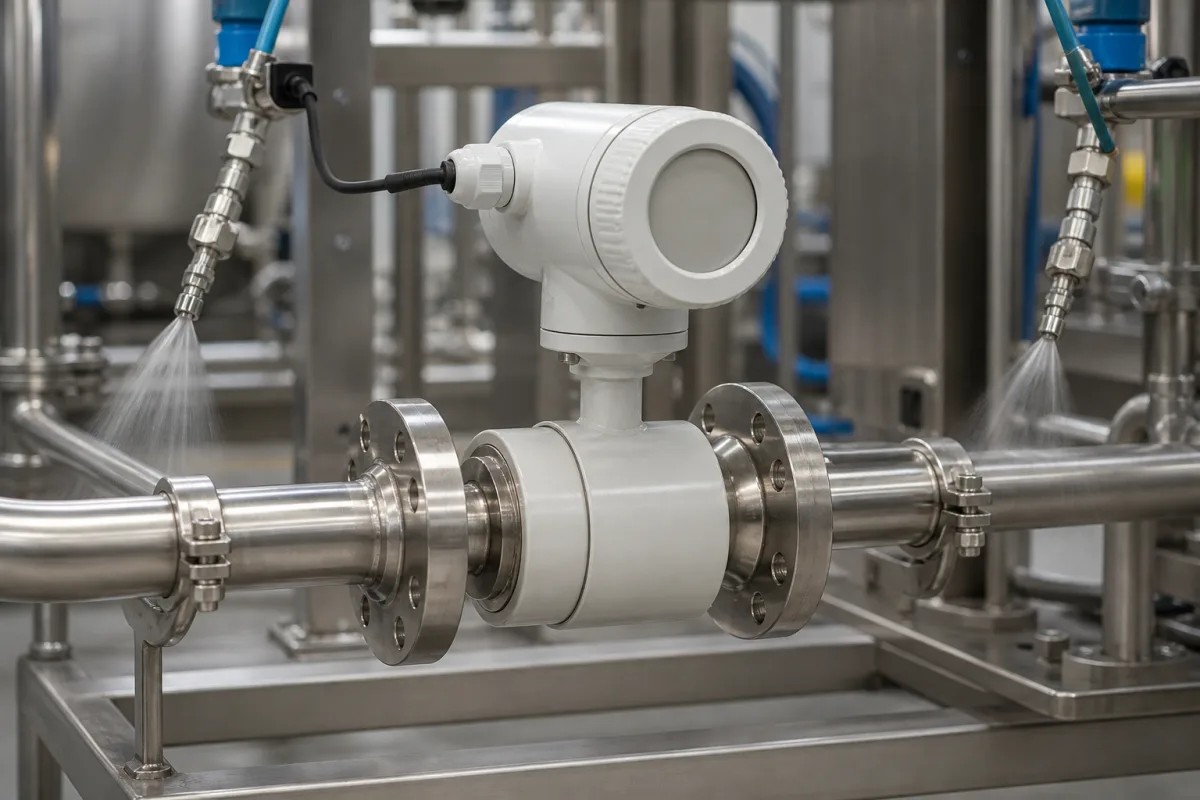
Instrumentation · Right principle, right range, right pipe run
A flow meter is only as good as the match between its principle, the fluid and the pipe it sits in. A magnetic meter cannot read a non-conductive liquid, a transit-time ultrasonic meter struggles with bubbles, and a vortex meter placed just after a bend reads a distorted profile. Choose the principle first, then the range, then the installation.
Inline, insertion and clamp-on flow meters for water, process liquids, gases and steam: magnetic, ultrasonic, vortex, turbine, positive-displacement, variable-area, thermal and Coriolis mass meters. Open-channel measurement is outside this page.
CNFX editorial research · Sources checked October 10, 2026 · 13 sources
The US Bureau of Reclamation explains that a magnetic flowmeter senses the voltage induced in the flowing liquid, so the liquid needs sufficient conductivity; temperature, viscosity, density and solids do not change its calibration, but dissolved chemicals can deposit on the electrodes. It measures in both directions with negligible head loss, and the electrodes should be horizontal so air does not break the circuit. [2]
The US Department of Energy's metering guide describes two ultrasonic types: transit-time meters compare upstream and downstream signal times and are designed for clean fluids, while Doppler meters need bubbles or solids in the liquid to reflect the signal. Ultrasonic meters can be clamped outside the pipe, for temporary or permanent metering. [1]
Vortex meters sense the frequency of vortices shed by a bluff body in the stream, which is proportional to velocity; turbine meters count the rotation of an impeller. Positive-displacement meters need no straight run but have a higher pressure drop at peak flow. For gas, DOE notes that volume must be corrected to standard temperature and pressure, so meters may include temperature and pressure compensation. [1]
Variable-area meters (rotameters) read the height of a float in a tapered tube; Reclamation notes they have few moving parts but can have large head loss and must be installed vertically. [4]
Give the supplier the fluid, its conductivity (for magnetic meters), whether it carries bubbles or solids, viscosity, and for gas or steam the pressure and temperature at the meter.
02
Check how accuracy is stated and over what turndown
DOE notes that accuracy may be stated as a percentage of reading or a percentage of scale, and that turndown is the range of flows over which a meter keeps its stated accuracy and repeatability: a steam meter accurate from 1,000 to 25,000 lb/h has a 25:1 turndown. [1]
DOE's water metering table gives turndown figures of 10:1 for positive displacement and turbine meters, below 5:1 for orifice and venturi meters, 20:1 for vortex meters and 10:1 or 20:1 for Doppler or transit-time ultrasonic meters. [1]
As an editorial calculation example only: a meter stated at ±1% of full scale on a 100 m³/h range can be off by 1 m³/h at any flow, which is ±5% of reading at 20 m³/h. A meter stated at ±1% of reading stays at ±0.2 m³/h at that flow. Ask which basis the data sheet uses.
Reclamation reports that later magnetic meters can hold about ±1.0% from minimum to maximum discharge, and that propeller meters should be chosen to run near the middle of their range because bearing wear raises errors at low velocity. [2][3]
03
Plan the straight pipe the meter needs
DOE explains that elbows, tees, filters, valves and fittings distort the flow profile, so velocity and differential-pressure meters need unobstructed straight pipe upstream and downstream, expressed in pipe diameters and in addition to the meter's own length. Flow conditioners can reduce it, and isolation valves make later removal easier. [1]
One manufacturer's engineering table gives conservative minimums: a vortex meter 25 diameters upstream and 5 downstream after a fully open gate valve, rising to 30 upstream after a partially open valve or regulator; a thermal meter 15 upstream, rising to 40; a turbine meter 10 upstream and 5 downstream. It states that positive-displacement and Coriolis meters are not influenced by upstream and downstream fittings. [6]
Reclamation adds that a fully developed velocity profile needs about 20 to 30 diameters, that spiral flow from bends and valves can cause large errors in either direction, and that the straight approach and straightening vanes used in calibration must be reproduced in the field. [3]
Send a sketch of the pipe with fittings and distances. If the run is short, ask the supplier which principle or flow conditioner suits it before choosing the size.
04
Plan inspection and recalibration
DOE recommends monthly checks for leaks, unusual noise, blocked strainers and cleanliness, and calibration as the manufacturer recommends or when trended data suggest drift. For ultrasonic meters it adds checking transducer position, coupling and pipe vibration. [1]
Reclamation notes that water measured with mechanical meters must be free of foreign matter and that meters should be inspected for wear and corrosion; some magnetic meters have wipers or electrode cleaners against deposits. [5][2]
05
Sanitary magmeters for dairy lines, Coriolis and thermal meters for fuel and gas
BCST and Aister each cover magnetic, vortex, turbine, ultrasonic, Coriolis and thermal mass meters in one catalogue; Wepower's range runs from magnetic and turbine meters to oval-gear units. [7][8][9]
For food and beverage lines, Artang lists a 3-A sanitary electromagnetic flowmeter for milk and beverages, Sentec a sanitary food and beverage electromagnetic flowmeter, and Wepower hygienic tri-clamp magnetic meters. [10][11][9]
For fuels and gases, Bluesky lists dispenser flow meters and Coriolis mass meters, and Chang AI lists thermal mass flowmeters, which it states cover 0.1 to 250 Nm/s with a 1:2500 range ratio — a supplier claim to verify on the data sheet. [12][13]
06
Sensor, tube, transmitter and the parts that change with principle
The sensor row is where the principles described above part ways; gas and steam meters add the temperature and pressure compensation DOE describes. [1]
Part
Role
Fix in the order
Primary element or sensor
Electrodes and coils, transducers, bluff body, impeller, measuring chamber or float, depending on principle. [2][1][4]
Principle, sensor and wetted materials.
Meter body or measuring tube
Carries the flow; magnetic meters use an insulated, non-magnetic tube. [2]
Size, end connections, liner and pressure rating.
Transmitter and electronics
Convert the sensor signal to flow rate, totals and outputs. [2]
Power supply, outputs, display and compact or remote mounting.
Compensation sensors (gas and steam)
Measure temperature and pressure to correct to standard conditions. [1]
Built-in or external compensation.
Flow conditioner or straightening vanes (where fitted)
Line conditions to send: size, flow range, accuracy basis, pressure, outputs
Size the meter to the flow rather than the pipe, and say whether accuracy is meant as percentage of reading or of scale; the earlier calculation shows how far the two drift apart at low flow. [3][1]
Field
What it means and published values
Ask the supplier for
Nominal diameter (mm)
Sized to the flow, not just the pipe; meters lose accuracy at low velocity. [3]
Recommended size and velocity at minimum and maximum flow.
Flow range (m³/h)
Turndown sets the range over which accuracy holds. [1]
Minimum, normal and maximum flow at stated accuracy.
Accuracy, its basis and the calibration certificate.
Repeatability (%)
Ability to reproduce the same value under the same conditions. [1]
Repeatability.
Operating pressure (MPa)
Needed for body rating and, for gas, compensation. [1]
Pressure rating and pressure loss at maximum flow.
Operating temperature (°C)
Fluid and ambient limits of sensor, liner and electronics.
Fluid and ambient temperature limits.
Power supply (V DC)
Magnetic meters need power for the field coils. [2]
Supply voltage and consumption.
Output signal (mA)
Analogue, pulse or digital output to the control system.
Output types and protocols.
Ingress protection
Sets suitability for outdoor or washdown areas.
IP rating of sensor and transmitter.
Material
Wetted materials, liner and electrodes must suit the fluid; deposits affect magnetic meters. [2]
Wetted materials and certificates.
Weight (kg)
Needed for pipe support.
Mass and installation length.
08
Send the fluid, range and pipe data together
Paste it into your enquiry below or into an email to a maker, then replace every bracket.
Fluid: [liquid, gas or steam; conductivity; viscosity; bubbles or solids; corrosive or hygienic]
Flow: [minimum; normal; maximum; units; volume or mass]
Conditions: [pressure; temperature; standard reference conditions for gas]
Accuracy: [required accuracy; % of reading or % of scale; calibration certificate]
Pipe: [diameter; material; sketch with fittings and straight runs upstream and downstream; orientation]
Connection: [flange standard; tri-clamp; clamp-on; insertion]
Electrical: [power supply; outputs; protocol; compact or remote transmitter; IP rating; hazardous area]
Documents: [data sheet; calibration certificate; material and hygiene certificates]
Artang, Sentec and Wepower list sanitary magnetic meters for food lines; Bluesky and Chang AI list fuel-dispensing and gas mass meters; Basidewt sells plastic-tube variable-area meters for water treatment.
Explore company information and manufacturing capabilities, then discuss the scope of your project with a relevant supplier.
Share this page
Compiled and source-reviewed by the CNFX editorial team.
Each manufacturer above links to the page on that company's own website where the product is listed, with the date we checked it. How we source and review
· Page last updated 13 October 2026
Buyer questions
Can a magnetic flow meter measure any liquid?
No. Reclamation explains it needs a liquid with sufficient conductivity; temperature, viscosity, density and solids do not change its calibration, but deposits on the electrodes can cause errors. [2]
What is turndown ratio?
DOE defines it as the range of flows over which a meter keeps its stated accuracy; a meter accurate from 1,000 to 25,000 lb/h has a 25:1 turndown. [1]
How much straight pipe does a flow meter need?
It depends on the principle and the fitting upstream. One manufacturer's table gives 25 diameters upstream for a vortex meter after an open gate valve and 10 for a turbine meter, and states positive-displacement and Coriolis meters are unaffected. [6]
Sources and what still needs a direct check
Sources checked 2026-10-10. The DOE metering guide and the Bureau of Reclamation manual are US government sources. The straight-run table is one manufacturer's engineering data. Supplier pages describe their own offers. ISO 5167 and other flow measurement standards were not read for this page.