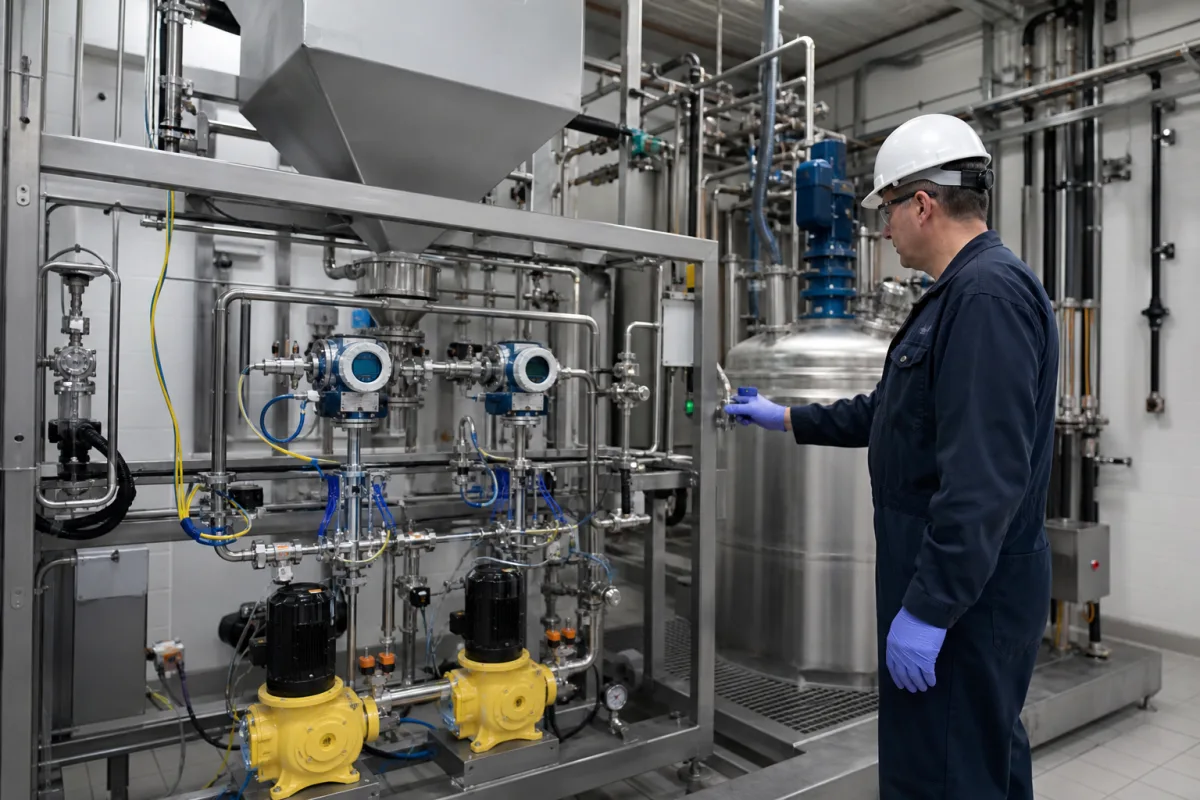
Reagent feed system (metering pump skid) for continuous chemical reactors
Reagent delivery to continuous reactors · Pump type against pressure and solids, metering range and stroke control, wetted materials
A reagent feed system, as used on this page, is the skid of tanks, metering pumps, pulsation control, flow measurement and valves that delivers each feed stream into a continuous reactor at a set rate and pressure. It is specified separately from the reactor because its pump choice is set by what is being fed — a clear solution, a suspension or a slurry — and by the reactor's pressure. Ask three things first: what solids content and particle size each feed carries, what pressure the reactor runs at, and how precisely and steadily each stream must be metered.
Feed and metering skids for continuous chemical and pharmaceutical reactors: metering pumps (piston, syringe, peristaltic, diaphragm), feed tanks, flow measurement, pulsation dampeners and control valves. The reactors themselves — plug-flow, microchannel and tubular reactors for drug substance synthesis — are covered on the Continuous flow reactor for pharmaceutical synthesis page. Antenna feed systems, animal feed equipment and batch charging of stirred reactors are outside this page.
CNFX editorial research · Sources checked October 12, 2026 · 3 sources
Match the pump type to what you are feeding and the reactor pressure
A 2026 review in Communications Chemistry (Johnston and co-authors) on solids handling in continuous flow synthesis states that piston and syringe pumps deliver homogeneous liquids accurately at pressures exceeding 100 bar, but their narrow fluid paths block with solids and particles settle in the barrel or chamber, so they are restricted to dissolved solutions or suspensions with negligible solids. [1]
Peristaltic pumps handle slurries and suspensions in fluoropolymer tubing such as PTFE or FEP, provided particles are no more than one-third of the tubing diameter and stay dispersed; the review puts their pressure tolerance below 10 bar and notes their pulsatile flow. Diaphragm pumps handle suspensions of 1–20% solids by volume and slurries of 20–60% solids. Solenoid-driven diaphragm pumps dose 0.36–80 L/h at up to 25 bar with ±1% reproducibility, while air-operated double-diaphragm pumps move 1–1,040 L/min at up to 8.6 bar with solids up to 10 mm. Both suffer pulsating flow, mitigated by pulsation dampers or multiple diaphragms, and diaphragm wear. [1]
Editorial calculation: with 1.6 mm bore tubing, the one-third rule limits particles to about 1.6 ÷ 3 ≈ 0.53 mm. [1] Editorial note: if a reactor runs above 10 bar, the review's figures rule out peristaltic feed for that stream; ask how pulsation will be damped before the reactor inlet.
Give the supplier each feed stream's composition, solids content and particle size, viscosity, density, temperature, required flow range and turndown, reactor inlet pressure, allowed pulsation, metering accuracy, wetted materials needed, hazardous-area classification, and whether the skid must be cleaned or flushed between campaigns.
02
Size the metering range, pressure and wetted materials
ProMinent lists its motor-driven metering pumps by capacity and pressure: the alpha at 1.0–30.6 L/h and 10–2 bar, the Sigma/1 at 17–144 L/h and 12–4 bar, the Sigma/2 at 50–420 L/h and 16–4 bar, and the Sigma/3 at 146–1,030 L/h and 12–4 bar. Metering rate is set by stroke length and stroke rate, and ProMinent states the metering volume can be adjusted in 1% steps. [3]
LEWA's ecoflow diaphragm metering pumps are built to API 675 and reach flow rates up to 19 m³/h per pump head or discharge pressures up to 1,200 bar, with suction down to 0.1 bar absolute. Its M500 pump head, with a PTFE sandwich diaphragm and diaphragm position control, is listed at 350 bar, 19 m³/h, −50 to +150 °C and viscosities to 100,000 mPa·s, in 1.4401/1.4404 (AISI 316/316L) stainless steel, PVC or PVDF; flow is adjusted by electric or pneumatic stroke adjustment or by variable-frequency motor drive. [2]
Editorial calculation: ProMinent's Sigma/3 maximum of 1,030 L/h equals 1.03 m³/h, against LEWA's 19 m³/h per head, so a production feed can need a larger pump class or two or more heads per stream. [3][2]
Signal type; interface to the reactor control system.
05
Feed rate, discharge pressure, accuracy and wetted materials for each reagent stream
Fill one row set per reagent: solids content decides the pump type, since piston and syringe pumps block on particles while peristaltic pumps stay below 10 bar. [1]
Field
What it means and published values
Ask the supplier for
Feed Rate (m³/h)
0.0010–1.03 m³/h across ProMinent alpha to Sigma/3; up to 19 m³/h per ecoflow head (editorial conversion of L/h). [3][2]
Minimum and maximum rate per stream.
Feed Accuracy (%)
±1% reproducibility for solenoid diaphragm pumps in the review. [1]
Explore company information and manufacturing capabilities, then discuss the scope of your project with a relevant supplier.
Share this page
Compiled and source-reviewed by the CNFX editorial team.
Each manufacturer above links to the page on that company's own website where the product is listed, with the date we checked it. How we source and review
· Page last updated 13 October 2026
Buyer questions
Which pump suits a slurry feed?
The Communications Chemistry review lists peristaltic pumps below 10 bar with particles up to a third of the tubing bore, and diaphragm pumps for 1–20% suspensions and 20–60% slurries. [1]
How high can a feed pump's pressure go?
The review puts piston and syringe pumps above 100 bar; LEWA lists its ecoflow series up to 1,200 bar. [1][2]
How is a metering pump's rate adjusted?
By stroke length and stroke rate or motor speed; ProMinent states 1% adjustment steps. [3]
Sources and what still needs a direct check
Sources checked 2026-10-12. The Communications Chemistry review is a peer-reviewed survey of solids handling in flow synthesis; LEWA and ProMinent are metering pump makers describing their own ranges.