Industry-Verified Manufacturing Data (2026)

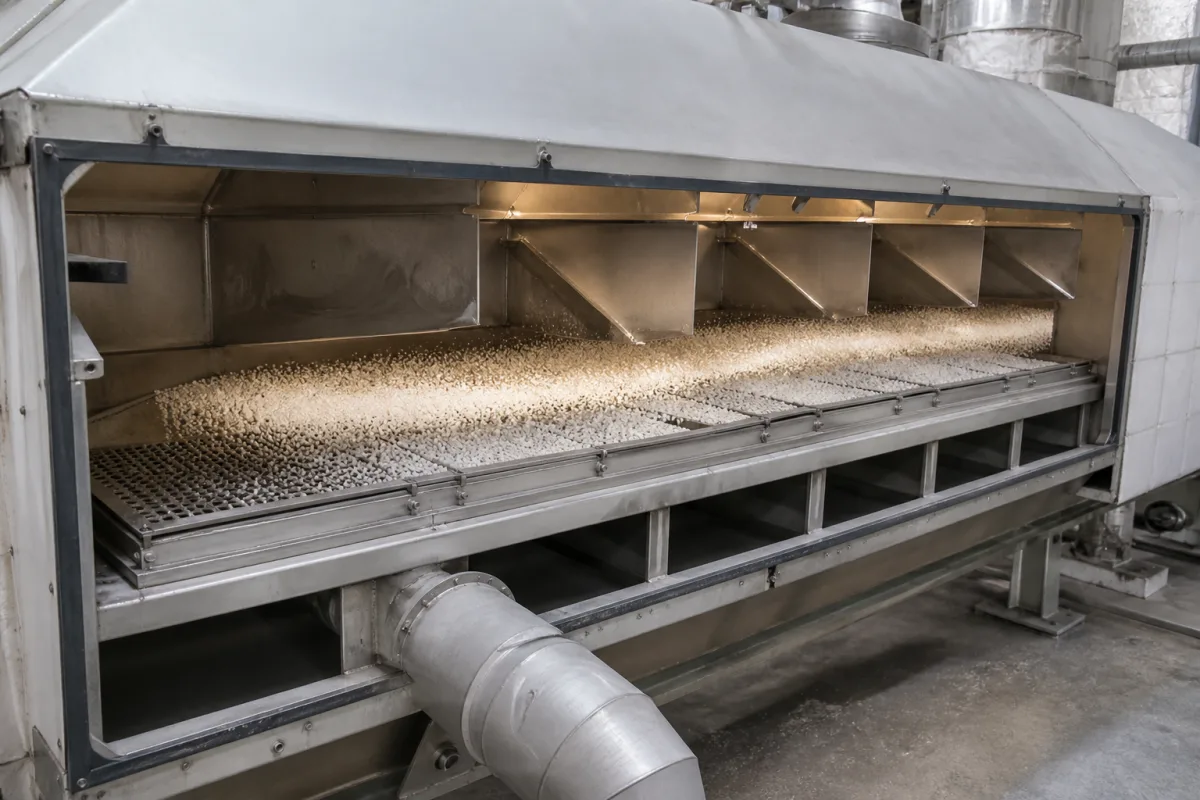
Fluidization Chamber

Based on aggregated insights from multiple verified factory profiles within the CNFX directory, the standard Fluidization Chamber used in the Machinery and Equipment Manufacturing sector typically supports operational capacities ranging from standard industrial configurations to heavy-duty production requirements.

Technical Definition & Core Assembly

A canonical Fluidization Chamber is characterized by the integration of Distributor Plate and Observation Port. In industrial production environments, manufacturers listed on CNFX commonly emphasize Stainless steel construction to support stable, high-cycle operation across diverse manufacturing scenarios.

The chamber where fluidization of solid particles occurs through gas flow in a fluidized bed cooler.
Product Specifications

Technical details and manufacturing context for Fluidization Chamber

Definition
The fluidization chamber is the core component of a fluidized bed cooler where solid particles are suspended and mixed by an upward-flowing gas stream, creating a fluid-like state that enables efficient heat transfer and cooling of the particles.
Working Principle
Gas (typically air) is introduced through a distributor plate at the bottom of the chamber at sufficient velocity to suspend solid particles, creating a fluidized bed where particles behave like a fluid, allowing for uniform temperature distribution and rapid heat exchange.
Common Materials
Stainless steel, Carbon steel
Technical Parameters
  • Internal diameter and height of the chamber (mm) Standard Spec
Components / BOM
  • Distributor Plate
    Evenly distributes gas flow across the chamber bottom to create uniform fluidization
    Material: Stainless steel
  • Observation Port
    Allows visual inspection of fluidization quality and particle movement
    Material: Tempered glass
  • Gas Inlet Nozzle
    Connects gas supply to the distributor plate for fluidization
    Material: Stainless steel
  • Thermowell
    Housing for temperature sensors to monitor bed temperature
    Material: Stainless steel
Engineering Reasoning
0.5-2.5 bar gauge pressure, 20-80°C gas inlet temperature, 0.3-1.2 m/s superficial gas velocity
Minimum fluidization velocity (Umf) below 0.25 m/s causes defluidization; gas velocity exceeding 1.5 m/s leads to particle entrainment; wall temperature exceeding 150°C causes thermal degradation of refractory lining
Design Rationale: Defluidization occurs when drag force (Fd = 0.5*Cd*ρg*A*Ug²) falls below particle weight minus buoyancy; particle entrainment initiates when gas velocity exceeds terminal settling velocity (Ut = √[4gd(ρp-ρg)/(3Cdρg)]); thermal fatigue from cyclic heating/cooling above 150°C creates microcracks in refractory via thermal stress (σ = EαΔT)
Risk Mitigation (FMEA)
Trigger Insufficient gas distributor pressure drop (ΔP < 0.3 bar) due to fouling
Mode: Mal-distribution causing channeling and dead zones, reducing heat transfer coefficient by >40%
Strategy: Integrate sintered metal plate distributor with ΔP > 30% of bed pressure drop, install differential pressure monitoring with 0.1 bar resolution
Trigger Cyclic thermal loading from 50-150°C temperature swings exceeding 1000 cycles
Mode: Refractory lining spallation exposing chamber wall to 800°C bed temperature
Strategy: Install monolithic refractory with 0.8 W/m·K thermal conductivity and 5×10⁻⁶/°C expansion coefficient, implement controlled heating/cooling at 50°C/hour maximum rate

Industry Taxonomies & Aliases

Commonly used trade names and technical identifiers for Fluidization Chamber.

Applied To / Applications

This component is essential for the following industrial systems and equipment:

Industrial Ecosystem & Supply Chain DNA

Complementary Systems
Downstream Applications
Specialized Tooling

Application Fit & Sizing Matrix

Operational Limits
pressure: Up to 10 bar (standard), 20 bar with reinforced design
flow rate: 0.5-50 m³/min gas flow (adjustable via distributor design)
temperature: -20°C to 400°C (typical), up to 600°C with special materials
slurry concentration: Up to 70% solids by weight (depending on particle size and density)
Media Compatibility
✓ Polymer pellets cooling ✓ Catalyst regeneration ✓ Mineral ore drying
Unsuitable: Highly corrosive chlorine gas environments (accelerated material degradation)
Sizing Data Required
  • Required heat transfer duty (kW)
  • Particle size distribution (μm)
  • Gas inlet temperature and desired outlet temperature (°C)

Reliability & Engineering Risk Analysis

Failure Mode & Root Cause
Abrasive erosion of internal surfaces
Cause: High-velocity particle impingement from fluidized media, particularly with abrasive materials like silica sand or catalysts, leading to wall thinning and eventual perforation.
Thermal fatigue cracking
Cause: Cyclic thermal stresses from rapid heating/cooling cycles during startup/shutdown or process fluctuations, causing cracks in welds, nozzles, or refractory linings.
Maintenance Indicators
  • Abnormal vibration or audible knocking indicating uneven fluidization or internal component detachment
  • Visible hotspots on external surfaces (via thermal imaging) suggesting refractory failure or wall thinning
Engineering Tips
  • Implement real-time erosion monitoring using ultrasonic thickness gauges at high-wear zones and schedule predictive replacements before failure
  • Optimize startup/shutdown procedures to minimize thermal cycling rates and install expansion joints to accommodate thermal stresses

Compliance & Manufacturing Standards

Reference Standards
ISO 14644-1:2015 Cleanrooms and associated controlled environments ASME BPE-2019 Bioprocessing Equipment DIN 28000-1:2016 Chemical apparatus - General requirements
Manufacturing Precision
  • Internal surface roughness: Ra ≤ 0.8 μm
  • Chamber circularity: ±0.5 mm
Quality Inspection
  • Helium leak test: ≤ 1×10⁻⁶ mbar·L/s
  • Material verification test: Positive Material Identification (PMI)

Factories Producing Fluidization Chamber

Verified manufacturers with capability to produce this product in China

✓ 93% Supplier Capability Match Found

P Project Engineer from Germany Jan 17, 2026
★★★★★
"The technical documentation for this Fluidization Chamber is very thorough, especially regarding technical reliability."
Technical Specifications Verified
S Sourcing Manager from Brazil Jan 14, 2026
★★★★★
"Reliable performance in harsh Machinery and Equipment Manufacturing environments. No issues with the Fluidization Chamber so far."
Technical Specifications Verified
P Procurement Specialist from Canada Jan 11, 2026
★★★★★
"Testing the Fluidization Chamber now; the technical reliability results are within 1% of the laboratory datasheet."
Technical Specifications Verified
Verification Protocol

“Feedback is collected from verified sourcing managers during RFQ (Request for Quote) and factory evaluation processes on CNFX. These reports represent historical performance data and technical audit summaries from our B2B manufacturing network.”

6 sourcing managers are analyzing this specification now. Last inquiry for Fluidization Chamber from UAE (1h ago).

Supply Chain Compatible Machinery & Devices

Heavy-Duty CNC Plasma Cutting Machine

Industrial machine for precision metal cutting using plasma arc technology

Explore Specs →
Automated Assembly Line System

Integrated production system for sequential component assembly operations

Explore Specs →
Automated Powder Coating System

Integrated industrial system for applying dry powder coatings to metal substrates.

Explore Specs →
Centrifugal Pump Impeller

Rotating component that transfers energy to fluid in centrifugal pumps.

Explore Specs →

Frequently Asked Questions

What is the primary function of a fluidization chamber in machinery manufacturing?

The fluidization chamber enables controlled fluidization of solid particles through gas flow, facilitating efficient heat transfer and cooling in fluidized bed systems for industrial processes.

What materials are commonly used for fluidization chamber construction?

Fluidization chambers are typically constructed from stainless steel for corrosion resistance or carbon steel for cost-effective durability, depending on process requirements and operating conditions.

What key components are included in a standard fluidization chamber BOM?

Standard components include a distributor plate for uniform gas distribution, gas inlet nozzle for flow control, observation port for process monitoring, and thermowell for temperature measurement.

Can I contact factories directly on CNFX?

CNFX is an open directory, not a transaction platform. Each factory profile provides direct contact information and production details to help you initiate direct inquiries with Chinese suppliers.

Get Quote for Fluidization Chamber

Request technical pricing, lead times, or customized specifications for Fluidization Chamber directly from verified manufacturing units.

Your business information is encrypted and only shared with verified Fluidization Chamber suppliers.

Thank you! Your message has been sent. We'll respond within 1–3 business days.

Need to Manufacture Fluidization Chamber?

Connect with verified factories specializing in this product category

Add Your Factory Contact Us
Previous Product
Fluid Reservoir / Inlet
Next Product
Flywheel