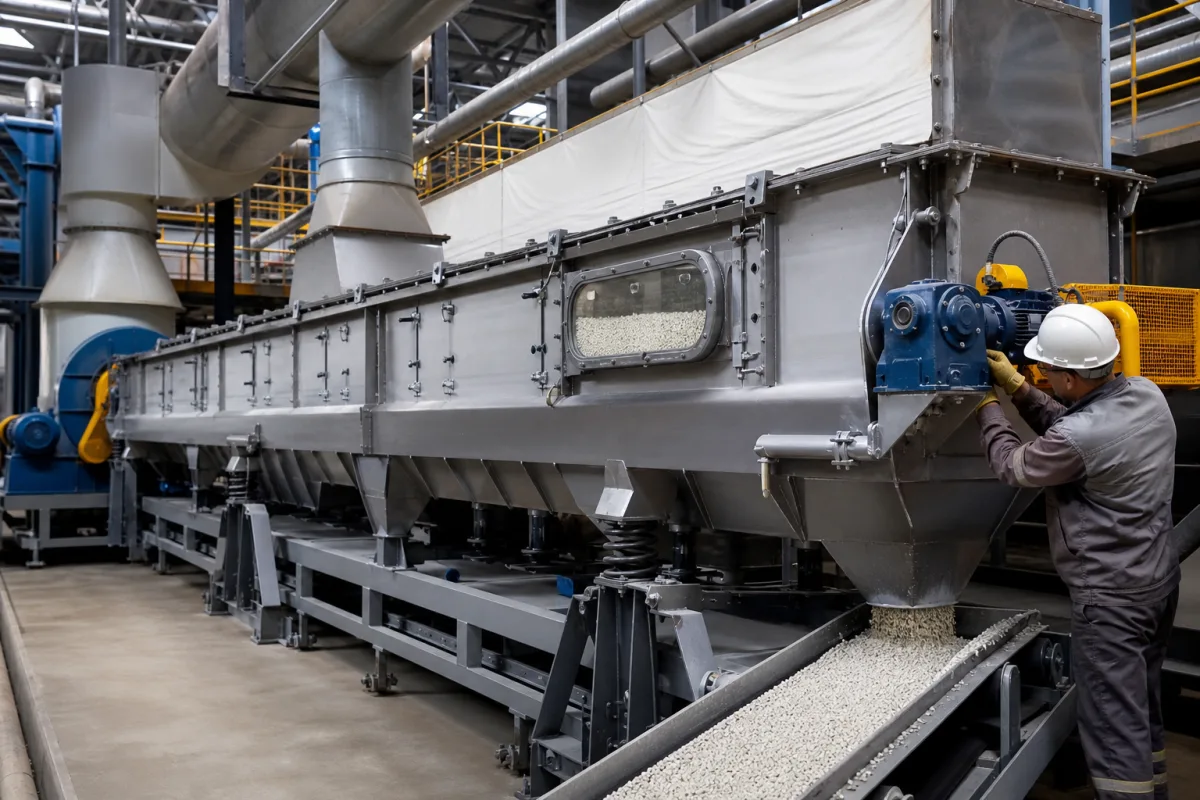
Fluidized bed coolers for urea and other fertilizer granules · cooling air blown up through a perforated deck, vibrating and static designs, intermediate and final cooling in granulation plants, retention time, bed depth, dust capture, and construction materials
A fluidized bed cooler blows air up through a perforated deck under a layer of hot granules. At high enough air velocity the bed lifts and mixes like a boiling liquid, and the solids give up heat to the air as they move towards the discharge. In urea and other fertilizer plants it cools product after granulation or prilling so that it can be screened, stored and shipped without caking. Ask three things first: what product goes in, at what rate and temperature; what discharge temperature you need; and how the exhaust air will be cleaned.
Fluidized bed coolers, both vibrating and static, for granular and prilled fertilizers such as urea and ammonium nitrate, with notes on general bulk solids. Granulators, rotary drum coolers, plate coolers and complete granulation plants are outside this page except where compared.
CNFX editorial research · Sources checked October 11, 2026 · 7 sources
See where the cooler sits in a urea granulation plant
thyssenkrupp Uhde describes its fluid bed urea granulation process as follows. Urea melt from the evaporation section goes to the fluid bed granulator. Product taken from the granulator is cooled and lifted to screening. Oversize material is crushed and returned to the granulator as seed with the undersize, and after final cooling the on-spec product goes to storage. Urea dust in the air from the granulator, the fluidized-bed coolers and the dedusting points is recovered in a scrubbing system. Its UFT brochure flow sheet shows intermediate cooling, classification and final cooling as separate steps. The brochure lists no cooling water consumption when a fluid bed cooler is used for final product cooling. [1][2]
EPA's AP-42 emission factor guide counts solids cooling as one of up to seven unit operations in urea manufacture. In its ammonium nitrate section it states that product leaves solids formation at about 66 to 124 °C (150 to 255 °F), and that cooling in rotary drums or fluidized beds prevents deterioration and agglomeration before storage and shipping. [3][4]
Give the supplier the product and grade, feed rate, inlet and required outlet temperature, granule size range, moisture, the ambient air temperature and humidity at the site, whether this is intermediate or final cooling, the exhaust scrubbing or dust collection arrangement, and the construction materials you need.
02
Understand how a fluid bed cools granules
Carrier Vibrating Equipment, a maker of fluid bed equipment, describes how its static fluid bed coolers work. They pass air directly through a bed of solids via a perforated plate, nozzles or other fluidizing media, lifting and mixing the solids; at the fluidization velocity the bed behaves much like a boiling liquid. The maker says bed depth, retention time and product temperature can be varied, and that indirect heat transfer tubes or plates immersed in the bed can reduce the size of the fluid bed. [5]
Carrier's vibrating fluid bed coolers add vibration to help fluidize materials that are harder to fluidize. Carrier offers once-through, partially recirculated and fully recirculated, self-inerting air systems, and a drive that changes the vibration angle while running to control retention time. Contact surfaces can be carbon steel, stainless steel, titanium, Inconel or other alloys. For fertilizers, the maker says its vibrating coolers bring granules to safe handling and packaging temperatures while preventing clumping, agglomeration and moisture pick-up in hygroscopic products. [6][7]
03
Static bed, vibrating bed or rotary drum
Carrier adds vibration for materials that are harder to fluidize; a static bed can carry immersed tubes or plates instead. [6][5]
Types include static (conventional) fluid bed coolers, vibrating fluid bed coolers, and fluid beds with immersed indirect cooling tubes or plates. Rotary drum coolers are an alternative for the same duty. [5][6][4]
04
Deck, plenum, drive, immersed tubes, exhaust and materials
The vibration drive applies only to vibrating coolers, and the immersed tubes or plates are an option on static beds.
Part
Role
Fix in the order
Fluidizing deck
Perforated plate or nozzles that let cooling air into the bed. [5][6]
Explore company information and manufacturing capabilities, then discuss the scope of your project with a relevant supplier.
Share this page
Compiled and source-reviewed by the CNFX editorial team.
Each manufacturer above links to the page on that company's own website where the product is listed, with the date we checked it. How we source and review
· Page last updated 13 October 2026
Buyer questions
How does a fluidized bed cooler work?
Air is blown up through a perforated plate or nozzles under a bed of solids, lifting and mixing them; at the fluidization velocity the bed behaves much like a boiling liquid. [5]
Where is it used in a urea granulation plant?
thyssenkrupp Uhde describes cooling product after the granulator before screening and again before storage, with the cooler exhaust scrubbed to recover urea dust. [1][2]
Why are fertilizer granules cooled?
EPA AP-42 says cooling ammonium nitrate solids in rotary drums or fluidized beds prevents deterioration and agglomeration before storage and shipping. [4]
Sources and what still needs a direct check
Sources checked 2026-10-11. EPA AP-42 describes fertilizer processes for emission estimates. thyssenkrupp Uhde and Carrier Vibrating Equipment describe their own technology and equipment; their statements are maker descriptions, not independent tests.