Editorial Technical Reference

Gantry Bridge/Beam

This page explains how Gantry Bridge/Beam is classified within Machinery and Equipment Manufacturing. Technical values and manufacturer relationships are research references; confirm the current specification and supplier evidence for each order.

Technical Definition & Core Assembly

The primary horizontal structural member of a gantry system that spans between vertical supports and provides the main load-bearing path.
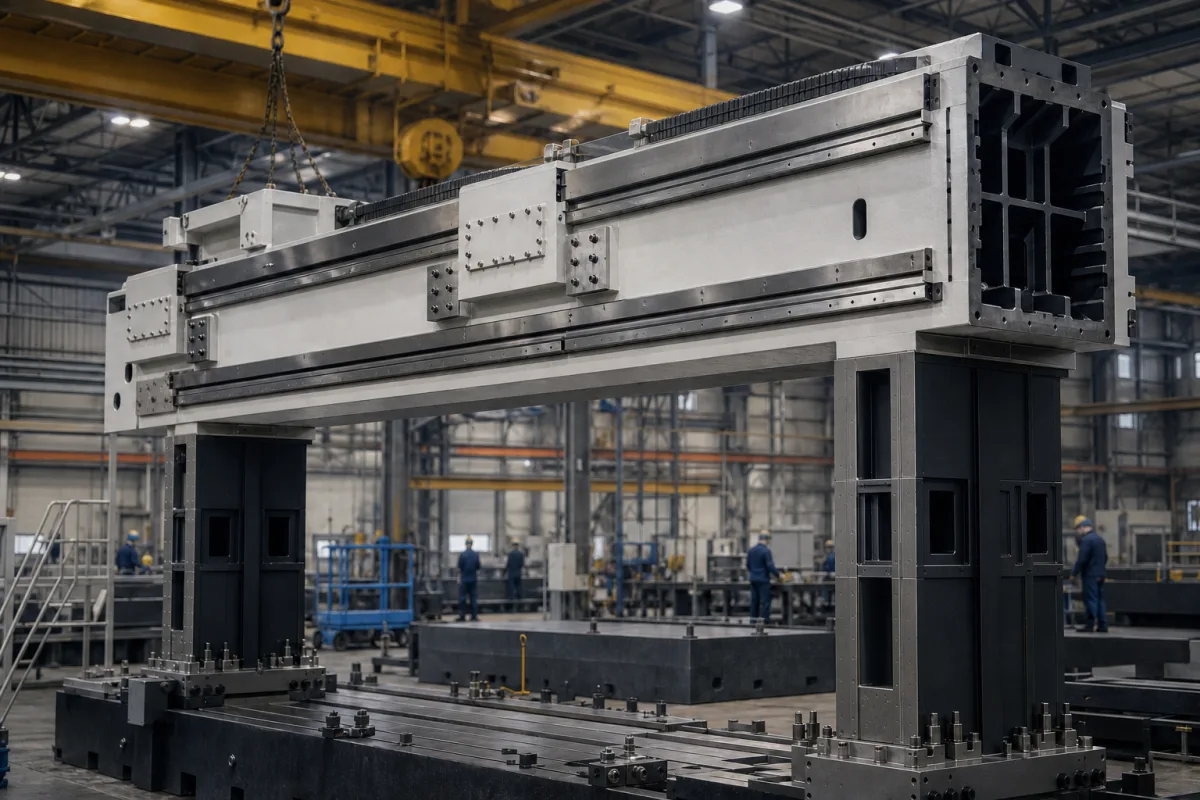
Representative product image. Confirm appearance and specifications with the manufacturer.

Product Specifications

Technical details and manufacturing context for Gantry Bridge/Beam

Definition
The gantry bridge or beam is the critical horizontal structural component in a gantry system that connects the vertical columns or legs, forming the main framework. It serves as the primary load-bearing element that supports moving equipment such as hoists, cranes, or robotic arms, and transfers loads to the vertical supports. This component determines the system's span capacity and overall structural integrity.

In a typical gantry configuration, the bridge spans the working area and carries a trolley or carriage that moves along its length. The beam must resist bending moments and shear forces induced by the moving load, while maintaining precise alignment and minimal deflection to ensure accurate positioning and safe operation. The cross-sectional shape, material, and fabrication quality directly influence the beam's stiffness, load capacity, and service life.

Typical materials include structural steel, aluminum alloy, and carbon steel, with material grades such as Q235B to Q355B (per GB/T 700) for steel versions. Standard span lengths range from 5 to 30 meters, with custom spans up to 50 meters. Load capacity at mid-span is typically 10 to 100 tonnes. Beam height ranges from 500 to 2000 mm, and beam width from 300 to 1200 mm, depending on rail spacing and load requirements. Deflection at full load is limited to L/800 (L = span) per ISO 10721. Surface treatment is blast cleaning to Sa2.5 (ISO 8501-1) before painting, with dry film thickness of 80–120 μm (ISO 19840). Operating temperature range is -20°C to 60°C; for temperatures below -20°C, low-temperature steel is recommended. Weight per beam ranges from 2 to 20 tonnes, depending on span and capacity. Straightness tolerance over full length is ±2 mm, and flatness on mounting surfaces is ±1.5 mm, both per ISO 10721.

These values are reference ranges and must be verified for the specific model and application with the legal manufacturer or supplier. The gantry bridge is a component, not a standalone product, and its design must be integrated with the overall gantry system, including columns, end trucks, and control systems.
Working Principle
The gantry bridge/beam functions as a horizontal structural element that resists bending moments and shear forces from applied loads. It provides a stable, rigid platform for moving equipment to traverse along its length while maintaining precise alignment and minimal deflection under load. The beam's cross-sectional design and material properties determine its load capacity and stiffness. When a load moves along the beam, it induces internal stresses that must be within allowable limits to prevent permanent deformation or failure. The beam transfers these forces to the vertical supports, which then distribute them to the foundation. Proper selection of beam dimensions, material grade, and fabrication quality ensures safe and reliable operation over the intended service life.
Common Materials
Structural steel, Aluminum alloy, Carbon steel
Technical Parameters
ParameterTypical rangeNotes & selection driver
Span Length5–30 mStandard spans; custom up to 50 m
Load Capacity10–100 tMax load at mid-span
Beam Height500–2000 mmAffects stiffness and headroom
Beam Width300–1200 mmDepends on rail spacing and load
Deflection≤L/800At full load; L=spanISO 10721
Material GradeQ235B–Q355BHigher grade for heavy dutyGB/T 700
Surface TreatmentSa2.5Blast cleaning before paintingISO 8501-1
Paint Thickness80–120 μmDry film thicknessISO 19840
Operating Temperature-20–60 °CBelow -20°C use low-temp steel
Weight2–20 tPer beam, depends on span and capacity
Tolerance - Straightness±2 mmOver full lengthISO 10721
Tolerance - Flatness±1.5 mmOn mounting surfacesISO 10721

Ranges are indicative industry figures for RFQ preparation, not a supplier commitment. Confirm every value and standard with the legal manufacturer before ordering.

Components / BOM
  • Flange Plates Part
    Provide primary bending resistance and load transfer
    Material: steel
  • Web Plate Part
    Connect flanges and resist shear forces
    Material: steel
  • Stiffeners Part
    Prevent web buckling and maintain cross-sectional shape
    Material: steel
  • End Connections Part
    Interface with vertical columns/supports
    Material: steel
  • Rail Mounting Surface Part
    Provide attachment for moving equipment rails
    Material: steel

Industry Taxonomies & Aliases

Commonly used trade names and technical identifiers for Gantry Bridge/Beam.

Applied To / Applications

This component is essential for the following industrial systems and equipment:

Industrial Ecosystem & Supply Chain Structure

Complementary Systems
Downstream Applications
Specialized Tooling

Application Fit & Sizing Matrix

Operational Limits
pressure: N/A (structural load bearing, not fluid pressure)
other spec: Max span: 5-50m, Max load capacity: 1-100 tons, Deflection limit: L/500 to L/1000
temperature: -20°C to +60°C
Media Compatibility
✓ Industrial manufacturing environments ✓ Warehouse/material handling systems ✓ Outdoor construction sites
Unsuitable: High-corrosion marine/offshore environments without specialized coatings
Sizing Data Required
  • Span length between supports (m)
  • Maximum concentrated/ distributed load (kN)
  • Required deflection tolerance (mm or ratio)

Reliability & Engineering Risk Analysis

Failure Mode & Root Cause
Fatigue cracking at weld joints
Cause: Cyclic loading from repeated lifting operations and dynamic forces causing stress concentration at welded connections, leading to crack initiation and propagation.
Corrosion-induced section loss
Cause: Exposure to industrial environments with moisture, chemicals, or salt leading to oxidation and material degradation, particularly in hard-to-inspect areas and at structural interfaces.
Maintenance Indicators
  • Visible cracks or deformation in structural members, especially at connection points
  • Unusual vibrations, creaking noises, or excessive deflection during operation
Engineering Tips
  • Implement regular non-destructive testing (NDT) inspections using ultrasonic or magnetic particle methods to detect subsurface defects before catastrophic failure
  • Apply protective coatings and corrosion inhibitors, and ensure proper drainage to prevent water accumulation on structural surfaces

Indicative industry ranges for design and RFQ preparation. Confirm the exact figures and applicable standard with the manufacturer before specifying.

Compliance & Manufacturing Standards

Applicable Standards
ISO 10209:2012 (Technical product documentation - Vocabulary) ANSI/AWS D14.1/D14.1M:2022 (Specification for Welding of Industrial and Mill Cranes and Other Material Handling Equipment) DIN 15018-1:1984 (Cranes; Steel Structures; Principles for Calculation, Design and Construction)

Quoted from the published standard.

Manufacturing Precision
  • Beam straightness: +/- 2mm per 10m length
  • Bolt hole alignment: +/- 0.5mm positional tolerance
Quality Inspection
  • Ultrasonic Testing (UT) for weld integrity
  • Load Testing (static and dynamic) to 125% rated capacity

Manufacturers of Gantry Bridge/Beam

Manufacturer profiles associated with Gantry Bridge/Beam.

Sourcing Gantry Bridge/Beam from China?
Tell us your specification and target quantity — we will match it against manufacturer records and come back with the factories that fit.
Request manufacturers We manufacture this

Manufacturer listings support early research and capability understanding. They are not certification, ranking, or transaction guarantees.

Technical documentation
Request current drawings, revision history, and a signed specification sheet.
Manufacturing capability
Verify equipment lists, process limits, capacity, and representative production evidence.
Inspection readiness
Confirm test methods, calibrated equipment, sampling plans, and traceable reports.
Supplier transparency
Check the legal entity, factory address, ownership, certifications, and direct contacts.

CNFX does not score or rank suppliers. Buyers must verify all claims and documents with the legal manufacturer before ordering.

Supply Chain Compatible Machinery & Devices

Hydraulic Press

Industrial machine using hydraulic pressure to compress, form, or assemble materials

Explore Specs →
Heavy-Duty CNC Plasma Cutting Machine

The Heavy-Duty CNC Plasma Cutting Machine is a standalone industrial device designed for cutting conductive metals such as steel, stainless steel, aluminum, and copper alloys.

Explore Specs →
Automated Powder Coating System

Integrated industrial system for applying dry powder coatings to metal substrates.

Explore Specs →
Centrifugal Pump Impeller

The centrifugal pump impeller is a critical rotating component that converts mechanical energy from the motor into kinetic energy in fluid systems.

Explore Specs →

Frequently Asked Questions

What is the primary function of a gantry bridge/beam?

The gantry bridge/beam is the main horizontal structural member that spans between vertical supports. It carries moving equipment like hoists or robotic arms and transfers loads to the supports, determining the system's span capacity and structural integrity.

What materials are commonly used for gantry beams?

Common materials include structural steel, aluminum alloy, and carbon steel. Steel grades such as Q235B to Q355B (per GB/T 700) are typical for steel beams. The choice depends on load requirements, environmental conditions, and weight considerations.

What are typical span and load capacity ranges?

Standard span lengths range from 5 to 30 meters, with custom spans up to 50 meters. Load capacity at mid-span is typically 10 to 100 tonnes. These values are reference ranges and must be confirmed for the specific application.

What standards apply to gantry beam manufacturing?

Relevant standards include ISO 10721 for deflection and tolerances, ISO 8501-1 for surface preparation, and ISO 19840 for paint thickness. Material grades may reference GB/T 700. Always verify compliance with the manufacturer.

Data Basis

Editorial classification, named public sources where available, and source-reviewed manufacturer records.

Preliminary Technical Classification
This page supports structured research, RFQ preparation, and supplier evaluation. It does not replace buyer-led supplier qualification, standards review, or technical approval.
Buyer enquiry

Request manufacturing insight for Gantry Bridge/Beam

Ask for use case, specification boundaries, supplier type, and RFQ preparation information for this product.

Where it goes
Straight to the CNFX editorial desk, and to the manufacturer if this product is linked to a claimed profile. Nothing is broadcast to a supplier list.
Your details stay here
We do not sell or rent enquiry data, and we do not add you to a mailing list. Used only to answer this request.
No commission, no middleman
CNFX is a directory. We take no cut of any order and never negotiate on a supplier's behalf.
What we don't claim
A listing is not an endorsement. Qualify every supplier and verify every figure yourself before ordering.

Your business information is used only to process this request.

Thank you! Your message has been sent. We'll respond within 1–3 business days.
Sorry, we couldn't send your message. Please try again, or email us at contact@cnfx.com.

Need to Manufacture Gantry Bridge/Beam?

Compare manufacturer profiles with relevant product and process capability.

Previous Product
Z-axis Ram/Spindle
Last Product
Get QuotesChat