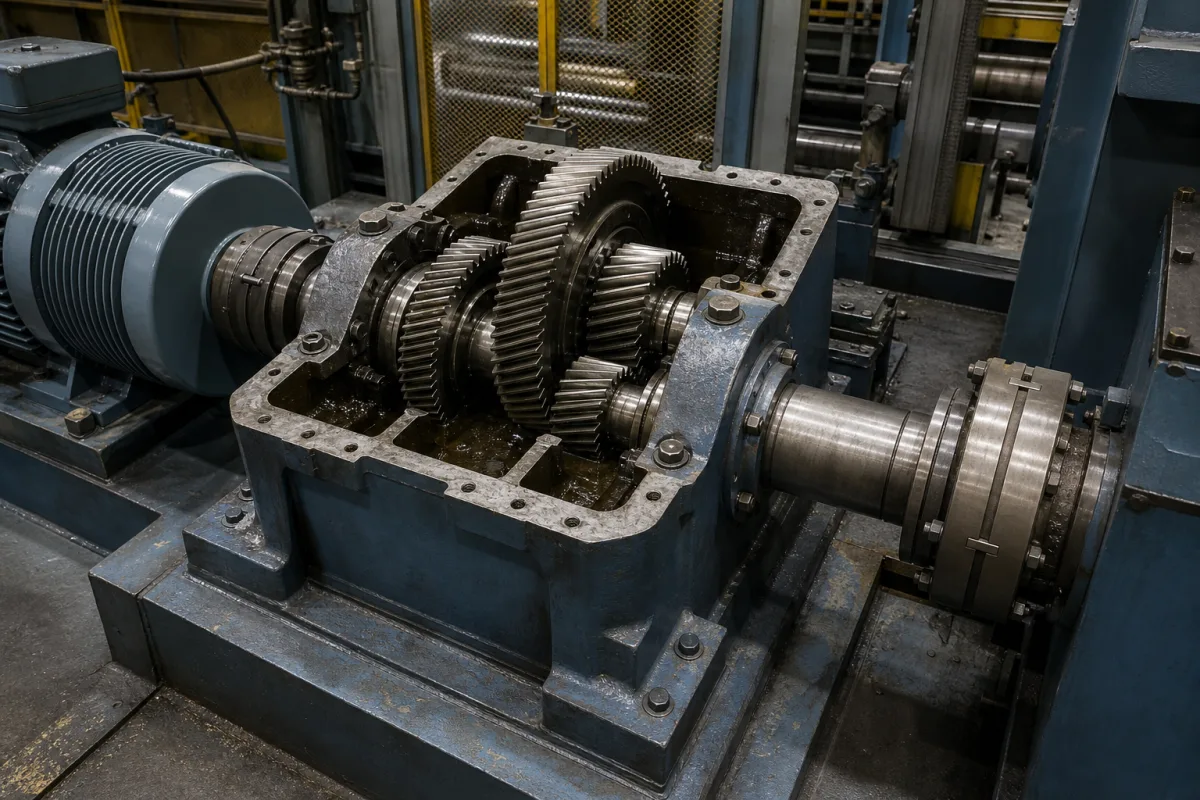
Industrial gear reducers · Enclosed helical gear units that cut motor speed and raise torque in single, double or triple reduction, selected from output torque and speed with an AGMA service factor for shock and running hours, plus overhung load, mounting and lubrication
A gear reduction unit (speed reducer) sits between a motor and a driven machine and uses meshing gears to lower speed and multiply torque. Ask three things first: what output torque and speed the machine needs, how severe its shock loads and running hours are (which sets the service factor), and how the unit will be driven, mounted, connected to the load and lubricated.
Enclosed industrial gear reducers with helical and helical-bevel gearing, foot- or flange-mounted, supplied without a motor or with a motor adapter. Gear motors sold as complete units (see drive assembly gear motor), inline planetary reducers (see planetary gear reducer), loose gear sets (see helical/bevel gears) and vehicle transmissions are outside this page.
CNFX editorial research · Sources checked October 12, 2026 · 4 sources
Boston Gear's 600 Series catalog says selecting a speed reducer needs three pieces of application information: the service factor or AGMA class of service, the output horsepower or torque, and the output speed or ratio. Design horsepower is application horsepower times the service factor, and design torque is application torque times the service factor; the reducer is then chosen from rating tables to meet output speed, service class and torque. [1]
Its service factor table gives 1.00 for AGMA Class I (moderate shock for no more than 15 minutes in 2 hours, or uniform load up to 10 hours a day); 1.25 and 1.50 for Class II (moderate shock up to 10 hours a day or uniform load over 10 hours; heavy shock for no more than 15 minutes in 2 hours or moderate shock over 10 hours); and 1.75 and 2.00 for Class III (heavy shock up to and over 10 hours a day). [1]
Its worked example takes a continuous-duty concrete mixer needing 8,000 lb-in at about 35 rpm for up to 8 hours a day, driven at 1,160 rpm, applies a 1.25 service factor to get 10,000 lb-in design torque, and selects a unit rated at or above that. It adds that an auxiliary drive such as a 3:1 chain reduces the torque needed at the reducer output in proportion. [1]
Editorial calculation: 10,000 lb-in is about 1,130 N·m; 1,160 rpm in to about 35 rpm out implies a ratio of about 33:1. [1]
Give the supplier the driven machine and its load type (uniform, moderate or heavy shock), hours per day, required output torque and speed, input speed and motor or input type, reduction ratio, mounting (foot, flange, shaft-mounted) and position, shaft arrangement, overhung or thrust loads, ambient conditions, lubrication and backstop needs.
02
Fix stages, input, mounting, loads and lubrication
Boston Gear offers its 600 Series helical gear speed reducers in single reduction and in double and triple reduction, as flanged (F600B) and non-flanged (600B) versions, with ordering codes covering reducer size, ratio, reduction stages, lubrication and NEMA motor mounting; backstops and other special needs require factory consultation. It warns that overhung shaft load must be checked when belt or chain drives are used to avoid premature shaft or bearing failure, and gives mounting positions and lubricants in the catalog. [1]
Flender describes its industrial gear units as available in single-stage and multi-stage designs for a wide range of applications. [2]
SEW-EURODRIVE's documentation calculates the overhung load F_R (N) on the gear unit shaft from the operating torque on the low-speed shaft (Nm), the mean diameter d₀ (mm) of the mounted transmission element and a transmission element factor f_Z that it says must be applied: 1.15 for gear wheels with fewer than 17 teeth, 1.40 for sprockets with fewer than 13 teeth, 1.25 for sprockets with fewer than 20 teeth, 1.75 for narrow V-belt pulleys, 2.50 for flat V-belt pulleys and 1.50 for toothed belt pulleys, the belt factors reflecting the influence of pre-tensioning. [4]
Editorial calculation: an output torque of 500 Nm (assumed) on a 200 mm mean-diameter element gives a tangential force of 2 × 500 / 0.200 = 5,000 N; with SEW's factor this is about 5,750 N for a small gear, 6,250 N for a sprocket under 20 teeth and 8,750 N for a narrow V-belt pulley, so a belt drive needs about 1.75 / 1.15 ≈ 1.5 times the shaft load capacity of a small-gear drive at the same torque and diameter. [4]
03
Compare efficiency by gear type before choosing
The US Department of Energy's guidebook Continuous energy improvement in motor driven systems (Advanced Manufacturing Office, 2014) defines gear reducer efficiency as output shaft power divided by input shaft power, with losses from tooth friction, lubricant churning, seals and windage, and notes that a 20:1 reducer multiplies motor torque by 20. Its Table 8-1 gives ratio and efficiency ranges by gear type. [3]
The guidebook explains that worm gears lose efficiency because of sliding rather than rolling contact, that their efficiency depends on ratio, output speed and motor rating and falls at lower input speed and partial load, and that they run hotter than other types; switching from mineral to synthetic lubricant can raise efficiency and extend life. It lists low first cost, compactness, high reduction, quiet running, overload capacity and self-locking as reasons worm gears are specified. It also notes that makers' catalogues may not state reducer efficiency, which can be derived from catalogue performance values. [3]
Editorial calculation: for a 10 hp (7.46 kW) drive at 75% load running 8,000 h a year (about 44,700 kWh at the gear input), moving from 80% to 95% gearbox efficiency cuts input energy by 1 − 0.80/0.95 ≈ 16%, about 7,100 kWh a year, using the DOE guidebook's savings formula.
Gear reducer type (DOE Table 8-1)
Ratio range
Efficiency range
Spur
1:1 to 6:1
98–99%
Helical
2:1 to 10:1
92–98%
Bevel
1:1 to 5:1
97–99%
Helical/bevel
5:1 to 200:1
92–95%
Worm (single stage)
5:1 to 100:1
55–94%
Ask the supplier for gearbox efficiency at your ratio, speed and load (not only at rated load), the lubricant type, and the thermal rating, and compare helical or helical-bevel with worm options on lifetime energy.
04
Find gear reduction unit manufacturers
The manufacturer card below states what the reviewed source shows.
Ask any supplier for rated output torque and power at your speed and service factor, exact ratio, number of stages, efficiency, thermal rating, overhung and thrust load capacity, backlash, housing material, mounting positions, lubricant type and quantity, seals, weight and dimensions.
05
Trace what each part does
This is a functional reference built from the sources cited; it is not one maker's specification.
Fill the specification fields with values for your order
A gear reducer quotation needs values for your drive. The table explains each field, gives published values where a reviewed source states them, and says what to obtain from the supplier.
The manufacturer below lists industrial gear reducers on its own website; each card links to the page reviewed. Confirm ratings, materials and approvals for your order.
Jiangsu Guomao Reducer
Manufacturing site to be confirmed for the order
Lists GM series high-power industrial gearboxes alongside helical, helical-bevel and parallel-shaft geared motors.
Explore company information and manufacturing capabilities, then discuss the scope of your project with a relevant supplier.
Share this page
Compiled and source-reviewed by the CNFX editorial team.
Published product pages show what a company offers, not tested performance. Confirm the legal seller, factory and scope for your order. How we source and review
· Page last updated 13 October 2026
Buyer questions
How is a gear reducer sized?
Boston Gear multiplies application torque or horsepower by the AGMA service factor and selects a unit rated at or above it. [1]
What service factor applies?
Boston Gear's table runs from 1.00 for Class I to 2.00 for Class III heavy shock over 10 hours a day. [1]
Why check overhung load?
Boston Gear says belt or chain drives can cause premature shaft or bearing failure if overhung load is not checked. [1]
How efficient are helical gear reducers compared with worm gears?
The US DOE guidebook gives 92–98% for helical (2:1 to 10:1), 92–95% for helical/bevel and 55–94% for single-stage worm reducers. [3]
How much does a V-belt pulley add to gearbox shaft load?
SEW-EURODRIVE applies a transmission element factor of 1.75 for narrow V-belt pulleys and 2.50 for flat belt pulleys, against 1.15 for gear wheels with fewer than 17 teeth, because of belt pre-tension. [4]
Sources and what still needs a direct check
Sources checked 2026-10-12. Boston Gear, Flender and SEW-EURODRIVE make industrial gear reducers; the US DOE guidebook compares reducer efficiency by gear type.