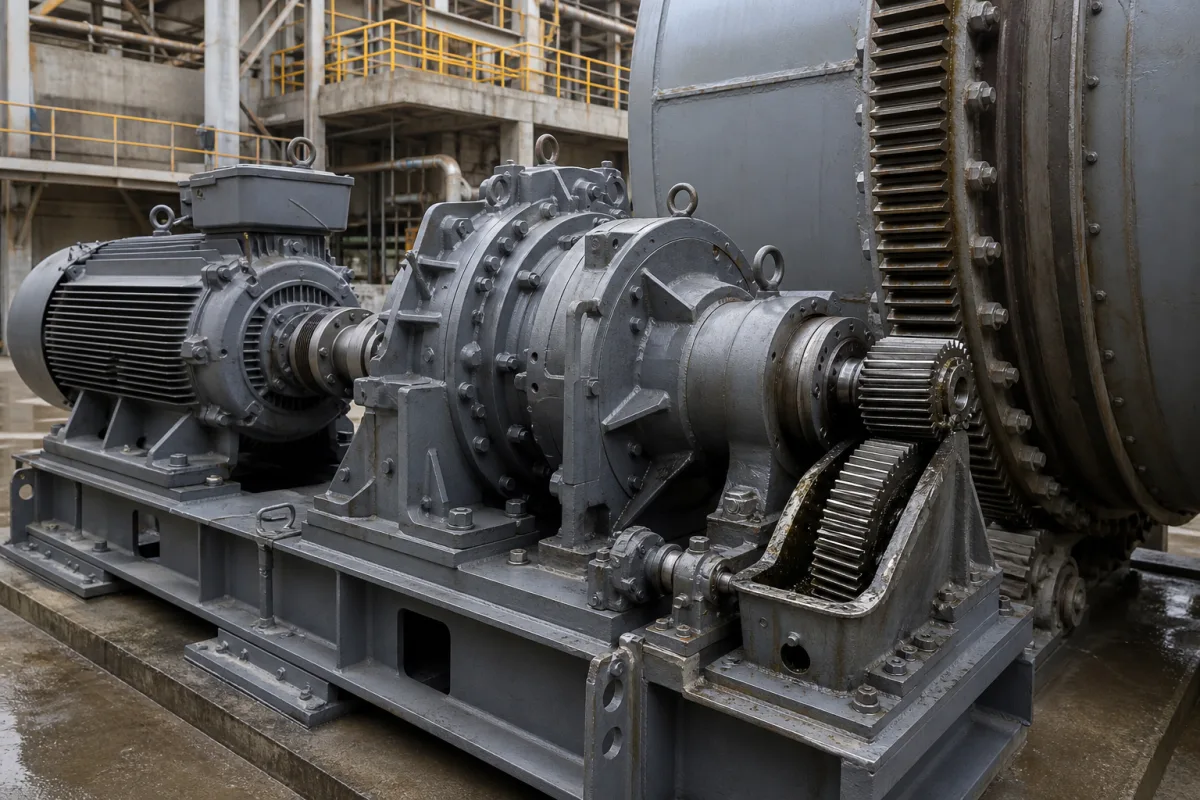
Power transmission · Service factor, efficiency and shaft loads
A gear drive trades speed for torque and loses some power on the way. Pick the ratio from motor and output speed, size the gearbox for torque multiplied by a service factor that reflects how many hours it runs and how hard the load hits, check the side load from the pulley, sprocket or pinion, and remember that a high-ratio worm can waste close to half the motor's power.
AC and DC gear motors and motor-coupling-reducer drive assemblies with helical, helical-bevel, worm and planetary gearing, for conveyors, mixers, drums and machines. Hydraulic motors are outside this page.
CNFX editorial research · Sources checked October 11, 2026 · 6 sources
AutomationDirect's gearbox guide explains that a gearbox reduces speed by its ratio and increases torque by the same ratio while power stays the same less efficiency losses: a 10:1 gearbox gives roughly motor speed divided by 10 and motor torque multiplied by 10. [1]
As an editorial calculation example only: a drum that needs 500 N·m at 36 rpm absorbs about 500 × 36 × 2π ÷ 60 ≈ 1.9 kW at the output shaft. With a 1,450 rpm motor the ratio is about 40:1; the motor power then depends on gearbox efficiency, as shown below.
Ask the supplier for rated output torque, output speed at your supply frequency and the actual (not nominal) ratio.
02
Apply a service factor for duty and shock
AutomationDirect's service-factor table for electric-motor-driven gearboxes ranges from 1.00 for uniform loads run occasionally or under 3 hours a day, through 1.25 for moderate shock at 3–10 hours, to 2.00 for extreme shock over 10 hours; shock includes sudden stopping, restarting or reversing, heavy loads dropped onto a conveyor and impact loads such as punch presses. [2]
It instructs dividing the gearbox power, overhung load and maximum mechanical capacity ratings by the applicable service factor. [2]
Continuing the editorial example: at moderate shock for 3–10 hours a day (service factor 1.25), the gearbox should be rated for at least 500 × 1.25 = 625 N·m at the output.
Give the supplier the driven machine, its load type, hours per day, starts per hour, reversing and any shock, so the service factor is chosen with the right table for its product.
03
Check overhung load from pulleys, sprockets and pinions
AutomationDirect rates overhung load as a force perpendicular to the output shaft at its midpoint, from a gear, pulley or sprocket, and divides the rating by a K factor for the drive type: 1.00 for chain and sprocket, 1.25 for gear, 1.50 for V-belt, 2.50 for flat belt and 3.50 for variable-pitch belt, as well as by the service factor. [2][1]
Give the supplier the pitch diameter of the pulley, sprocket or pinion and its distance from the gearbox face, or ask for a flexible coupling and separate bearings where the side load is too high, as on drum and girth-gear drives.
04
Compare worm and helical efficiency
In AutomationDirect's cast-iron worm gearbox tables, listed efficiency falls as ratio rises: for one frame size, 93% at 5:1, 88% at 10:1, 83% at 20:1, 62% at 40:1 and 52% at 60:1. Its helical-bevel gearboxes are listed at 91%. [1][2]
Completing the editorial example: delivering 1.9 kW through a 40:1 worm at 62% needs about 3.1 kW from the motor, against about 2.1 kW through a helical-bevel unit at 91%. Over long running hours the difference becomes an energy and heat question as well as a sizing one.
AutomationDirect also lists separate mechanical and thermal ratings for worm gearboxes, the thermal rating being the limit for continuous use without overheating. Ask for both, at your ambient temperature and duty. [1]
05
Compare what suppliers offer
Suppliers linked to this page list AC helical and helical-bevel gear motors, worm and planetary gear motors, BLDC gear motors and planetary gearboxes. [3][4][5]
Shengjie lists inline, parallel-shaft, helical-bevel and helical-worm gear motors; DMK lists BLDC planetary, worm, hypoid and parallel-shaft gear motors; ZGC lists brushed planetary and spur gear motors for small drives. [4][5][6]
06
Trace the drive assembly components
This is a functional reference built from the sources cited; it is not one maker's parts list.
Part
Role
Fix in the order
Electric motor
Supplies power; efficiency losses in the gearbox add to its load. [1]
Power, speed, voltage, frequency and enclosure.
Gear reducer
Multiplies torque by the ratio; type sets efficiency. [1][2]
Fill the specification fields with values for your drive
A gear drive quotation needs drive-specific values. The table explains each field, gives published values where a reviewed source states them, and says what to obtain from the supplier.
Explore company information and manufacturing capabilities, then discuss the scope of your project with a relevant supplier.
Share this page
Compiled and source-reviewed by the CNFX editorial team.
Published product pages show what a company offers, not tested performance. Confirm the legal seller, factory and scope for your order. How we source and review
· Page last updated 13 October 2026
Buyer questions
What service factor should I use for a gear motor?
It depends on daily running hours and shock. AutomationDirect's table runs from 1.00 for uniform, short-duty loads to 2.00 for extreme shock over 10 hours a day; ratings are divided by the factor. [2]
Are worm gearboxes inefficient?
At high ratios, yes. AutomationDirect lists one worm frame at 93% efficiency at 5:1 but 62% at 40:1 and 52% at 60:1, against 91% for its helical-bevel units. [1][2]
What is overhung load?
A force perpendicular to the output shaft from a pulley, sprocket or gear; AutomationDirect divides the rating by a K factor from 1.00 for chain to 3.50 for variable-pitch belts. [2]
Sources and what still needs a direct check
Sources checked 2026-10-11. AutomationDirect's IronHorse gearbox documents give its own ratings and selection factors; they are used here as worked references, not limits for other makes. Supplier pages describe their own offers. AGMA and ISO gear rating standards and GB/T 10095.1 were not read for this page.