Editorial Technical Reference

HEPA Filter Bank

This page explains how HEPA Filter Bank is classified within Machinery and Equipment Manufacturing. Technical values and manufacturer relationships are research references; confirm the current specification and supplier evidence for each order.

Technical Definition & Core Assembly

A modular assembly of HEPA filters designed to remove airborne particles with high efficiency within air handling systems.
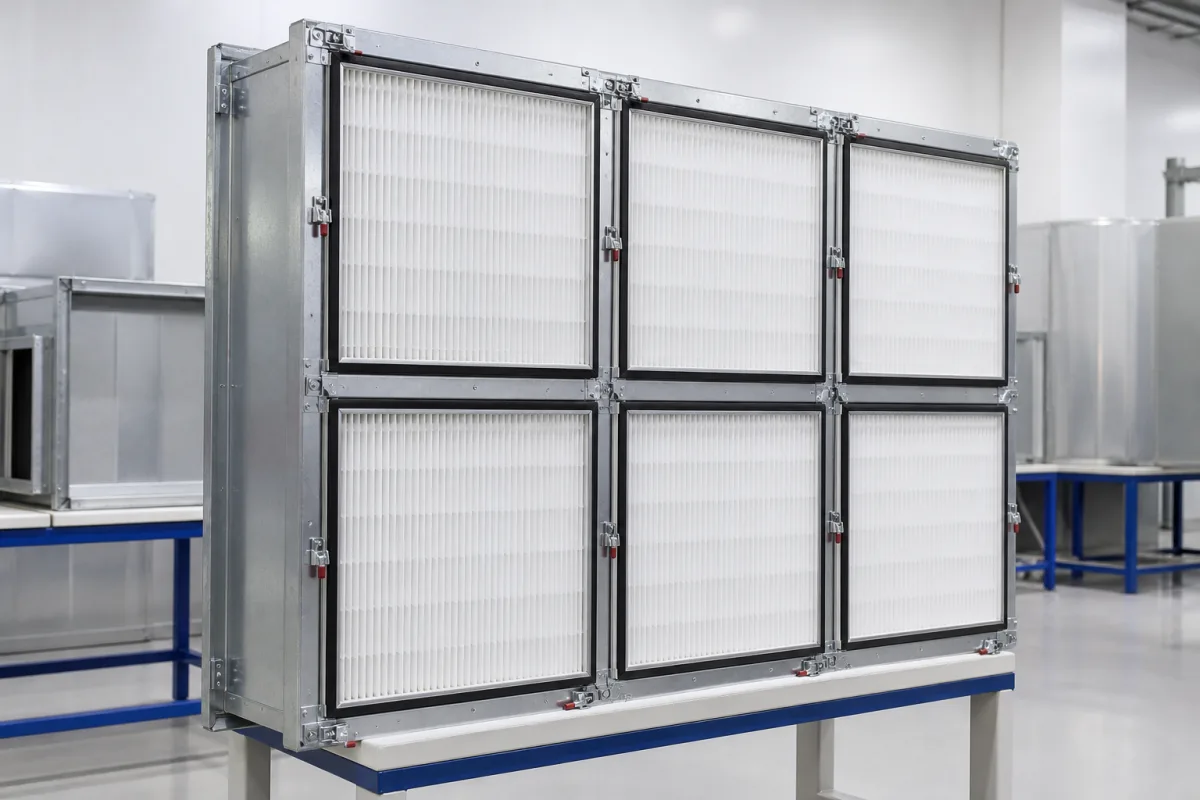
Representative product image. Confirm appearance and specifications with the manufacturer.

Product Specifications

Technical details and manufacturing context for HEPA Filter Bank

Definition
A HEPA filter bank is a critical component of an Air Handling Unit (AHU) that consists of multiple HEPA (High-Efficiency Particulate Air) filters arranged in a bank configuration. Its primary role is to provide the final stage of air filtration, capturing at least 99.97% of particles 0.3 microns in diameter or larger from the airstream before conditioned air is supplied to cleanrooms, laboratories, hospitals, pharmaceutical facilities, or other controlled environments requiring ultra-clean air. The bank configuration allows for a larger total filtration area, which reduces air resistance and extends filter life compared to a single filter, while maintaining the required high-efficiency particulate removal. This product is a component intended for integration into larger systems; it is not a standalone device. The filter bank is typically housed in a rigid frame, with individual filter elements arranged in parallel to achieve the desired airflow capacity. The construction materials include glass fiber media, aluminum separators, polyurethane sealant, and a frame made of galvanized steel or aluminum. The rated airflow ranges from 1000 to 5000 m³/h, with an initial pressure drop of 150–250 Pa at rated airflow. The filtration efficiency is 99.97–99.99% for HEPA H13–H14 grades. The operating temperature range is -40 to 80°C, with brief peaks up to 100°C. The operating pressure should be between 1.0 and 1.6 MPa, and relative humidity should be kept below 95% non-condensing. The filter media grade is H13–H14 per EN 1822, and the frame material can be 304 or 316 stainless steel, depending on corrosion requirements. Seal materials are EPDM or silicone, with silicone suitable for high temperatures. Standard dimensions range from 610×610×292 mm to 1220×610×292 mm, and weight varies from 15 to 30 kg. The maximum operating pressure drop is 600–800 Pa, at which point the filter should be replaced. All values are reference ranges and must be verified for the specific model and application with the legal manufacturer or supplier.
Working Principle
Air is forced through the dense, pleated media of the HEPA filters. Particles are captured through a combination of interception, impaction, and diffusion mechanisms. The bank configuration allows for a larger total filtration area, reducing air resistance and extending filter life compared to a single filter, while maintaining the required high-efficiency particulate removal. The filter bank is designed to operate within specified airflow and pressure parameters; exceeding these limits may reduce efficiency or damage the media. Regular monitoring of pressure drop is essential to determine when replacement is needed.
Common Materials
Glass fiber media, Aluminum separator, Polyurethane sealant, Galvanized steel or aluminum frame
Technical Parameters
ParameterTypical rangeNotes & selection driver
Rated Airflow1000–5000 m³/hSelect based on system design airflow.ISO 5167
Initial Pressure Drop150–250 PaAt rated airflow; increases with loading.ISO 29463
Filtration Efficiency99.97–99.99 %For HEPA H13–H14.ISO 29463
Operating Temperature-40–80 °CContinuous operation; brief peaks up to 100°C.ISO 29463
Relative Humidity0–95 % RHNon-condensing; avoid water droplets.ISO 29463
Filter Media GradeH13–H14Higher grade for stricter cleanliness.EN 1822
Frame Material304–316 SS316 for corrosive environments.ASTM A240
Seal MaterialEPDM–SiliconeSilicone for high temp.ASTM D2000
Dimensions (L×W×H)610×610×292–1220×610×292 mmStandard sizes; custom available.ISO 29463
Weight15–30 kgDepends on size and materials.
Max Operating Pressure Drop600–800 PaReplace filter when reached.ISO 29463

Ranges are indicative industry figures for RFQ preparation, not a supplier commitment. Confirm every value and standard with the legal manufacturer before ordering.

Components / BOM
  • HEPA Filter Cell Part
    Individual filter unit containing the pleated media; the basic building block of the bank.
    Material: Glass fiber media with aluminum separators
  • Filter Frame
    Holds multiple filter cells in a rigid, sealed assembly and provides mounting interface to the AHU.
  • Gasket/Seal Part
    Ensures an airtight seal between the filter bank frame and the AHU housing to prevent bypass.

Applied To / Applications

This component is essential for the following industrial systems and equipment:

Industrial Ecosystem & Supply Chain Structure

Complementary Systems
Downstream Applications
Specialized Tooling

Application Fit & Sizing Matrix

Operational Limits
pressure: Max 2500 Pa differential pressure
flow rate: 0.5 to 5.0 m³/s per module
temperature: -20°C to 80°C
particle retention: ≥99.97% at 0.3 μm
Media Compatibility
✓ Cleanroom HVAC systems ✓ Pharmaceutical manufacturing ✓ Hospital isolation rooms
Unsuitable: High-moisture environments with liquid aerosols
Sizing Data Required
  • Required air volume (m³/h)
  • Available installation space dimensions
  • Target particle size efficiency (μm)

Reliability & Engineering Risk Analysis

Failure Mode & Root Cause
Filter Media Degradation
Cause: Excessive particulate loading beyond design capacity, leading to media clogging, tearing, or chemical degradation from corrosive aerosols.
Seal Failure
Cause: Gasket or seal material degradation due to aging, improper installation, or exposure to incompatible chemicals, resulting in bypass leakage around the filter.
Maintenance Indicators
  • Significant increase in system differential pressure (ΔP) beyond the manufacturer's recommended change-out threshold, indicating severe clogging.
  • Visible particulate emissions downstream of the filter bank or audible air whistling/leakage sounds at the filter housing seals.
Engineering Tips
  • Implement a predictive maintenance program using continuous differential pressure monitoring with set alarms to schedule filter changes before catastrophic clogging or bypass occurs.
  • Ensure proper installation and regular inspection of gaskets/seals; use compatible materials for the operating environment and follow a torque sequence during housing assembly to prevent uneven compression and leaks.

Indicative industry ranges for design and RFQ preparation. Confirm the exact figures and applicable standard with the manufacturer before specifying.

Compliance & Manufacturing Standards

Applicable Standards
ISO 29463: High-efficiency filters and filter media for removing particles in air ANSI/ASHRAE 52.2: Method of Testing General Ventilation Air-Cleaning Devices for Removal Efficiency by Particle Size EN 1822: High efficiency air filters (EPA, HEPA and ULPA)

Quoted from the published standard.

Manufacturing Precision
  • Frame squareness: +/- 0.5 mm per meter
  • Seal bead height: +/- 0.2 mm
Quality Inspection
  • Particle counting efficiency test (0.3 μm MPPS)
  • Pressure drop uniformity test across filter face

Manufacturers of HEPA Filter Bank

Manufacturer profiles associated with HEPA Filter Bank.

Sourcing HEPA Filter Bank from China?
Tell us your specification and target quantity — we will match it against manufacturer records and come back with the factories that fit.
Request manufacturers We manufacture this

Manufacturer listings support early research and capability understanding. They are not certification, ranking, or transaction guarantees.

Technical documentation
Request current drawings, revision history, and a signed specification sheet.
Manufacturing capability
Verify equipment lists, process limits, capacity, and representative production evidence.
Inspection readiness
Confirm test methods, calibrated equipment, sampling plans, and traceable reports.
Supplier transparency
Check the legal entity, factory address, ownership, certifications, and direct contacts.

CNFX does not score or rank suppliers. Buyers must verify all claims and documents with the legal manufacturer before ordering.

Supply Chain Compatible Machinery & Devices

Heavy-Duty CNC Plasma Cutting Machine

The Heavy-Duty CNC Plasma Cutting Machine is a standalone industrial device designed for cutting conductive metals such as steel, stainless steel, aluminum, and copper alloys.

Explore Specs →
Automated Powder Coating System

Integrated industrial system for applying dry powder coatings to metal substrates.

Explore Specs →
Centrifugal Pump Impeller

The centrifugal pump impeller is a critical rotating component that converts mechanical energy from the motor into kinetic energy in fluid systems.

Explore Specs →
High-Precision CNC Laser Cutting Machine

Computer-controlled industrial machine using focused laser beams to cut sheet metal with micron-level accuracy.

Explore Specs →

Frequently Asked Questions

What is the typical application of a HEPA filter bank?

It is used as the final filtration stage in air handling units serving cleanrooms, laboratories, hospitals, pharmaceutical facilities, and other controlled environments requiring ultra-clean air.

What is the filtration efficiency of this HEPA filter bank?

The filtration efficiency is at least 99.97% for particles 0.3 microns or larger, with grades H13–H14 per EN 1822. Specific efficiency depends on the filter media grade selected.

How do I determine when to replace the filters?

Monitor the pressure drop across the filter bank. The maximum operating pressure drop is 600–800 Pa; when this is reached, the filters should be replaced to maintain performance and avoid damage.

What are the operating limits for temperature and humidity?

The operating temperature range is -40 to 80°C, with brief peaks up to 100°C. Relative humidity should be kept below 95% non-condensing to prevent moisture damage.

Data Basis

Editorial classification, named public sources where available, and source-reviewed manufacturer records.

Preliminary Technical Classification
This page supports structured research, RFQ preparation, and supplier evaluation. It does not replace buyer-led supplier qualification, standards review, or technical approval.
Buyer enquiry

Request manufacturing insight for HEPA Filter Bank

Ask for use case, specification boundaries, supplier type, and RFQ preparation information for this product.

Where it goes
Straight to the CNFX editorial desk, and to the manufacturer if this product is linked to a claimed profile. Nothing is broadcast to a supplier list.
Your details stay here
We do not sell or rent enquiry data, and we do not add you to a mailing list. Used only to answer this request.
No commission, no middleman
CNFX is a directory. We take no cut of any order and never negotiate on a supplier's behalf.
What we don't claim
A listing is not an endorsement. Qualify every supplier and verify every figure yourself before ordering.

Your business information is used only to process this request.

Thank you! Your message has been sent. We'll respond within 1–3 business days.
Sorry, we couldn't send your message. Please try again, or email us at contact@cnfx.com.

Need to Manufacture HEPA Filter Bank?

Compare manufacturer profiles with relevant product and process capability.

Previous Product
Z-axis Ram/Spindle
Last Product
Get QuotesChat