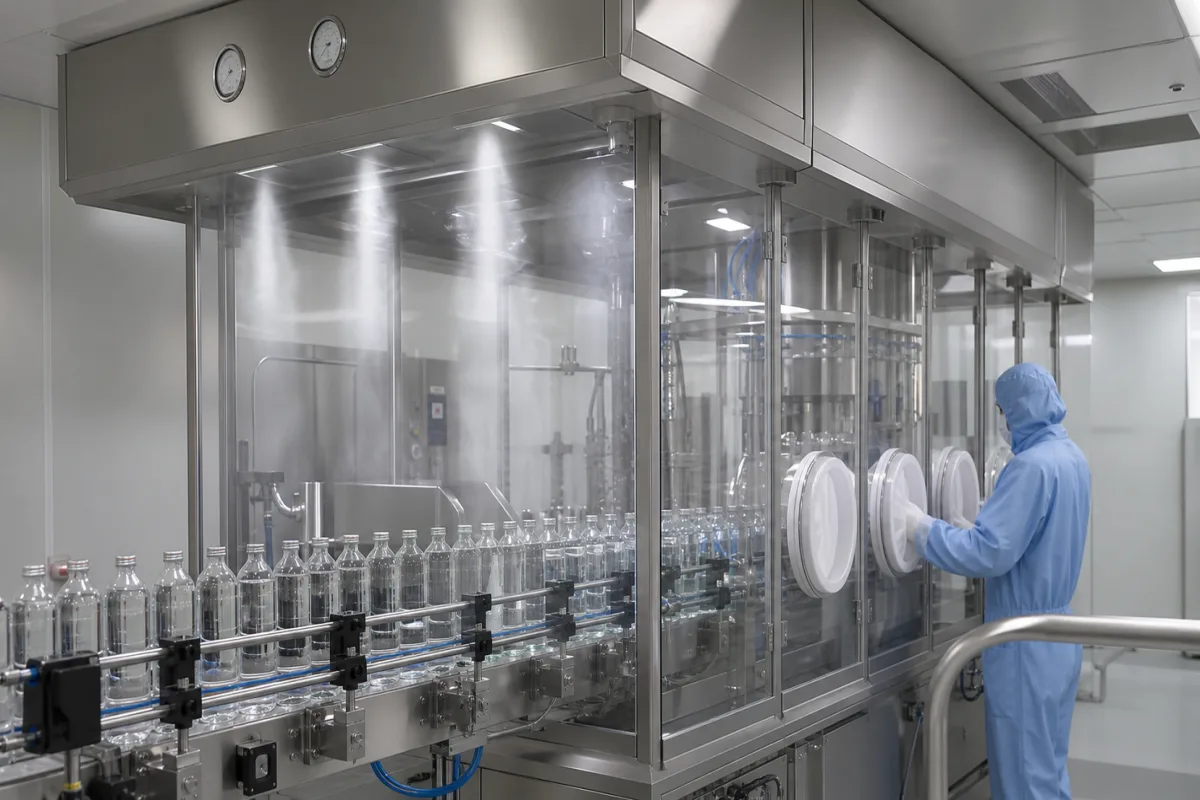
Laminar-flow clean-air cabin for ultra-clean (ESL) filling: the HEPA-fed enclosure that keeps decontaminated bottles and cups clean for chilled dairy drinks and juices
Extended-shelf-life (ESL) filling · HEPA clean box at 10 Pa overpressure around the filler and capper, laminar-flow hoods over cup filling and sealing, 3 to 5 log decontamination targets, chilled shelf life of 40 days and more
Between a hygienic filler and a fully aseptic one sits ultra-clean filling: the product still travels and sells chilled, but the containers and closures are decontaminated and filled under a cabin of filtered air so the drink keeps for weeks instead of days. The cabin is what holds the decontaminated containers clean until they are closed. When buying one, settle three things: what shelf life and which decontamination targets the cabin and its treatments are designed for, how the clean air is delivered and held at overpressure around the filling and closing stations, and how containers and lids are treated before they enter it.
Clean-air cabins and laminar-flow hoods around ultra-clean and extended-shelf-life (ESL) fillers for chilled milk drinks, dairy desserts, iced coffee and juices in bottles and cups: shelf-life and log-reduction targets, HEPA air supply and overpressure, the enclosure around filler, capper and sealer, and the container and lid decontamination that feeds it. Isolators and RABS for sterile medicinal products are covered on the Aseptic barrier: isolator and RABS page; sterile chambers, pressure cascades and peroxide decontamination of fully aseptic bottle fillers on the Sterile chamber and tunnel on an aseptic bottle filler page; HEPA hood enclosures sized by fan filter unit and outflow velocity under 21 CFR 129 on the Sterile Air/Hood Enclosure page; HEPA units on their own on the HEPA filtration unit for aseptic filling and sterilisation areas page; cleanroom HVAC on the Cleanroom conditioning system page; complete aseptic cold-fill PET lines on the Aseptic cold-fill PET beverage line page.
CNFX editorial research · Sources checked October 13, 2026 · 3 sources
Chilled shelf life of 40 days and more, set by 3 log on B. atrophaeus and 5 log on A. brasiliensis
GEA describes its Whitebloc ESL as a cold-chain filling system for sensitive beverages and liquid dairy products in which the decontamination target, for high- or low-acid products, is set according to the shelf life required. Its stated targets reach up to 5 log reduction on Aspergillus brasiliensis and up to 3 log reduction on Bacillus atrophaeus, for bottles from 200 ml single-serve to 1 US gallon, and GEA rates the machine for low to medium speeds. [1]
Below that level GEA places its Aerobloc Fresh, configured for hygienic filling of milk and sensitive beverages with a short shelf life in the cold chain without any container decontamination. [1] Editorial note: the difference between the two GEA machines is the step this page is about, from filling clean air around untreated containers to decontaminating containers and closures and then keeping them clean under a cabin.
Waldner's cup line for iced coffee gives a shelf-life figure for an ultra-clean result: with H₂O₂ on the cups, UV-C on the aluminium lids and a clean-air cabin around the machine, the dairy reaches a latte shelf life of at least 40 days. [2] Novapac rates the pulsed-light or UV-C treatment of cups and lids on its Novacup RS 200 Ultraclean for LOG rates up to 4–5. [3]
Tell the supplier the product, its pH, the storage temperature and the shelf life wanted, and ask which organisms and log reductions the container and closure treatments are validated for, and how that is shown at acceptance.
02
A 10 Pa clean box around filler and capper, a sealed cabin against a humid hall, and laminar-flow hoods over filling and sealing
GEA calls the Clean Box the key to its ESL technology: a physically isolated ultraclean environment around the filler and capper, fed through a HEPA filter with sterile air at an ambient overpressure of 10 Pa, so that bottles are not recontaminated after their H₂O₂ treatment; the surfaces inside are designed to be accessible and easy to clean. [1]
Waldner's iced-coffee line shows why the cabin sometimes has to be sealed against the hall itself. The dairy's warm, humid site was, in Waldner's words, the perfect breeding ground for germs, so the filling machine needed a sealed enclosure able to isolate the outside climate in a small space; the result is a compact line enclosed in a clean-air cabin with laminar airflow, kept at a slight overpressure of clean air, with a checkweigher and packing station on the same line. [2]
Novapac's sheet for its Novacup RS 200 describes an Ultraclean execution with a laminar-flow air hood, and a sealing-lid sterilization station with its own laminar-flow air hood next to the sealing station. It lists 5,000–16,000 cups per hour on a 16-position turntable with up to 6 rows, fill volumes of 10–1,000 ml at ±0.5 % per cup depending on product, plastic, aluminium or paper cups, and a machine of 2,000 × 2,000 × 3,200 mm weighing 3,500 kg. [3]
Editorial calculation: GEA's 10 Pa is 0.1 mbar, about one ten-thousandth of atmospheric pressure. [1] Editorial note: ask the supplier how much clean air leaves through the container infeed and outfeed openings at that overpressure, since that sets the air the HEPA supply has to provide.
Ask for the overpressure held inside the cabin and how it is monitored, which stations sit under laminar flow, the HEPA filter class, the size of the container inlet and outlet openings, and how the cabin interior is cleaned between production runs.
03
What enters the cabin: H₂O₂ on bottles and cups, residual peroxide under 0.5 ppm, VHP, UV-C or pulsed light on caps and lids
In GEA's two-phase process the bottles are sprayed with H₂O₂ solution on a first carousel, then flushed on a second carousel with hot sterile air that activates the peroxide and purges it to a final concentration below 0.5 ppm, without any water rinse. Caps, flat or sport, and aluminium foils pass through a dry vaporised H₂O₂ (VHP) module after a preheating phase that prevents condensation; the caps are moved only by the VHP flow or gravity so that their slip agent stays in place. [1]
Waldner disinfects the inside of the cups with H₂O₂, which it uses so that cardboard cups can be run as well as plastic, and treats the aluminium lids with UV-C light in the 100–280 nm band. [2] Novapac offers pulsed light or UV-C for both cups and sealing lids, with aluminium or plastic seal lids and press-in or snap-on lids, for milk, yoghurt, processed cheese and other dairy products, juices, ketchup and mustard. [3]
List every container and closure material and format to be run, and ask which treatment each one receives before the cabin, with the residual peroxide or lamp dose that the treatment is set to.
04
Product, pack and site data for an ultra-clean filling cabin
Paste it into your enquiry below or into an email to a maker, then replace every bracket.
Product: [type; pH; storage temperature; shelf life wanted]
Containers: [bottles or cups; material; volumes; output per hour]
Closures: [caps, foils or lids; material]
Decontamination: [H₂O₂, VHP, UV-C or pulsed light; target organisms and log reductions]
Cabin: [whole-machine clean box or hoods over stations; overpressure; HEPA class]
Site: [hall temperature and humidity; space available]
Cleaning: [cabin interior cleaning between runs]
Acceptance: [microbiological tests and documents required]
Explore company information and manufacturing capabilities, then discuss the scope of your project with a relevant supplier.
Share this page
Compiled and source-reviewed by the CNFX editorial team.
Each manufacturer above links to the page on that company's own website where the product is listed, with the date we checked it. How we source and review
· Page last updated 13 October 2026
Buyer questions
What overpressure does an ESL filler's clean box run at?
GEA states 10 Pa of HEPA-filtered sterile air around the filler and capper of its Whitebloc ESL. [1]
What log reductions do ultra-clean fillers aim for?
GEA gives targets up to 5 log on A. brasiliensis and up to 3 log on B. atrophaeus; Novapac rates its cup and lid treatment for LOG 4–5. [1][3]
Why enclose a cup filler in a sealed clean-air cabin?
Waldner sealed an iced-coffee line in a laminar-flow clean-air cabin at slight overpressure because the warm, humid site encouraged germs; the dairy reached at least 40 days' shelf life. [2]
How are lids decontaminated before they enter the cabin?
Waldner uses UV-C at 100–280 nm on aluminium lids, Novapac pulsed light or UV-C, and GEA dry vaporised H₂O₂ for caps and foils. [2][3][1]
Sources and what still needs a direct check
Sources checked 2026-10-13. Three filling-machine makers describing their own equipment: GEA's product page for the Whitebloc ESL filling system, Waldner's reference for a compact iced-coffee cup line, and Novapac's specification sheet for the Novacup RS 200 Ultraclean cup filler.