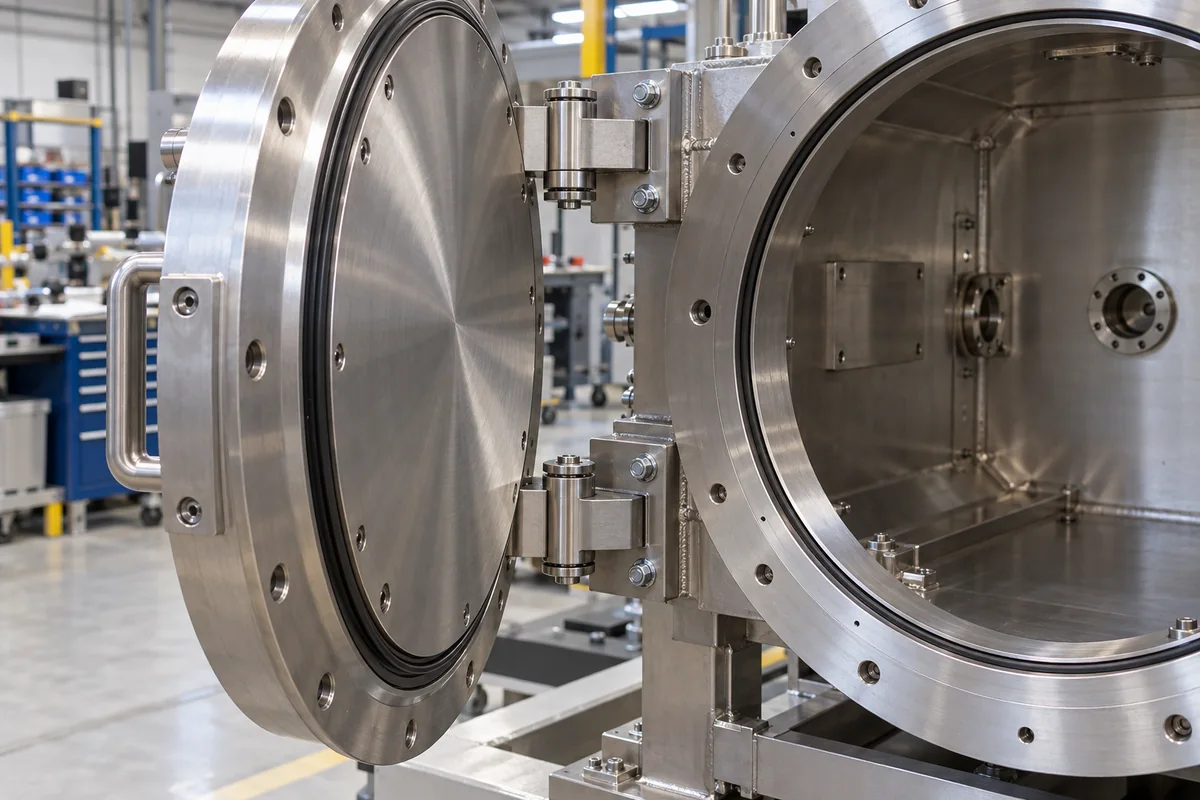
Vacuum chamber door hinge system: floating hinges that let the door seat itself on the O-ring
Door and hatch hinges for vacuum chambers · floating and slotted hinges that let atmospheric pressure seat the door, even O-ring squeeze, open-assist for heavy hatches, demountable hinge pins
On a vacuum chamber, the door or hatch is not held shut by its hinge. Once the chamber is pumped down, the pressure difference pulls the door onto its O-ring, and the hinge has to get out of the way: a rigid hinge that fixes the door's last position can leave one side of the O-ring squeezed harder than the other, and the seal leaks. The hinge systems on this page are built to float, slide or flex so that the door can find its own seat, and on large hatches they also carry the door's weight while it is opened by hand.
Hinge assemblies for the doors, hatches and access plates of vacuum chambers: compliant and floating hinges, slotted and spring-loaded hinge mounts, demountable hinge pins and open-assist mechanisms, supplied with a chamber or as a retrofit. The vacuum chambers themselves are covered on the Vacuum chamber page, and molten-aluminium degassing stations on their own page. Furniture hinges, hinged machine-guard doors, inspection hatches for bulk-handling equipment and control-enclosure doors have their own pages; building door hinges and pivot hinges are outside this page.
CNFX editorial research · Sources checked October 12, 2026 · 4 sources
Why a fixed hinge leaks: uneven O-ring squeeze and the door that pump-down pulls in
Lam Research's patent for a semiconductor transport-module hatch describes the problem with a hatch rotating on a fixed pin: depending on manufacturing tolerances, its last rotation may not leave the hatch sealing surface parallel to the cover sealing surface, and an O-ring loaded only on its inner side is not evenly loaded. In Lam's design the hinge lets the hatch move from an O-ring pre-load position to an intermediate and then a final position during pumping, so the pre-loaded O-ring is compressed to its operating compression and the entire perimeter becomes equally loaded. [1]
Ethicon's patent for a sterilizer chamber door makes the same point for a door with hinges on one side and a latch on the other: when vacuum pulls the door closed, unless hinges and latch are precisely placed, the force between door and chamber is higher on one side, which can cause leaks, damage the seals and damage the hinges. Its answer is a force equalization system at the hinge or the latch. [3]
Marco Rubber's gland guidance shows what the hinge is protecting: it gives squeeze as (O-ring cross-section − gland depth) ÷ cross-section and recommends 20–30 % for a face seal, warns that eccentricity and side loading leave too much squeeze on one side and too little or none on the other, and calls for a narrower groove when sealing vacuum or gas and a 16 Ra finish on static surfaces that seal gas. [4] Editorial calculation with an assumed 5.33 mm cross-section: 20–30 % squeeze means a compressed height of 3.73 to 4.26 mm, so a door that closes 0.5 mm out of parallel across the O-ring can push one side of the O-ring outside that band.
Ask how the hinge lets the door move toward the chamber at pump-down, and how the O-ring is pre-loaded evenly before the vacuum takes over.
02
Compliant spring connection, slotted floating mount and demountable pin: three hinge designs from patents
Each patent below solves the floating door differently; they also differ in how the door is removed and how heavy it is.
Lam's patent gives the hatch weight that makes open-assist worth having: a hatch may weigh thirty-five or fifty pounds, and once it is opened, safety requirements call for a latch against sudden closing; it contrasts this with lifting a whole cover of about 500 pounds. [1] Editorial calculation: 35 to 50 lb is about 16 to 23 kg, and 500 lb about 227 kg.
The Hewlett-Packard patent notes that pressure sealing alone was earlier limited to plates heavy enough to seal under gravity before pump-down, which ruled it out for openings in the side or bottom of a chamber; its hinge is meant to make pressure sealing usable on all sides. In its example the hinge pin and plate are stainless steel and the integral hinge assembly and chamber are aluminium. [2]
Design
How the door is allowed to float
Other features
Compliant hinge with open-assist (Lam Research)
An intermediate hatch mounting plate is fastened to the hatch through countersunk bores with a spring assembly under each fastener head, so the hatch can tilt relative to the hinge body while the O-ring is compressed. [1]
A torsion rod assists opening, and friction springs hold the hatch at any angle without the operator. [1]
Slotted, spring-loaded floating hinge (Ethicon)
The hinge mounting plates are screwed to a bracket through elongated slots, using shoulder screws, and a spring biases the plate away from the door; another version slides the hinge between PTFE plates. [3]
The door clips onto the hinge plates by a pin and catch for easy removal; the latch is interlocked with the plasma and sterilant controls. [3]
Demountable pin in a slot (Hewlett-Packard)
The hinge pin sits in a lower aperture and an upper slot, giving it room to move as the plate is pressure-sealed at pump-down. [2]
No bolts or clamps: the plate is held by the pressure difference and released on venting, can be lifted off the hinge, and carries feed-throughs. [2]
03
Tolerance stack in a compliant hatch hinge
Lam's patent lists the manufacturing tolerances its compliant hinge has to absorb. Units are not stated in the passage reviewed; inches are inferred from the 35 to 50 lb hatch weights given in the same text.
Editorial note: when a chamber builder offers a hinged door, ask which of these dimensions the hinge design absorbs and which must be held by machining, and ask for a leak test with the door closed by the hinge, not clamped.
Explore company information and manufacturing capabilities, then discuss the scope of your project with a relevant supplier.
Share this page
Compiled and source-reviewed by the CNFX editorial team.
Each manufacturer above links to the page on that company's own website where the product is listed, with the date we checked it. How we source and review
· Page last updated 13 October 2026
Buyer questions
Why does a vacuum chamber door need a floating hinge?
Lam Research's patent explains that a fixed hinge can leave the sealing surfaces out of parallel, so the O-ring is unevenly loaded; a compliant hinge lets the door move during pump-down until the whole O-ring is equally loaded. [1]
How much should the door O-ring be squeezed?
Marco Rubber recommends 20–30 % squeeze for face seals, with a narrower groove for vacuum or gas and a 16 Ra static surface finish to seal gas. [4]
Can a hinged vacuum plate seal without bolts?
Hewlett-Packard's patent describes a hinged plate that is pressure-sealed at pump-down and released on venting, with no bolts or clamps. [2]
How is a floating hinge mounted?
Ethicon's patent mounts hinge plates through elongated slots with shoulder screws and a spring, or slides the hinge between PTFE plates. [3]
Sources and what still needs a direct check
Sources checked 2026-10-12. Three patents, from Lam Research, Hewlett-Packard and Ethicon, describe floating hinges for vacuum chamber hatches and doors; Marco Rubber, an O-ring supplier, gives gland design guidance. Patents show designs, not tested products.