Industry-Verified Manufacturing Data (2026)

Vacuum Sealed Door

Based on aggregated insights from multiple verified factory profiles within the CNFX directory, the standard Vacuum Sealed Door used in the Machinery and Equipment Manufacturing sector typically supports operational capacities ranging from standard industrial configurations to heavy-duty production requirements.

Technical Definition & Core Assembly

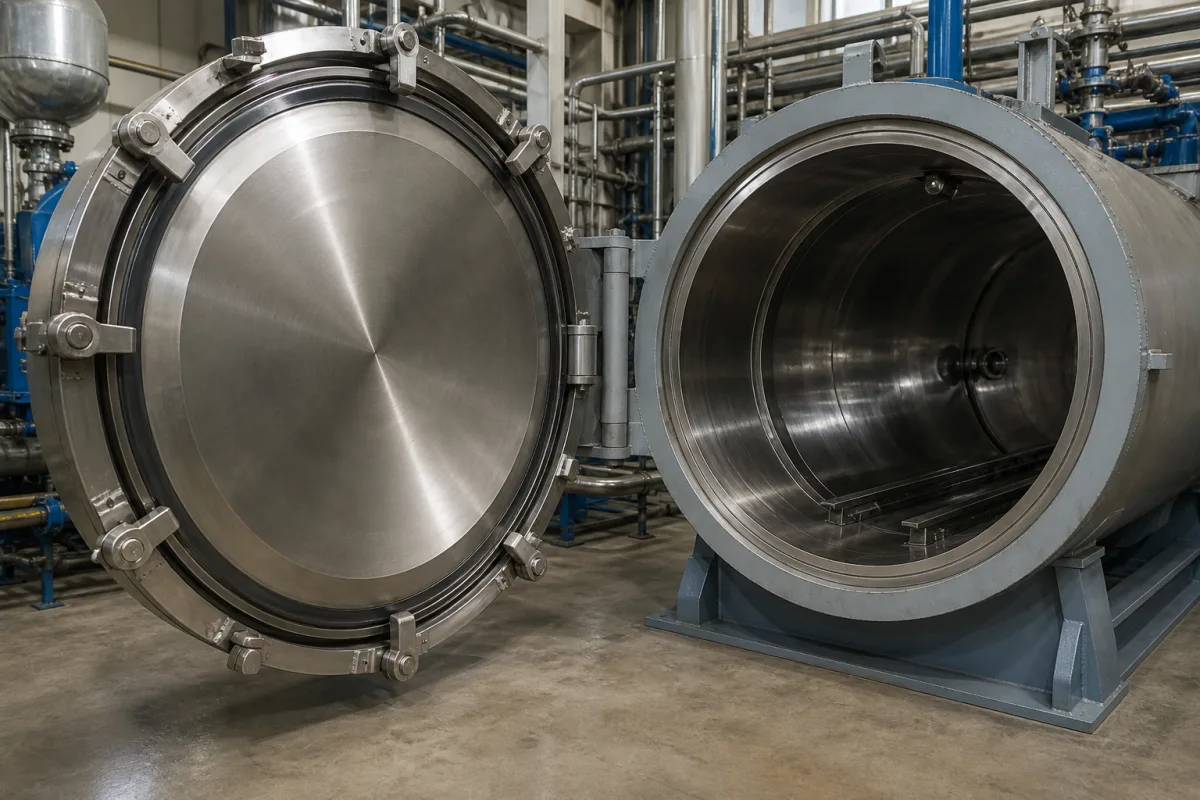
A canonical Vacuum Sealed Door is characterized by the integration of Door Flange and Sealing Gasket. In industrial production environments, manufacturers listed on CNFX commonly emphasize Stainless Steel (304/316) construction to support stable, high-cycle operation across diverse manufacturing scenarios.

A specialized door designed to maintain vacuum integrity in pressure vessels and chambers.
Product Specifications

Technical details and manufacturing context for Vacuum Sealed Door

Definition
A critical component of Vacuum-Pressure Impregnation (VPI) Chambers that provides secure access while maintaining the required vacuum and pressure conditions during the impregnation process. It ensures no air leakage during vacuum cycles and withstands pressure differentials during resin injection phases.
Working Principle
The door creates an airtight seal through mechanical compression of sealing gaskets against a precisely machined sealing surface. When closed and locked, it compresses elastomeric or metallic seals to prevent gas exchange between the chamber interior and external environment, maintaining vacuum levels as low as 0.1 mbar or pressure up to several bars.
Common Materials
Stainless Steel (304/316), Neoprene/Viton Seals, Tempered Glass Viewport
Technical Parameters
  • Door diameter or rectangular dimensions matching chamber opening (mm) Customizable
Components / BOM
  • Door Flange
    Provides mounting surface and sealing interface with chamber
    Material: Stainless Steel
  • Sealing Gasket
    Creates airtight seal when compressed against sealing surface
    Material: Viton/Neoprene
  • Locking Mechanism
    Applies uniform compression force to seal and secure door
    Material: Stainless Steel
  • Viewport
    Allows visual inspection of chamber interior without breaking vacuum
    Material: Tempered Glass with O-ring seal
  • Hinge System
    Enables smooth opening and closing while maintaining alignment
    Material: Stainless Steel with bearings
Engineering Reasoning
1e-6 to 1e-3 mbar (10^-6 to 10^-3 mbar)
1e-2 mbar (10^-2 mbar) differential pressure across seal
Design Rationale: Seal compression force exceeds elastomer yield strength (σ_y > 15 MPa) due to atmospheric pressure differential (101.325 kPa) acting on door surface area, causing permanent deformation and vacuum leak paths
Risk Mitigation (FMEA)
Trigger Elastomer seal thermal aging at 120°C for 1000+ hours
Mode: Seal compression set exceeding 25% of original thickness
Strategy: Install redundant metallic knife-edge seal with 0.05 mm interference fit
Trigger Cyclic pressure differential of 0.1-1.0 bar at 0.5 Hz frequency
Mode: Hinge bolt fatigue fracture at 10^6 cycles (S-N curve σ_a = 200 MPa)
Strategy: Replace ASTM A325 bolts with Inconel 718 fasteners having fatigue limit σ_e = 450 MPa

Industry Taxonomies & Aliases

Commonly used trade names and technical identifiers for Vacuum Sealed Door.

Applied To / Applications

This component is essential for the following industrial systems and equipment:

Industrial Ecosystem & Supply Chain DNA

Complementary Systems
Downstream Applications
Specialized Tooling

Application Fit & Sizing Matrix

Operational Limits
pressure: Up to 10^-6 mbar vacuum to 10 bar positive pressure
other spec: Leak rate: <1×10^-9 mbar·L/s, Seal material dependent
temperature: -50°C to +200°C
Media Compatibility
✓ High-purity gases (e.g., nitrogen, argon) ✓ Chemical vapors (e.g., solvents, etchants) ✓ Dry particulate environments
Unsuitable: Abrasive slurry with high solids concentration (>20%)
Sizing Data Required
  • Chamber/vessel diameter (mm)
  • Required vacuum level (mbar)
  • Operating temperature range (°C)

Reliability & Engineering Risk Analysis

Failure Mode & Root Cause
Seal Degradation
Cause: Compression set and material fatigue due to repeated cycling, exposure to temperature variations, and chemical attack from cleaning agents or environmental contaminants.
Mechanical Misalignment
Cause: Wear in hinge mechanisms or latch assemblies from improper adjustment, excessive force during operation, or structural deformation of the door frame due to thermal expansion or external impacts.
Maintenance Indicators
  • Audible hissing or whistling during vacuum cycle indicating seal leakage
  • Visible deformation, cracking, or permanent compression of the sealing gasket
Engineering Tips
  • Implement a routine inspection and cleaning protocol for sealing surfaces using compatible, non-abrasive cleaners to prevent contamination buildup that accelerates seal wear.
  • Establish and adhere to manufacturer-recommended torque settings for latch mechanisms and perform periodic alignment checks using precision tools to ensure uniform seal compression and prevent mechanical stress concentrations.

Compliance & Manufacturing Standards

Reference Standards
ISO 9001:2015 - Quality Management Systems ANSI/AMCA 500-D - Laboratory Methods for Testing Dampers for Rating EN 12207:2017 - Windows and doors - Air permeability - Classification
Manufacturing Precision
  • Seal Surface Flatness: 0.1mm per meter
  • Door Frame Squareness: +/-1.5mm diagonal difference
Quality Inspection
  • Vacuum Leak Test (Helium Mass Spectrometry)
  • Seal Compression Force Test

Factories Producing Vacuum Sealed Door

Verified manufacturers with capability to produce this product in China

✓ 97% Supplier Capability Match Found

T Technical Director from Canada Feb 23, 2026
★★★★★
"Reliable performance in harsh Machinery and Equipment Manufacturing environments. No issues with the Vacuum Sealed Door so far."
Technical Specifications Verified
P Project Engineer from United States Feb 20, 2026
★★★★☆
"Testing the Vacuum Sealed Door now; the technical reliability results are within 1% of the laboratory datasheet. (Delivery took slightly longer than expected, but technical support was excellent.)"
Technical Specifications Verified
S Sourcing Manager from United Arab Emirates Feb 17, 2026
★★★★★
"Impressive build quality. Especially the technical reliability is very stable during long-term operation."
Technical Specifications Verified
Verification Protocol

“Feedback is collected from verified sourcing managers during RFQ (Request for Quote) and factory evaluation processes on CNFX. These reports represent historical performance data and technical audit summaries from our B2B manufacturing network.”

14 sourcing managers are analyzing this specification now. Last inquiry for Vacuum Sealed Door from Vietnam (21m ago).

Supply Chain Compatible Machinery & Devices

Hydraulic Press

Industrial machine using hydraulic pressure to compress, form, or assemble materials

Explore Specs →
Heavy-Duty CNC Plasma Cutting Machine

Industrial machine for precision metal cutting using plasma arc technology

Explore Specs →
Automated Assembly Line System

Integrated production system for sequential component assembly operations

Explore Specs →
Automated Powder Coating System

Integrated industrial system for applying dry powder coatings to metal substrates.

Explore Specs →

Frequently Asked Questions

What materials are used in your vacuum sealed doors?

Our vacuum sealed doors feature stainless steel (304/316 grade) construction, neoprene or viton sealing gaskets for optimal vacuum integrity, and tempered glass viewports for safe observation.

What applications are these vacuum sealed doors designed for?

These doors are engineered for pressure vessels, vacuum chambers, industrial processing equipment, and any machinery requiring maintained vacuum or pressure integrity in manufacturing environments.

Can you customize vacuum sealed doors for specific chamber requirements?

Yes, we offer custom manufacturing including various sizes, pressure ratings, locking mechanisms, and material specifications to match your specific vessel or chamber requirements.

Can I contact factories directly on CNFX?

CNFX is an open directory, not a transaction platform. Each factory profile provides direct contact information and production details to help you initiate direct inquiries with Chinese suppliers.

Get Quote for Vacuum Sealed Door

Request technical pricing, lead times, or customized specifications for Vacuum Sealed Door directly from verified manufacturing units.

Your business information is encrypted and only shared with verified Vacuum Sealed Door suppliers.

Thank you! Your message has been sent. We'll respond within 1–3 business days.

Need to Manufacture Vacuum Sealed Door?

Connect with verified factories specializing in this product category

Add Your Factory Contact Us
Previous Product
Vacuum Seal Door
Next Product
Vacuum Sensor