Industry-Verified Manufacturing Data (2026)

Hood Body/Enclosure

Based on aggregated insights from multiple verified factory profiles within the CNFX directory, the standard Hood Body/Enclosure used in the Machinery and Equipment Manufacturing sector typically supports operational capacities ranging from standard industrial configurations to heavy-duty production requirements.

Technical Definition & Core Assembly

A canonical Hood Body/Enclosure is characterized by the integration of Duct Collar/Flange and Baffles/Deflectors. In industrial production environments, manufacturers listed on CNFX commonly emphasize Stainless Steel construction to support stable, high-cycle operation across diverse manufacturing scenarios.

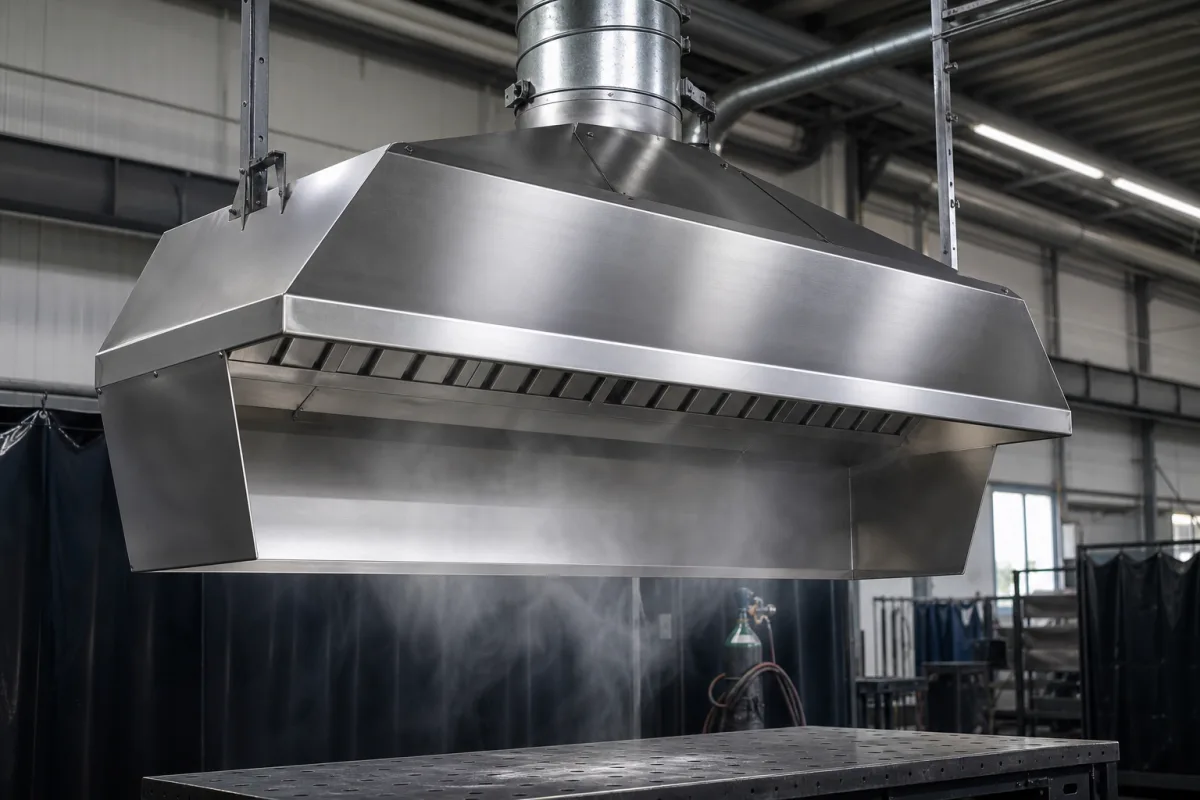
The main structural housing of a fume extraction hood that contains and directs airflow.
Product Specifications

Technical details and manufacturing context for Hood Body/Enclosure

Definition
The hood body or enclosure is the primary structural component of a fume extraction hood, forming the physical chamber that captures, contains, and channels contaminated air, fumes, or particulates away from the work area. It provides the necessary geometry to ensure efficient airflow and containment.
Working Principle
The hood body acts as a physical barrier and conduit. Contaminated air is drawn into the enclosure through its open face or capture points by negative pressure created by an exhaust fan. The body's shape and internal surfaces guide this airflow towards the duct connection, minimizing turbulence and preventing the escape of contaminants back into the workspace.
Common Materials
Stainless Steel, Galvanized Steel, Aluminum
Technical Parameters
  • Overall dimensions (Length x Width x Height) defining the capture area and volume of the hood. (mm) Customizable
Components / BOM
  • Duct Collar/Flange
    Connection point for attaching the exhaust ductwork to the hood body.
    Material: Steel
  • Baffles/Deflectors
    Internal plates or vanes that help distribute airflow evenly and prevent backflow within the hood.
    Material: Steel
  • Access Panel/Door
    Removable section for maintenance, inspection, or cleaning of the interior and filters.
    Material: Steel with gasket
Engineering Reasoning
0.5-2.0 m/s face velocity at hood opening
Structural deformation exceeding 3 mm deflection at 1500 Pa negative pressure differential
Design Rationale: Euler buckling instability in thin-walled sheet metal construction under cyclic pressure loading
Risk Mitigation (FMEA)
Trigger Corrosive condensate accumulation (pH<4.0) from acid fume condensation
Mode: Galvanic corrosion at welded seams leading to 0.5 mm/year material loss
Strategy: 316L stainless steel construction with 2.5 mm minimum thickness and continuous weld bead
Trigger Resonant vibration at 85-120 Hz matching natural frequency of 18 gauge steel panels
Mode: Fatigue cracking initiating at 0.1 mm stress concentrations near mounting brackets
Strategy: Stiffening ribs at 300 mm intervals and constrained layer damping pads at panel centers

Industry Taxonomies & Aliases

Commonly used trade names and technical identifiers for Hood Body/Enclosure.

Applied To / Applications

This component is essential for the following industrial systems and equipment:

Industrial Ecosystem & Supply Chain DNA

Complementary Systems
Downstream Applications
Specialized Tooling

Application Fit & Sizing Matrix

Operational Limits
pressure: -500 Pa to +500 Pa (typical), up to ±2000 Pa (reinforced designs)
flow rate: 100-10,000 m³/h (standard range), higher with custom sizing
temperature: -20°C to +80°C (standard polymer), up to +150°C (specialized materials)
slurry concentration: Not applicable (designed for gaseous/particulate flow, not liquid slurry)
Media Compatibility
✓ Laboratory chemical fumes (acids, solvents) ✓ Welding/grinding particulate exhaust ✓ Food processing steam/moisture extraction
Unsuitable: High-concentration corrosive gases (e.g., chlorine, concentrated HF) without specialized lining
Sizing Data Required
  • Required airflow volume (m³/h)
  • Duct connection diameter/geometry
  • Hood opening dimensions (width × depth)

Reliability & Engineering Risk Analysis

Failure Mode & Root Cause
Corrosion and rust formation
Cause: Exposure to moisture, chemicals, or corrosive environments without adequate protective coatings or material selection.
Structural fatigue and cracking
Cause: Vibration, thermal cycling, or mechanical stress leading to material fatigue and eventual failure at weld points or seams.
Maintenance Indicators
  • Visible rust spots or paint peeling indicating corrosion progression
  • Unusual vibrations or rattling noises suggesting loose fasteners or structural compromise
Engineering Tips
  • Implement regular coating inspections and touch-up protocols using corrosion-resistant paints or protective coatings
  • Install vibration monitoring and conduct periodic torque checks on fasteners to maintain structural integrity

Compliance & Manufacturing Standards

Reference Standards
ISO 14120:2015 Safety of machinery - Guards - General requirements for the design and construction of fixed and movable guards ANSI/ASSE Z244.1-2016 Control of Hazardous Energy - Lockout/Tagout and Alternative Methods DIN EN 1090-2:2018 Execution of steel structures and aluminium structures - Part 2: Technical requirements for steel structures
Manufacturing Precision
  • Flatness: +/- 0.5 mm per meter
  • Hole diameter: +/- 0.1 mm
Quality Inspection
  • Dimensional Verification with CMM (Coordinate Measuring Machine)
  • Visual and Dye Penetrant Test for weld integrity

Factories Producing Hood Body/Enclosure

Verified manufacturers with capability to produce this product in China

✓ 93% Supplier Capability Match Found

S Sourcing Manager from Germany Jan 12, 2026
★★★★★
"The Hood Body/Enclosure we sourced perfectly fits our Machinery and Equipment Manufacturing production line requirements."
Technical Specifications Verified
P Procurement Specialist from Brazil Jan 09, 2026
★★★★☆
"Found 28+ suppliers for Hood Body/Enclosure on CNFX, but this spec remains the most cost-effective. (Delivery took slightly longer than expected, but technical support was excellent.)"
Technical Specifications Verified
T Technical Director from Canada Jan 06, 2026
★★★★★
"The technical documentation for this Hood Body/Enclosure is very thorough, especially regarding technical reliability."
Technical Specifications Verified
Verification Protocol

“Feedback is collected from verified sourcing managers during RFQ (Request for Quote) and factory evaluation processes on CNFX. These reports represent historical performance data and technical audit summaries from our B2B manufacturing network.”

11 sourcing managers are analyzing this specification now. Last inquiry for Hood Body/Enclosure from Mexico (24m ago).

Supply Chain Compatible Machinery & Devices

Hydraulic Press

Industrial machine using hydraulic pressure to compress, form, or assemble materials

Explore Specs →
Heavy-Duty CNC Plasma Cutting Machine

Industrial machine for precision metal cutting using plasma arc technology

Explore Specs →
Automated Assembly Line System

Integrated production system for sequential component assembly operations

Explore Specs →
Automated Powder Coating System

Integrated industrial system for applying dry powder coatings to metal substrates.

Explore Specs →

Frequently Asked Questions

What materials are available for the hood body/enclosure?

Our hood bodies are constructed from high-quality stainless steel, galvanized steel, or aluminum, each offering different benefits for corrosion resistance, durability, and cost-effectiveness in industrial environments.

What components are included in the standard BOM for this hood body?

The standard bill of materials includes an access panel/door for maintenance, baffles/deflectors for optimal airflow control, and a duct collar/flange for secure connection to ventilation systems.

How does the hood body/enclosure improve fume extraction efficiency?

The precisely engineered housing contains and directs airflow effectively, preventing fume escape while maintaining consistent negative pressure. The structural design ensures maximum capture at the source with minimal turbulence.

Can I contact factories directly on CNFX?

CNFX is an open directory, not a transaction platform. Each factory profile provides direct contact information and production details to help you initiate direct inquiries with Chinese suppliers.

Get Quote for Hood Body/Enclosure

Request technical pricing, lead times, or customized specifications for Hood Body/Enclosure directly from verified manufacturing units.

Your business information is encrypted and only shared with verified Hood Body/Enclosure suppliers.

Thank you! Your message has been sent. We'll respond within 1–3 business days.

Need to Manufacture Hood Body/Enclosure?

Connect with verified factories specializing in this product category

Add Your Factory Contact Us
Previous Product
Hood (Capture Inlet)
Next Product
Hook Block