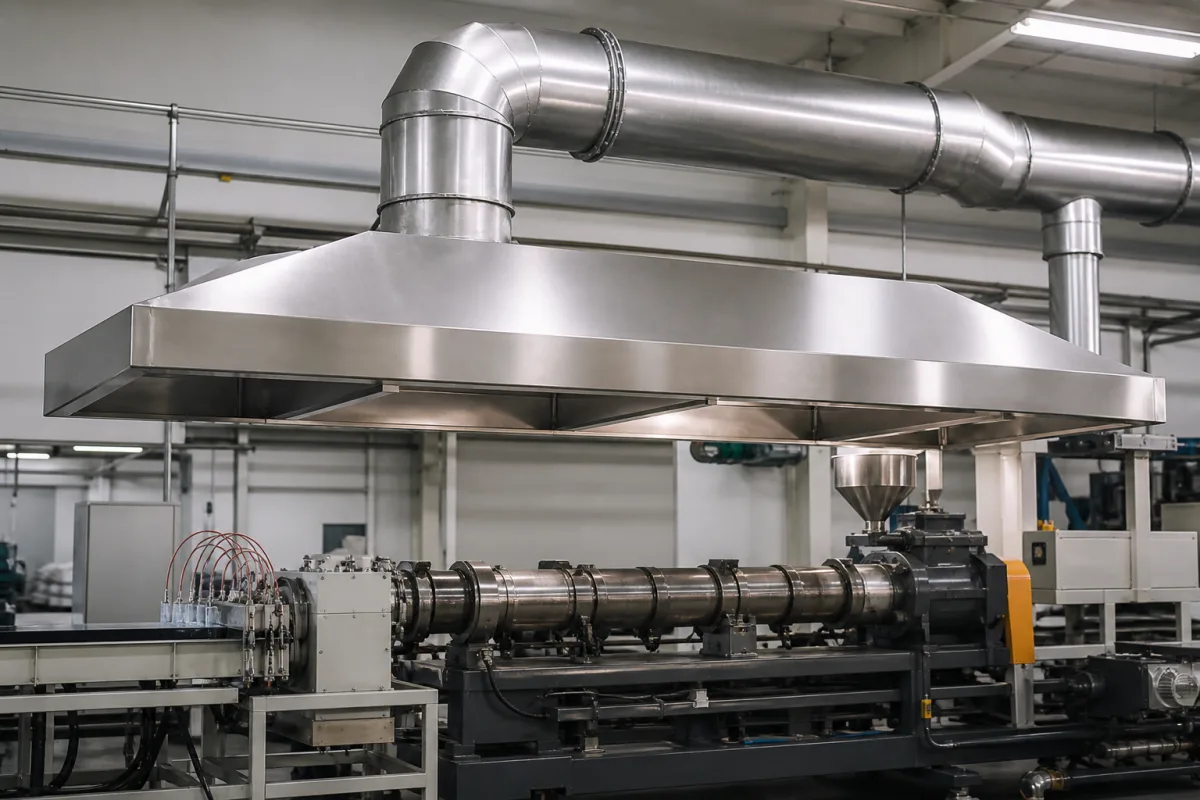
Fume extraction hood over rubber and plastics extrusion lines: canopy height above the die and cure line, cross-drafts, and rubber fume at 0.6 mg/m³
Rubber and plastics extrusion · overhead canopy hoods above dies, cooling runs and curing lines, hood height, cross-drafts and rubber fume limits
Hot rubber or polymer leaving an extruder die gives off fume and vapour that rises with the heat of the extrudate. The hood in question is a stainless or galvanised canopy hung over the die head and the first metres of the line, ducted to an exhaust fan, so that this warm plume is received from above rather than pulled sideways. A canopy works only while the plume reaches it: the gap between the line and the hood face, draughts across the line, and how hot the compound is decide whether the fume goes up the duct or into the operator's breathing zone.
Overhead canopy (receiving) hoods mounted above extruder dies, extrudate cooling runs, continuous vulcanisation lines and similar hot-compound stations in rubber and plastics processing: hood height and curtains, cross-drafts, the fume involved and its exposure limits, and testing of the hood in service. Extraction arms, on-torch extraction and filter units for welding and cutting fume are covered on the Welding fume extraction systems page; general hood families, duct sizing and fan selection for process exhaust on the Industrial exhaust system page; butterfly dampers for corrosive exhaust ducts on the Round butterfly damper page; catalyst-handling dust units on the Dust collection unit page.
CNFX editorial research · Sources checked October 13, 2026 · 3 sources
Vertical gap between the extrudate and the canopy face
OSHA's Technical Manual defines a canopy hood, or receiving hood, as a one- or two-sided overhead hood that receives rising hot air or gas. [3] At a US plant making extruded EPDM weather-stripping on continuous vulcanisation (CV) and sponge dense metal (SDM) lines, NIOSH fog-tested every local exhaust capture point in March 2018. All spray booths gave good capture; the canopy hoods were the poorest performers, which NIOSH attributed to excessive vertical distance between the rubber production lines and the hood openings. [1]
NIOSH suggested shortening the vertical distance between the rubber and the hood opening, or adding a curtain, to improve the canopy hoods. [1]
For simple capture hoods, OSHA's rule of thumb is that the emission source should be no further than 1.5 duct diameters from the hood, with a capture velocity of at least 50 fpm; with a duct velocity of 3,000 fpm, capture velocity is about 300 fpm one duct diameter in front of a plain or narrow-flanged hood and falls by a factor of 10, to 30 fpm, at two diameters. [3] Editorial calculation: on OSHA's rule, a hood on a 150 mm duct should be within 225 mm of the source (1.5 × 150 mm). A canopy hung, for example, one metre above a line is more than four times that distance and relies on the plume's own rise to carry fume up; this is why its height and side curtains matter more than its fan rating.
Give the supplier the die and line width, the height available above the line, where the extrudate is hottest, and whether side or end curtains can be fitted without blocking access to the die.
02
Rubber fume at 0.6 mg/m³, process dust at 6 mg/m³, and the VOCs found at extrusion lines
HSE's guidance on dust and fume in the rubber industry gives the UK workplace exposure limits as 0.6 mg/m³ for rubber fume and 6 mg/m³ for rubber process dust, both 8-hour time-weighted averages. Rubber fume covers fume from mixing, milling and blending elastomers and from the processes that convert the blends into finished products; limits for individual substances, such as carbon black and solvents, apply as well. [2]
Across its 10 locations NIOSH recorded total VOCs above 3,000 ppb at certain extrusion line areas, a highest total particulate of 6.5 mg/m³, particle counts above the 500,000 per cm³ limit of its instrument at five locations, and carbon monoxide from 0.9 to 7.1 ppm. Thermal desorption samples held 36 to 48 VOCs per location, including benzene, carbon disulfide, styrene, toluene and xylene, and at least 14 VOCs found only in extrusion areas near mixing. [1]
Editorial note: these are spot readings at one plant, not design values; they show that the plume a canopy receives is a mixture of particulate, vapour and gas, so ask the supplier which of these the hood and its downstream filter or stack are meant to handle.
Location at the NIOSH-evaluated plant
Ten-second spot readings
Between hood and belt (DHS)
TVOC 2,010 ppb; total particulate 5.3 mg/m³; CO 5.8 ppm [1]
CV11, after oven and before coating
TVOC 1,460 ppb; total particulate 0.2 mg/m³; CO 6.4 ppm [1]
CV7, before oven
TVOC 1,400 ppb; total particulate 0.2 mg/m³; CO 3.7 ppm [1]
03
Cross-drafts, open oven doors and cooling fans
NIOSH saw significant cross-drafts when outside air was supplied to the building under certain conditions, especially along the middle CV lines, and these altered the effectiveness of the local exhaust. The oven-related exhaust worked best with the oven doors closed, and NIOSH found slot vents along the CV ovens caked with debris. [1]
OSHA's checklist for a hood that moves enough air but still controls poorly starts with cross-drafts from process air movements, worker-cooling fans, air-supply systems and open doors and windows, then the distance of the work from the hood, missing doors, baffles or sides, and the hood type, noting that canopy hoods are inappropriate for toxic materials. [3] Editorial note: on an extrusion line this means fixing the make-up air outlets and pedestal fans near the die before blaming the hood, and choosing an enclosing or close-capture hood where the fume contains substances with low limits.
04
Smoke checks, airflow indicators and the 14-month examination
HSE asks for an LEV system to be commissioned to prove effective control, with a commissioning report, manual and logbook; for the plant to be examined and tested at least once every 14 months with results recorded; and for a weekly check by a responsible person for leaks and damage. It recommends airflow indicators, saying a correctly calibrated indicator is the only method that shows immediately if flow has been mis-set, blocked or the duct damaged. [2]
For a quick velocity check at a hood, OSHA describes timing a burst of smoke over a two-foot distance: two seconds over two feet is 60 fpm. It notes anemometers read down to 50 fpm and hood static pressure is measured 4 to 6 duct diameters downstream in a straight run of the take-off duct. [3]
HSE also lists process measures that cut the fume a hood has to receive: avoid compound temperatures above what the process needs, and cool fuming products straight after processing with water, air or chilled surfaces. For calendering and extrusion it names local exhaust ventilation, control of processing temperature, and direct or indirect water cooling of the product. [2]
Ask for the commissioning report to state the face velocity or plume capture shown by smoke at the die and along the line, and for an airflow indicator on the hood duct.
05
Line and fume details for an extrusion canopy hood
Paste it into your enquiry below or into an email to a maker, then replace every bracket.
Process: [rubber or plastic compound; extrusion, CV line, cooling run]
Line: [die width; line width and length to cover; height clear above line]
Fume: [compound temperature; substances from SDS; dust, vapour, gas]
Room: [make-up air outlets; cooling fans; doors near the line]
Hood: [material; curtains; access to die]
Airflow: [design flow; airflow indicator; duct size]
Testing: [commissioning smoke test; logbook; examination interval]
Explore company information and manufacturing capabilities, then discuss the scope of your project with a relevant supplier.
Share this page
Compiled and source-reviewed by the CNFX editorial team.
Each manufacturer above links to the page on that company's own website where the product is listed, with the date we checked it. How we source and review
· Page last updated 13 October 2026
Buyer questions
Why do canopy hoods over extrusion lines capture poorly?
At an EPDM extrusion plant, NIOSH found canopy hoods the poorest capture points because the hood openings were too high above the lines; it suggested lowering them or adding curtains. [1]
What is the UK limit for rubber fume?
HSE gives 0.6 mg/m³ for rubber fume and 6 mg/m³ for rubber process dust, as 8-hour time-weighted averages. [2]
How far from the source can a simple capture hood be?
OSHA's rule of thumb is no more than 1.5 duct diameters, with a capture velocity of at least 50 fpm. [3]
How often must the hood be tested in the UK?
HSE says LEV plant should be examined and tested at least once every 14 months, with a weekly check for leaks and damage. [2]
Sources and what still needs a direct check
Sources checked 2026-10-13. NIOSH Health Hazard Evaluation 2016-0227-3364 at a rubber weather-stripping plant (2019), HSE's leaflet on dust and fume control in the rubber industry, and the ventilation chapter of the OSHA Technical Manual.