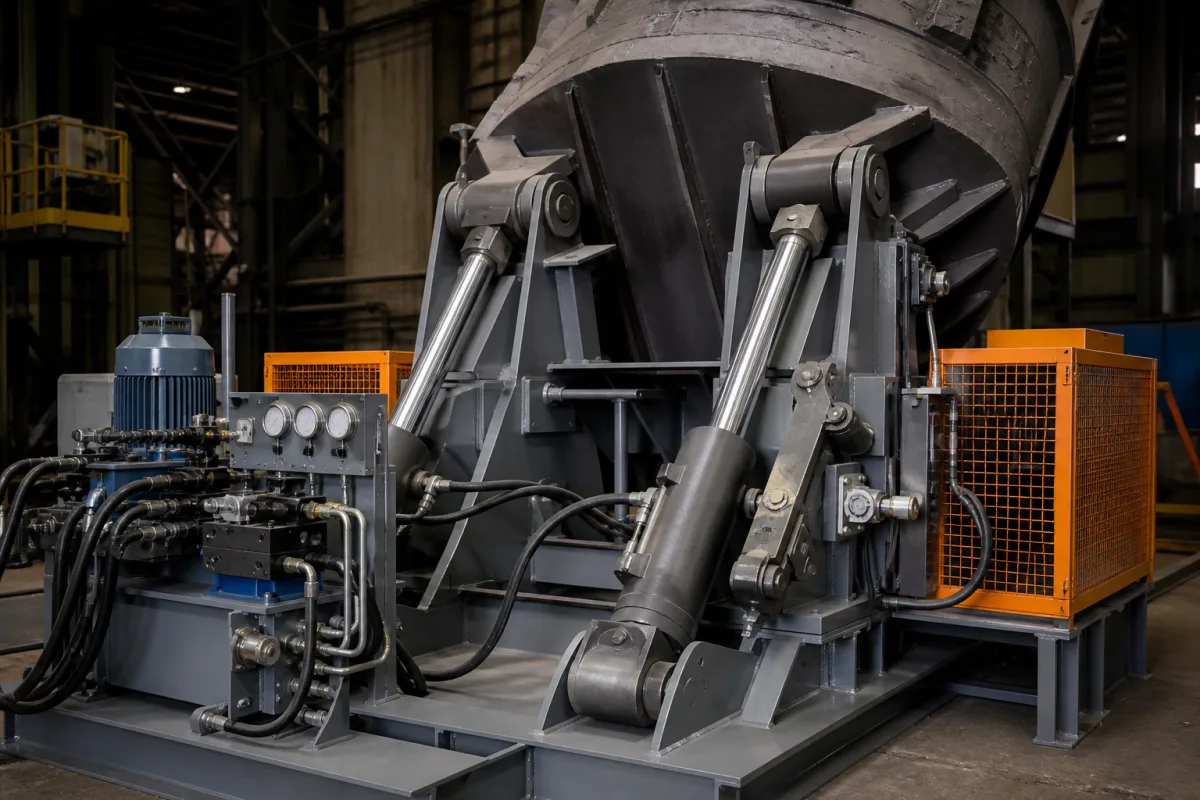
Ladle and vessel tilting drives · Tilt angle and pour rate, load-holding counterbalance valves, fire-resistant hydraulic fluid near molten metal
A hydraulic ladle tilting mechanism is the machine that turns a ladle or transfer vessel about its trunnions or a pivot frame to pour molten metal at a controlled rate: a base and tilting frame, one or two hydraulic cylinders, load-holding valves on the cylinders, and a hydraulic power unit with pump, valve manifold and controls. Ask three things first: what ladle mass, tilt angle and pouring rate it must handle, how the load is held if a hose or valve fails, and which hydraulic fluid is used beside molten metal.
Hydraulic tilting frames, cylinder drives and power units that tip ladles, transfer vessels, crucibles or furnaces for pouring molten metal. The ladle itself, its shell and refractory lining are covered on the Refractory-lined steel ladle page. Crane-hung ladle tipping, mechanical gear tilting drives, tilting tables for general loads and the hydraulic cylinders sold alone are outside this page.
CNFX editorial research · Sources checked October 12, 2026 · 3 sources
Jinan Hydeb's transfer ladle tilting unit pours molten aluminium from a transfer ladle into a furnace. It consists of a base, a turning frame and a lifting mechanism, takes ladles of 5 to 14.5 t, tilts through 0–70° with the angle displayed, and pours at 0 to 4 t/min. Control is by buttons on the hydraulic station cabinet or a remote hand controller on a trailing cable, and the ladle can be held at any position within the stroke. [1]
Hydeb says the hydraulic tilter removes the need to keep the ladle hanging from a crane during pouring, along with the uncontrolled turning and splashing that can come with it, and lets the operator pour from a distance; tilting speed and angle are adjustable and the unit needs no special foundation. [1] Editorial calculation: at the maximum 4 t/min, a full 14.5 t ladle takes at least 14.5 / 4 ≈ 3.6 minutes to empty. [1]
Editorial note: the pouring rate depends on the lip geometry and tilt speed together; ask how the control relates tilt speed to pour rate as the ladle empties and the centre of gravity moves, and whether the unit can stop and reverse instantly.
Give the supplier the metal and pouring temperature, ladle type, full and empty mass and centre of gravity, trunnion or pivot position, required tilt angle and pour rate, receiving furnace or mould height, control location and mode (local, remote, automatic), power supply, the hydraulic fluid required by the plant and the safety functions for power or hose failure.
02
Hold the load with counterbalance valves on the cylinders
Danfoss's motion control valve catalogue describes counterbalance (overcenter) valves as pilot-assisted relief valves with an integral bypass check that stop a load running away, hold it in position and, mounted on or in the actuator, protect against hose failure. It states that the relief function should be set at 1.3 times the maximum load-induced pressure so the load is held if a hose fails, and that the pilot pressure needed to open the valve is the relief setting minus the induced load pressure, divided by the pilot ratio. [2]
The same catalogue lists pilot ratios such as 3:1, 4.5:1 and 8:1 for its overcenter valves and notes that back pressure in the valve port adds to the relief setting by a factor of the pilot ratio plus 1. [2] Editorial calculation: if a tilted ladle produces 120 bar in the cylinder, the valve is set to at least 1.3 × 120 = 156 bar; opening it then needs about (156 − 120) / 3 = 12 bar of pilot pressure at a 3:1 ratio, or (156 − 120) / 8 ≈ 4.5 bar at 8:1. [2]
Editorial note: the load-induced pressure changes through the tilt as the ladle's centre of gravity moves relative to the pivot; ask the supplier for the cylinder force curve over the full angle and the highest pressure it reaches.
03
Choose a fire-resistant hydraulic fluid near molten metal
Repsol's Telex HFC is a water-glycol fire-resistant hydraulic fluid for replacing mineral oil in systems with high fire risk, designed for the metallurgy industry. It contains about 37% water, is meant for systems where the fluid does not exceed 60 °C, and meets ISO 6743/4 HFC, ISO 12922 HFC and the 7th Luxembourg Protocol, passing the ISO 15029-1 spray ignition and ISO 14935 flame spread tests. [3]
Repsol warns that loss of water raises viscosity and that deionised water has to be added to recover the fluid's properties; its typical values are ISO grade 46, 46 cSt at 40 °C, density 1.080 g/cm³ and pour point −48 °C. [3] Editorial note: a water-glycol fluid changes the choice of pump, seals and filters compared with mineral oil, so state the fluid at enquiry stage and ask the supplier to confirm the power unit is rated for it and that the reservoir stays below the fluid's temperature limit.
04
A casthouse maker's aluminium transfer-ladle tilter, and the data to ask for
The linked listing is a casthouse equipment maker offering a tilting unit for molten-aluminium transfer ladles. Ask for the ladle range, tilt angle, pour rate, cylinder and valve arrangement, hydraulic fluid and control mode.
05
Tilting frame, cylinders, counterbalance valves, power unit, fire-resistant fluid and pendant
1 company lists this product among what they make. Company figures are quoted from each
company's own website; every card states where the relationship came from.
Jinan Hydeb Thermal Tech Co., Ltd.
Manufacturing site to be confirmed for the order
Lists a hydraulic transfer ladle tilting unit for pouring molten aluminium into furnaces, for 5–14.5 t ladles.
Explore company information and manufacturing capabilities, then discuss the scope of your project with a relevant supplier.
Share this page
Compiled and source-reviewed by the CNFX editorial team.
Each manufacturer above links to the page on that company's own website where the product is listed, with the date we checked it. How we source and review
· Page last updated 13 October 2026
Buyer questions
How far does a ladle tilter turn?
Hydeb's aluminium ladle tilter covers 0–70° for 5–14.5 t ladles, pouring up to 4 t/min. [1]
How is the ladle held if a hose bursts?
Counterbalance valves on the cylinders hold it; Danfoss sets them at 1.3 times the maximum load-induced pressure. [2]
Which hydraulic fluid suits molten-metal areas?
Fire-resistant water-glycol (HFC) fluids such as Repsol Telex HFC, with about 37% water and a 60 °C limit. [3]
Sources and what still needs a direct check
Sources checked 2026-10-12. Jinan Hydeb is a casthouse equipment maker; Danfoss publishes a catalogue of motion control valves; Repsol publishes a datasheet for its fire-resistant fluid. Values are the publishers' stated figures.