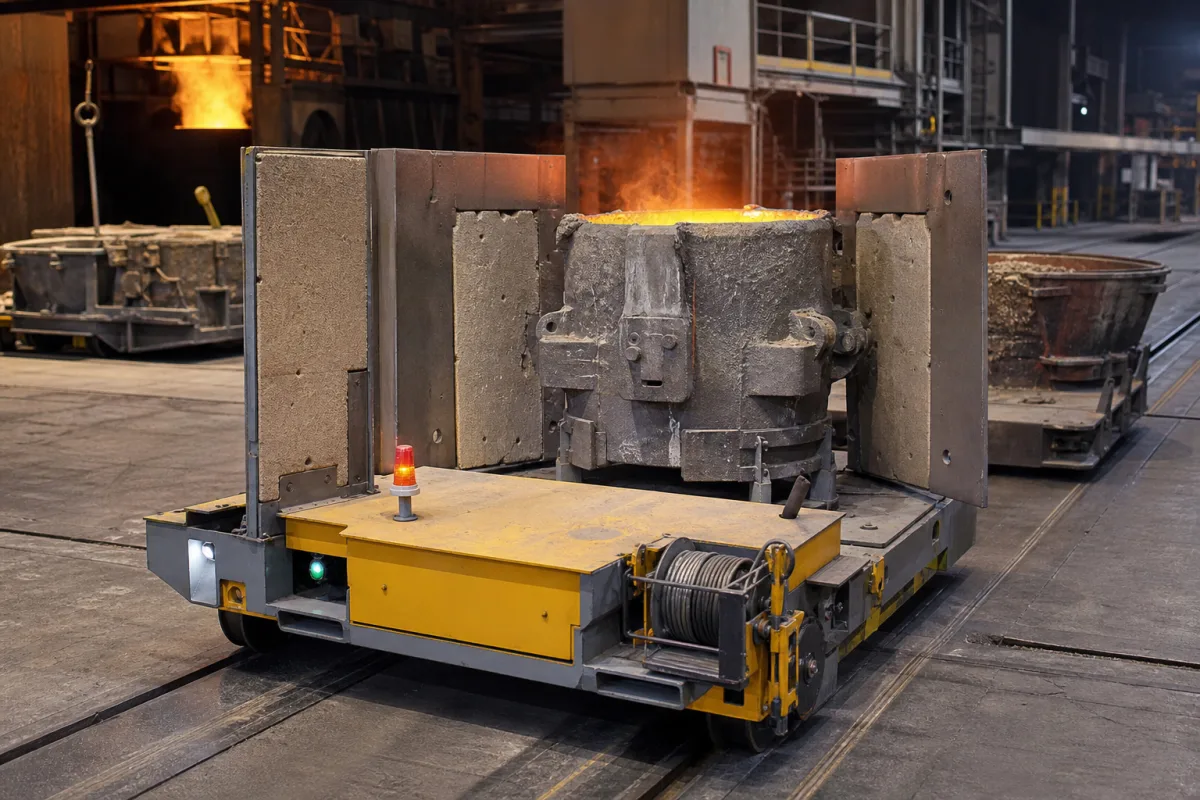
Ladle transfer cars · Heat protection, gentle start and stop, redundant drives, capacity and track, molten metal hazards
A molten metal transfer car is a rail-guided, powered platform that carries a ladle of molten steel or iron, or hot slag, between furnace, refining and casting areas, with heat shielding and drives designed to move the load without spilling. Ask three things first: the ladle's full weight and dimensions and the heat it will radiate, how the car starts, stops and keeps moving if a drive fails, and how power and controls are protected along the track.
Rail-mounted ladle and hot-slag transfer cars for steel plants and foundries, rail- or battery-powered. General-purpose transfer carts, overhead cranes, torpedo cars on mainline rail and the ladles themselves are outside this page.
CNFX editorial research · Sources checked October 11, 2026 · 4 sources
Protect the car from heat and the load from spills
DGCrane describes ladle transfer cars as carrying ladles of molten steel or iron and hot slag from the furnace to casting or processing, with higher demands on body materials, transmission and electrical control than ordinary transfer trolleys. It equips them with heat-insulating materials (refractory bricks or other insulation as an option), keeps starting and stopping speed within 0–20 m/min to prevent steel or slag spilling, and describes a double transmission in which, if one set fails, the other can complete the cycle; remote wireless control is offered for unmanned operation. [1]
The UK Health and Safety Executive warns that water contamination of molten metal can cause explosions, asks employers to consider whether water contamination is possible in all areas and processes, and requires suitable molten metal PPE, training and supervision. For lifting operations around molten metal it requires planning, competent people and supervision. [2]
Editorial note: apply HSE's water warning to the track, pits and car deck, which must stay dry under a full ladle, and agree with the supplier how cables, drives and controls are shielded from radiant heat and spills.
Give the supplier the ladle type, full and empty weight, diameter and height, metal or slag temperature, track length, layout and gauge, stations and stopping accuracy, power supply preference (low-voltage rail, battery or cable reel), duty cycle, control (pendant, remote, automatic) and site safety requirements.
02
Size capacity, speed and track
DGCrane's reference table lists cars from 5 t to 200 t: platforms from 3000 × 2000 mm to 8200 × 2800 mm, track gauges of 1435 mm (to 30 t), 1650 mm (40–60 t) and 2000 mm (100–200 t), travel speeds of 30 m/min at 5–10 t, 20 m/min at 20–60 t, 15 m/min at 100–150 t and 10 m/min at 200 t, and traction motors from 1.5 kW to 3 × 7.5 kW, powered by battery or 36 V low-voltage rail. [1]
The same table specifies cast-steel wheels with surface-hardened treads at least 4 mm deep and at least 240 HBW at that depth, quenched and tempered 40Cr or 45 steel axles, Q235 or Q345 frames, and recommended rail sections from P18 to QU100. [1]
Editorial calculation: at 20 m/min a car covers a 100 m run in about 5 minutes of travel, plus the slow start and stop phases; check that ladle temperature loss over the full cycle fits your process. [1]
03
Rail, battery and heat-resistant ladle carts from the listed makers
Listings include rail- and battery-powered ladle and hot-metal transfer carts, heat-resistant battery carts, and ladle cars supplied with furnaces and cranes.
04
Benchmark drive power and ask for on-car weighing and track cleaners
An installation report published by AIST, the Association for Iron & Steel Technology, gives a second reference point beside catalogue tables. It describes a ladle transfer car built for a Slovenian stainless steel plant with a load capacity of 170 tons and a travel speed of 20 m/min, driven by two 18.5 kW motors. The car was fitted with an automatic on-line ladle weighing system, track cleaners, and a folding platform for easier access to the weighing cells; the maker reported taking the turnkey project from conceptual design to on-site installation within four months. [3]
Editorial calculation: two 18.5 kW motors give 37 kW installed traction for 170 t at 20 m/min, about 0.22 kW per tonne of rated load (37 ÷ 170). For comparison, the maker table already cited on this page lists traction motors of 7.5×3 kW (22.5 kW) for its 200 t car at 10 m/min. [3][1] Ask each bidder for the drive power calculation behind its motor choice, covering rolling resistance, start-up acceleration under a full ladle, track gradient and the case of one drive failing. If ladle weight is needed for heat or alloy control, specify on-car weighing and safe access to the load cells, and specify track cleaners where scrap or slag can fall on the rails.
How the weighing cells are built into the car matters as much as specifying them. European patent EP 0 189 022 B1 (VOEST-ALPINE AG, Linz; filed 9 December 1985 with Austrian priority of 14 January 1985, granted 21 September 1988) describes a ladle transport car whose deck rests at each end on its running gear through load cells. It explains that in an earlier design (US 3,858,672) the thin, flexible stabilising links that let each bogie move vertically for weighing were loaded in shear by braking, driving and starting forces and by rail-guidance forces, which distorted the weight reading unpredictably and could, in the extreme, shear the links so the car could no longer move — awkward outside crane reach and, in every case, costing heat from the vessel's contents. Its solution gives each running gear a frame with wheels on at least two tracks, linked to the deck by at least two longitudinal and one transverse stabilising link that allow movement perpendicular to their length; load cells with spherical end faces are placed so that their axes intersect the wheel axles at rest, and each wheel axle carries its own drive motor held by a torque support. The patent proposes a two-axle car for lighter vessels and a four-axle car with two-axle bogies for heavy vessels such as furnace vessels. [4]
05
Frame, heat shield, twin drives, hardened wheels and load cells on a ladle car
Load cells between deck and running gear; links keep travel forces off the cells. [4][3]
Cell rating, link design, calibration.
06
Load, gauge, travel speed and power source for a ladle car order
DGCrane's 5–200 t table ties gauge and travel speed to rated load, so fix the load first; ladle volume, tilt angle and heat rating depend on your own ladles. [1]
5 companies list this product among what they make. Company figures are quoted from each
company's own website; every card states where the relationship came from.
DGCRANE
Manufacturing site to be confirmed for the order
Lists rail- and battery-powered ladle transfer cars from 5 to 200 t.
Explore company information and manufacturing capabilities, then discuss the scope of your project with a relevant supplier.
Share this page
Compiled and source-reviewed by the CNFX editorial team.
Each manufacturer above links to the page on that company's own website where the product is listed, with the date we checked it. How we source and review
· Page last updated 13 October 2026
Buyer questions
How fast should a ladle transfer car move?
DGCrane lists 10–30 m/min travel by capacity and keeps starting and stopping within 0–20 m/min to prevent spilling. [1]
Why do ladle cars have two drives?
So that if one transmission fails the other can complete the cycle, as DGCrane describes. [1]
What is the main hazard around molten metal?
HSE warns that water contamination of molten metal can cause explosions. [2]
What features does a large ladle transfer car have beyond the drive?
An AIST installation report describes a 170-ton car at 20 m/min with two 18.5 kW motors, an automatic on-line ladle weighing system, track cleaners and a folding platform for access to the weighing cells. [3]
Why can an on-car ladle weighing system give wrong readings?
EP 0 189 022 B1 explains that braking, driving, starting and rail-guidance forces acting on the links that let the deck move onto the load cells can distort the reading; its design uses links that allow movement perpendicular to their length and load cells aligned with the wheel axles. [4]
Sources and what still needs a direct check
Sources checked 2026-10-11. DGCrane is a crane and transfer car maker describing its own range (also listed below as a supplier); HSE is the UK regulator; AIST reports one installed ladle car; a VOEST-ALPINE patent describes on-car weighing design. Car design must be confirmed for your ladles and layout.