Editorial Technical Reference

Inlet/Outlet Manifold

This page explains how Inlet/Outlet Manifold is classified within Machinery and Equipment Manufacturing. Technical values and manufacturer relationships are research references; confirm the current specification and supplier evidence for each order.

Technical Definition & Core Assembly

A fluid distribution component that manages the entry and exit of cooling water in a water-cooled mold system.
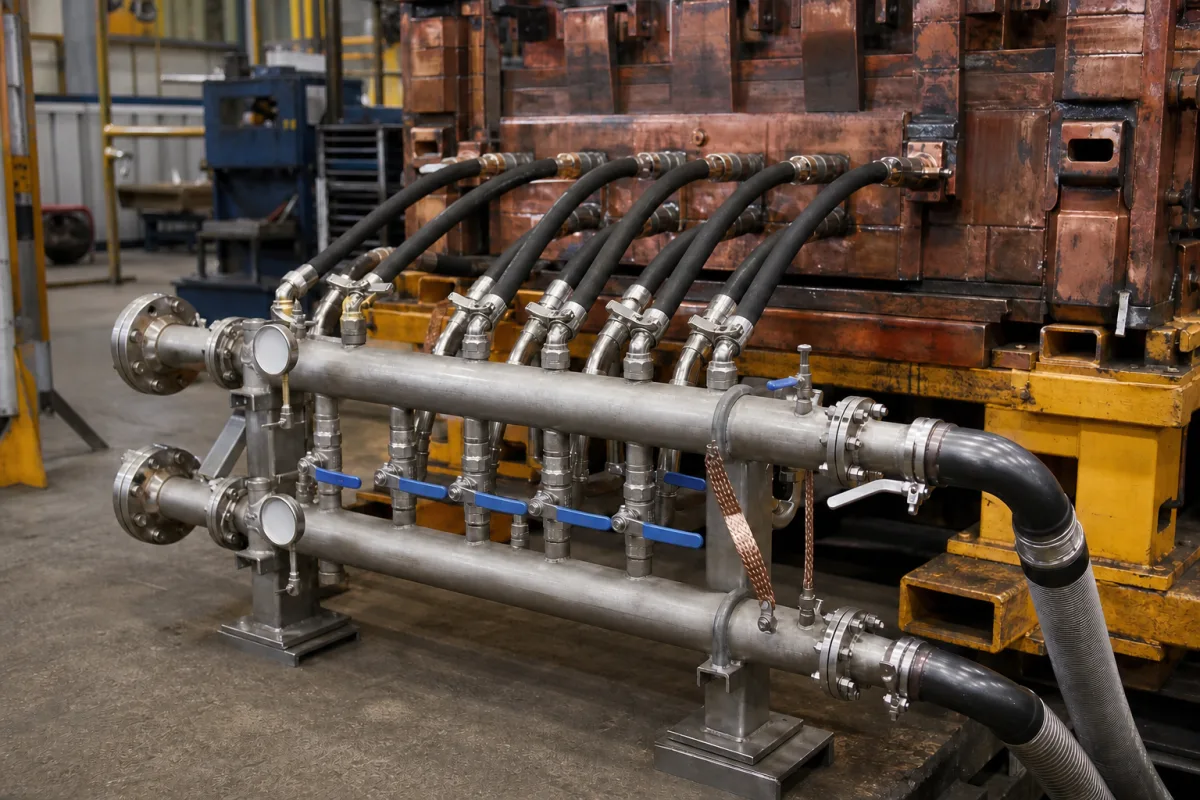
Representative product image. Confirm appearance and specifications with the manufacturer.

Product Specifications

Technical details and manufacturing context for Inlet/Outlet Manifold

Definition
The inlet/outlet manifold is a critical hydraulic component in water-cooled molds that serves as the central distribution point for cooling water. It connects the external cooling system to the internal cooling channels within the mold, ensuring controlled flow of coolant to regulate mold temperature during manufacturing processes. This component is typically manufactured from materials such as stainless steel, aluminum alloy, or brass, depending on the application requirements and environmental conditions. The manifold features inlet and outlet ports with specific diameters and thread specifications, which must be matched to the external piping and the mold's cooling channel design. As a part-level component, it is integral to the overall mold assembly and must be selected based on the mold's cooling requirements, flow rates, and pressure ratings. Verification of the manifold's specifications, including port sizes and thread types, is essential to ensure proper fit and function. The manifold operates by receiving pressurized cooling water from the external system through the inlet port, distributing it to multiple cooling channels within the mold via internal passages, collecting the heated water from the return channels through the outlet port, and returning it to the cooling system for temperature regulation and recirculation. Proper maintenance involves regular inspection for leaks, corrosion, and blockages, and ensuring that all connections are secure. Failure of the manifold can lead to inadequate cooling, resulting in mold temperature fluctuations, product defects, or even mold damage. Therefore, it is crucial to verify model-specific values and standards with the legal manufacturer or supplier before installation and use.
Working Principle
The manifold receives pressurized cooling water from the external system through the inlet port. It then distributes the water to multiple cooling channels within the mold via internal passages. After the water absorbs heat from the mold, it is collected from the return channels and exits through the outlet port. The heated water is then returned to the cooling system for temperature regulation and recirculation. This continuous flow ensures consistent mold temperature control during manufacturing.
Common Materials
Stainless Steel, Aluminum Alloy, Brass
Technical Parameters

What to specify in your RFQ

  • Port diameter and thread specifications for inlet/outlet connections in mm

These are the quantities to specify to the manufacturer when sizing or requesting a quote. The manufacturer's own documentation governs the exact figures and applicable standard.

Components / BOM
  • Inlet Port Part
    Receives pressurized cooling water from external system
    Material: Stainless Steel
  • Outlet Port Part
    Returns heated water back to cooling system
    Material: Stainless Steel
  • Distribution Chamber Part
    Internal cavity that divides flow to multiple channels
    Material: Aluminum Alloy
  • Mounting Flange Part
    Secures manifold to mold structure
    Material: Steel
  • Sealing Gaskets Part
    Prevents coolant leakage at connection points
    Material: Synthetic Rubber

Applied To / Applications

This component is essential for the following industrial systems and equipment:

Industrial Ecosystem & Supply Chain Structure

Complementary Systems
Downstream Applications
Specialized Tooling

Application Fit & Sizing Matrix

Operational Limits
pressure: 0 to 10 bar (gauge)
flow rate: Up to 200 L/min per port
temperature: -20°C to 120°C
slurry concentration: Up to 5% solids by weight
Media Compatibility
✓ Cooling water (treated) ✓ Glycol-water mixtures (up to 50%) ✓ Industrial process water (pH 6-8)
Unsuitable: Highly corrosive chemicals (e.g., strong acids, chlorides >500 ppm)
Sizing Data Required
  • Required total flow rate (L/min)
  • Number of inlet/outlet ports needed
  • Maximum system pressure (bar)

Reliability & Engineering Risk Analysis

Failure Mode & Root Cause
Thermal fatigue cracking
Cause: Cyclic thermal stresses from temperature fluctuations during operation, often exacerbated by material embrittlement or poor design of thermal expansion joints.
Corrosion and erosion
Cause: Exposure to corrosive fluids or abrasive particulates in the flow medium, leading to material degradation, thinning, and eventual leakage or structural failure.
Maintenance Indicators
  • Audible hissing or whistling indicating gas or fluid leakage at joints or cracks
  • Visible discoloration, soot deposits, or weeping of fluids at manifold surfaces or connections
Engineering Tips
  • Implement regular thermal imaging inspections to detect hot spots or uneven temperature distribution that may indicate stress concentrations or blockages.
  • Use corrosion-resistant coatings or materials compatible with the service environment, and ensure proper installation of gaskets and seals to prevent galvanic corrosion and leakage.

Indicative industry ranges for design and RFQ preparation. Confirm the exact figures and applicable standard with the manufacturer before specifying.

Compliance & Manufacturing Standards

Applicable Standards
ASTM A536 (Ductile Iron Castings) DIN EN 10204 (Material Inspection Certificates)

Quoted from the published standard.

Manufacturing Precision
  • Bore diameter: +/-0.025mm
  • Flange flatness: 0.08mm across mating surface
Quality Inspection
  • Pressure testing (hydrostatic/pneumatic)
  • Dimensional verification with CMM

Manufacturers of Inlet/Outlet Manifold

Manufacturer profiles associated with Inlet/Outlet Manifold.

Sourcing Inlet/Outlet Manifold from China?
Tell us your specification and target quantity — we will match it against manufacturer records and come back with the factories that fit.
Request manufacturers We manufacture this

Manufacturer listings support early research and capability understanding. They are not certification, ranking, or transaction guarantees.

Technical documentation
Request current drawings, revision history, and a signed specification sheet.
Manufacturing capability
Verify equipment lists, process limits, capacity, and representative production evidence.
Inspection readiness
Confirm test methods, calibrated equipment, sampling plans, and traceable reports.
Supplier transparency
Check the legal entity, factory address, ownership, certifications, and direct contacts.

CNFX does not score or rank suppliers. Buyers must verify all claims and documents with the legal manufacturer before ordering.

Supply Chain Compatible Machinery & Devices

Heavy-Duty CNC Plasma Cutting Machine

The Heavy-Duty CNC Plasma Cutting Machine is a standalone industrial device designed for cutting conductive metals such as steel, stainless steel, aluminum, and copper alloys.

Explore Specs →
Automated Powder Coating System

Integrated industrial system for applying dry powder coatings to metal substrates.

Explore Specs →
Centrifugal Pump Impeller

The centrifugal pump impeller is a critical rotating component that converts mechanical energy from the motor into kinetic energy in fluid systems.

Explore Specs →
High-Precision CNC Laser Cutting Machine

Computer-controlled industrial machine using focused laser beams to cut sheet metal with micron-level accuracy.

Explore Specs →

Frequently Asked Questions

What is the primary function of an inlet/outlet manifold?

The primary function is to serve as the central distribution point for cooling water in a water-cooled mold system. It manages the entry and exit of cooling water, ensuring controlled flow to regulate mold temperature.

What materials are commonly used for this manifold?

Common materials include stainless steel, aluminum alloy, and brass. The choice depends on the application requirements, such as corrosion resistance, thermal conductivity, and cost.

How do I verify the correct manifold for my mold?

You must check the port diameter and thread specifications against your mold's cooling channel design and external piping. Always confirm model-specific values with the legal manufacturer or supplier.

What maintenance is required for this component?

Regular inspection for leaks, corrosion, and blockages is recommended. Ensure all connections are secure and clean. Replace the manifold if any damage is detected to prevent cooling failures.

Data Basis

Editorial classification, named public sources where available, and source-reviewed manufacturer records.

Preliminary Technical Classification
This page supports structured research, RFQ preparation, and supplier evaluation. It does not replace buyer-led supplier qualification, standards review, or technical approval.
Buyer enquiry

Request manufacturing insight for Inlet/Outlet Manifold

Ask for use case, specification boundaries, supplier type, and RFQ preparation information for this product.

Where it goes
Straight to the CNFX editorial desk, and to the manufacturer if this product is linked to a claimed profile. Nothing is broadcast to a supplier list.
Your details stay here
We do not sell or rent enquiry data, and we do not add you to a mailing list. Used only to answer this request.
No commission, no middleman
CNFX is a directory. We take no cut of any order and never negotiate on a supplier's behalf.
What we don't claim
A listing is not an endorsement. Qualify every supplier and verify every figure yourself before ordering.

Your business information is used only to process this request.

Thank you! Your message has been sent. We'll respond within 1–3 business days.
Sorry, we couldn't send your message. Please try again, or email us at contact@cnfx.com.

Need to Manufacture Inlet/Outlet Manifold?

Compare manufacturer profiles with relevant product and process capability.

Previous Product
Z-axis Ram/Spindle
Last Product
Get QuotesChat