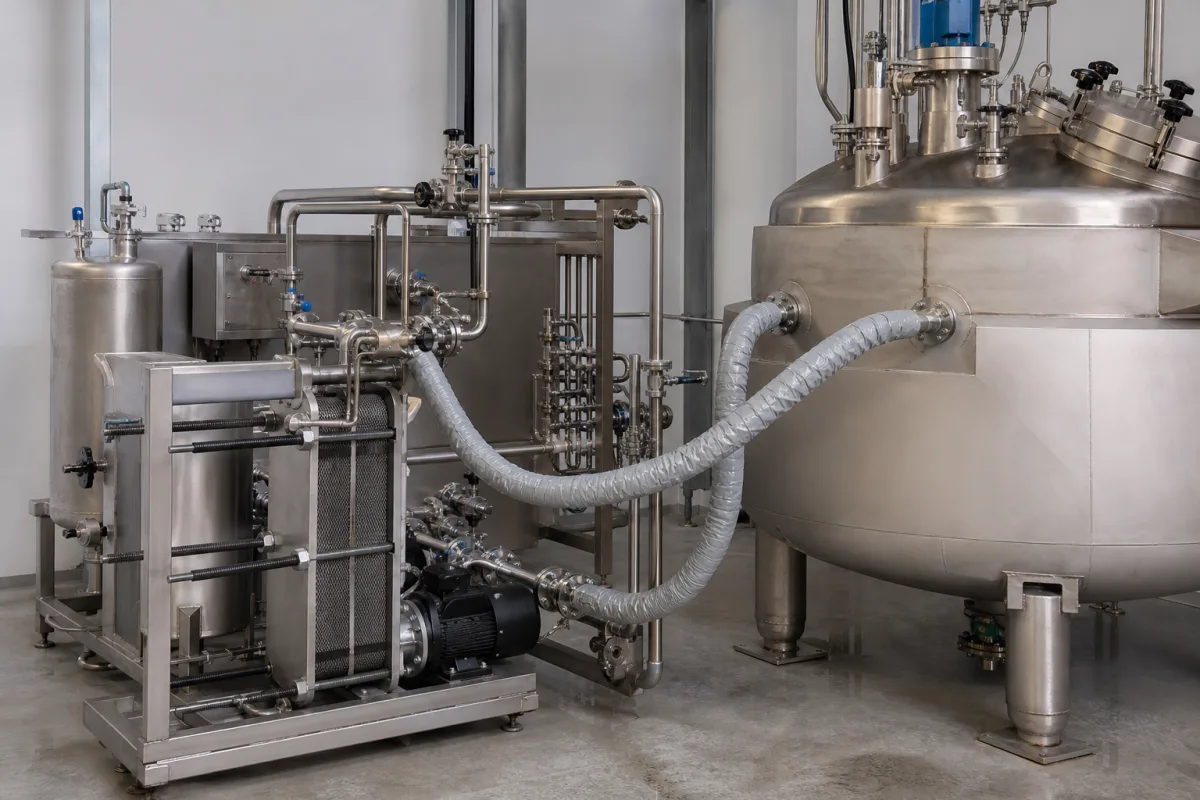
Jacket temperature control system (temperature control unit)
Jacket temperature control units · Circulators and skids that pump a heat transfer fluid through a reactor or vessel jacket, heating and cooling it — for example −55 to 250 °C with 12 kW heating and up to 21 kW cooling on a 50 L reactor
A jacket temperature control system pumps a heat transfer fluid through the jacket of a reactor, vessel or similar equipment, heating or cooling it to hold or change the process temperature. It may be a compact circulator beside a laboratory or pilot reactor or a skid with pump, heat exchangers and expansion vessel beside a production vessel. Ask three things first: what process temperature range and ramp the batch needs, what heating and cooling power that takes at each temperature, and which heat transfer fluid, connections and utilities the site provides.
Temperature control units and circulators that heat and cool jacketed reactors, vessels and similar process equipment through a circulating heat transfer fluid, including skid-mounted units with pumps, heat exchangers and expansion tanks. Process chillers supplying chilled water (see chiller unit), mould temperature controllers, electronic temperature controllers sold alone (see temperature controller), and the reactor jackets themselves are outside this page except where compared.
CNFX editorial research · Sources checked October 11, 2026 · 4 sources
Size heating and cooling power across the temperature range
Huber's case study CS 1206 lists the Unistat 530w at a temperature range of −55 to 250 °C, heating power 12 kW, and cooling power that varies with temperature: 7 kW at 250 °C, 19 kW at 200 °C, 21 kW at 100 °C, 16 kW at 0 °C, 9 kW at −20 °C and 3 kW at −40 °C. Cycling an uninsulated 50 L jacketed glass reactor, the jacket ramped quickly to create a wide temperature difference and took the process from 20 °C to −40 °C (60 K) in under two hours; on heating, the jacket ramped to 110 °C and then cooled to about 23 °C to bring the process to 20 °C in about 30 minutes. [1]
Case study CS 1017 lists the Unistat 425w at −40 to 250 °C, heating power 2.0 kW and cooling power of 2.8 kW at 250–100 °C, 2.5 kW at 0 °C, 1.9 kW at −20 °C and 0.2 kW at −40 °C. On a 20 L jacketed glass reactor holding 15 L of silicone-based fluid, the jacket ramped from 20 °C to 200 °C within 30 minutes (6 K/min) and cooled from 182 °C to −13 °C within 50 minutes (3.9 K/min) under process control. [2]
Editorial calculation: the 530w's cooling at −40 °C (3 kW) is one-seventh of its peak 21 kW at 100 °C, and the 425w's 0.2 kW at −40 °C is about 7 % of its 2.8 kW — size cooling at the lowest process temperature, not at the brochure peak. [1][2]
LAUDA's model table for its Integral XT process thermostats shows how heating and cooling power scale across one product line. The line covers −90 to 320 °C with a stated temperature stability of ±0.05 K; units work on the flow principle with a cold oil blanket and an electronically controlled, magnetically coupled eight-stage Vario pump. Listed heater power and cooling output at 20 °C (50 Hz) run from 3.5 kW and 1.5 kW for the IN 150 XT (−45 to 220 °C), through 8 kW and 5 kW for the IN 550 XT (−50 to 220 °C) and 12 kW and 10.3 kW for the IN 1090 XTW (−90 to 220 °C), to 12 kW and 18.5 kW for the IN 1590 XTW and 24 kW and 35.0 kW for the IN 3540 XTW (−45 to 200 °C); the water-cooled IN 4 XTW and IN 8 XTW heat only, from 25 to 320 °C. [4]
Editorial calculation: from the IN 1590 XTW upwards LAUDA lists more cooling than heating at 20 °C (18.5 against 12 kW, 35.0 against 24 kW), while the smaller units list more heating than cooling (IN 150 XT: 3.5 against 1.5 kW); the IN 150 XT's 1.5 kW at 20 °C compares with the 1.2 kW JULABO lists for the PRESTO A40 at the same temperature. Cooling at 20 °C says little about cooling at −40 °C, so ask for the full cooling curve as Huber and JULABO publish it. [4][3]
Give the supplier the reactor or vessel type, jacket volume and material, batch volume and fluid, process temperature range, required heat-up and cool-down times, exothermic loads, heat transfer fluid, hose lengths and connections, cooling water or refrigeration available, power supply, hazardous-area classification, control interface, and installation space.
02
Set the control mode, heat transfer fluid and connections
Both case studies ran the units in process control, where the circulator drives the jacket temperature to bring the process temperature to its setpoint, used DW-Therm heat transfer fluid (rated −90 to 200 °C), and connected the reactor with insulated hoses — 1 m and 2 m hoses with M30 × 1.5 connections on the 530w and two 1 m metal hoses with M38 × 1.5 on the 425w. [1][2]
In CS 1017 the fluid's 200 °C upper limit capped the jacket temperature during heat-up, so the fluid choice sets the usable range as much as the unit does. [2] The CS 1206 text gives 37 L of thermal load in the reactor while its setup table gives 34.5 L, so confirm test conditions when comparing case studies. [1]
03
Read a full datasheet: pump, volumes and ratings
JULABO's published technical data for its air-cooled PRESTO A40 shows the fields a datasheet should cover beyond heating and cooling power: working range −40 to 250 °C, temperature stability ±0.01 to ±0.05 °C, heating capacity 2.7 kW, and a magnetically coupled centrifugal pump delivering 0 to 40 L/min at 0.1 to 1.7 bar through M24 × 1.5 male connections. [3]
Its cooling capacity, measured to DIN 12876 with ethanol and at 20 °C ambient, is 1.2 kW at 20 °C, 0.9 kW at 0 °C, 0.8 kW at −10 °C, 0.6 kW at −20 °C, 0.3 kW at −30 °C and 0.1 kW at −40 °C with R449A refrigerant (430 g, global warming potential 1,397). The expansion vessel holds 4.8 L with 2.7 L usable expansion volume, the minimum process volume is 3.5 L, the unit weighs 79 kg, measures 33 × 59 × 67 cm, is rated IP 21 and classification III (FL) to DIN 12876-1, draws 16 A, runs at 55 dB(A), and is specified for ambient temperatures of +5 to +40 °C; JULABO notes performance depends on the mains voltage in the country of use. [3]
Editorial calculation: the A40's cooling at −40 °C (0.1 kW) is about 8% of its 1.2 kW at 20 °C, a fall of the same order as the Huber units above. Editorial note: give each supplier your jacket and hose volume and ask it to confirm the expansion and minimum process volumes cover it across your temperature range. [3][1][2]
04
Cooling at each temperature, pump data, fluid volumes and utilities to ask each supplier for
Ask any supplier for heating power, cooling power at each working temperature, temperature range and stability, pump flow and pressure, heat transfer fluid and expansion volume, control modes and interfaces, hose and connection sizes, utilities, hazardous-area options, dimensions and weight, and a performance curve or test on a comparable reactor.
05
Heater, cooling stage, circulating pump, heat transfer fluid, hoses and controller
Two parts set the usable range more than the heater does: the cooling stage, whose output on the Unistat 530w falls from 21 kW at 100 °C to 3 kW at −40 °C, and the fluid, whose 200 °C limit capped the jacket in CS 1017. [1][2]
Heating and cooling capacity, temperature range, stability, flow, connections and weight for a TCU order
Ask for cooling as a curve, not one figure: at −40 °C the Unistat 530w keeps about one-seventh of its peak cooling, the 425w about 7% and the PRESTO A40 about 8% (editorial calculation). [1][2][3]
Field
What it means and published values
Ask the supplier for
Heating/Cooling Capacity (kW)
e.g. 12 kW heat; 21 kW to 3 kW cooling by temperature. [1]
2 companies list this product among what they make. Company figures are quoted from each
company's own website; every card states where the relationship came from.
Suzhou Aode Precise Equipment Co., Ltd.
Manufacturing site to be confirmed for the order
Its website has a product page for jacket temperature control system.
Explore company information and manufacturing capabilities, then discuss the scope of your project with a relevant supplier.
Share this page
Compiled and source-reviewed by the CNFX editorial team.
Each manufacturer above links to the page on that company's own website where the product is listed, with the date we checked it. How we source and review
· Page last updated 13 October 2026
Buyer questions
Why size cooling at the lowest temperature?
Huber lists the 530w falling from 21 kW at 100 °C to 3 kW at −40 °C. [1]
What is process control on a temperature control unit?
The unit drives the jacket temperature to bring the process to setpoint, as in Huber's case studies. [1][2]
Can the heat transfer fluid limit the range?
Yes; in CS 1017 the fluid's 200 °C limit capped the jacket temperature. [2]
What should a temperature control unit datasheet list besides kW?
JULABO's PRESTO A40 data, for example, gives pump flow and pressure, temperature stability, cooling at each temperature, expansion and minimum process volumes, refrigerant, IP rating and current draw. [3]
How much cooling output do larger jacket temperature control units offer?
LAUDA's Integral XT line lists cooling output at 20 °C from 1.5 kW (IN 150 XT) to 35.0 kW (IN 3540 XTW), with heater power from 3.5 kW to 24 kW. [4]
Sources and what still needs a direct check
Sources checked 2026-10-11. Huber, JULABO and LAUDA make temperature control units; Huber publishes reactor case studies, JULABO the technical data quoted here for one unit, and LAUDA a model table for one product line.